
Preventing Stroke Risk During TAVI: The Role of Cerebral Protection Devices
‘Preventing Stroke Risk During TAVI: The Role of Cerebral Protection Devices’ – a detailed guide by Dr. Kuntal Bhattacharya, Senior Interventional Cardiologist, Narayana Health – RN Tagore Hospital, Kolkata
Welcome to a new era of cardiac care, where medical boundaries are constantly being pushed to prioritize patient safety and faster recovery. I am Dr. Kuntal Bhattacharya, a Senior Interventional Cardiologist with over 25 years of clinical experience, currently practicing at Narayana Hospital (RN Tagore Hospital) and RxVital Healthcare in Kolkata. Throughout my career, I have witnessed the incredible evolution of heart treatments. Among the most revolutionary advancements we have seen in modern cardiology is Transcatheter Aortic Valve Implantation (TAVI), a minimally invasive procedure that has given a new lease on life to thousands of patients suffering from severe valve disease.
However, as with any advanced medical procedure, it is our duty to not just perform the surgery but to actively anticipate and mitigate potential risks. For a long time, the elephant in the Cath Lab during a TAVI procedure was the risk of a stroke. Today, thanks to cutting-edge medical technology like the cerebral embolic protection device, we can safeguard the brain while we repair the heart.
This comprehensive blog is designed to guide cardiac patients from Kolkata, Eastern India, and beyond. We will delve deeply into how we manage TAVI stroke risk, the critical role of neuroprotection in TAVI, and how you can make informed decisions when seeking the best Treatment for Heart Disease in Kolkata.
Understanding the Basics: Aortic Stenosis Treatment and the TAVI Procedure
Before we discuss how to protect the brain, we must understand the primary condition that necessitates a TAVI procedure: severe aortic stenosis.
The human heart has four valves that act as one-way doors, ensuring blood flows in the right direction. The aortic valve is the main door through which oxygen-rich blood is pumped from the heart out to the rest of the body. In structural heart disease like aortic stenosis, the leaflets of this valve become stiff, thick, and heavily calcified (covered in calcium deposits). As a result, the valve cannot open fully. The heart must work exponentially harder to push blood through a narrowed opening, eventually leading to heart failure if left untreated.
Historically, the only Aortic stenosis treatment was open-heart surgery, where a surgeon would cut open the chest, stop the heart, cut out the diseased valve, and sew in a new one. While effective, this is a massive trauma to the body, especially for elderly or frail patients.
The Revolution of the TAVI Procedure
Transcatheter Aortic Valve Implantation (TAVI)—also known as Transcatheter Aortic Valve Replacement (TAVR)—changed everything. Instead of opening the chest, an Interventional Cardiologist in Kolkata can deliver a fully collapsible replacement valve to the valve site through a catheter (a thin tube) inserted via a small puncture in the groin.
Once the new valve is expanded, it pushes the old valve leaflets out of the way, and the tissue in the replacement valve takes over the job of regulating blood flow. This minimally invasive heart surgery takes about an hour or two, and patients are often walking the next day.
TAVI vs Open Heart Valve Replacement
When comparing TAVI vs open heart valve replacement, the benefits of TAVI are stark:
-
Invasiveness: Pinhole puncture in the groin vs a large incision through the breastbone.
-
Anesthesia: Often done under conscious sedation rather than general anesthesia.
-
Recovery Time: 2 to 3 days in the hospital for TAVI, compared to 7 to 10 days (and months of physical rehab) for open-heart surgery.
-
Safety for High-Risk Patients: TAVI is a lifesaver for octogenarians and those with multiple comorbidities who would not survive open-heart surgery.
The Hidden Danger: What Are the Complications of Transcatheter Aortic Valve Implantation?
While TAVI is remarkably safe, no medical intervention is entirely without risk. When patients ask me, “what are the complications of transcatheter aortic valve implantation?”, I believe in absolute transparency. General TAVR complications can include bleeding at the catheter insertion site, vascular complications, the need for a permanent pacemaker (if the new valve presses on the heart’s electrical system), and paravalvular leak (blood leaking around the edges of the new valve).
However, the most feared complication among patients and physicians alike is the TAVI stroke risk.
Understanding the Source of Stroke Risk: Embolic Debris
To place the new valve during a TAVI, we have to navigate catheters, wires, and the new valve itself through the aorta and directly across the heavily calcified native aortic valve. The mechanical force of crossing the old valve, expanding balloons, and deploying the new metal frame can cause small pieces of calcium, tissue, plaque, and organizing blood clots to break loose.
These dislodged particles are called embolic debris. Once they break free, they enter the bloodstream. Because the aortic arch has three major arteries that branch off and travel directly up to the brain, there is a distinct risk that this debris will travel to the cerebral vasculature. If a piece of debris blocks a blood vessel in the brain, it cuts off the oxygen supply, resulting in an ischemic stroke.
Even if the debris does not cause a massive, clinically obvious stroke, studies have shown that silent, covert cerebral infarctions (small micro-strokes) can occur, potentially leading to cognitive decline over time. Therefore, addressing this risk head-on is a top priority for any leading TAVI doctor in Kolkata.
How to Prevent Stroke During TAVI: Enter the Cerebral Embolic Protection Device
The medical community recognized that if we were physically causing debris to break loose, we needed a mechanical way to catch it before it reached the brain. The answer lies in embolic protection during TAVR procedure.
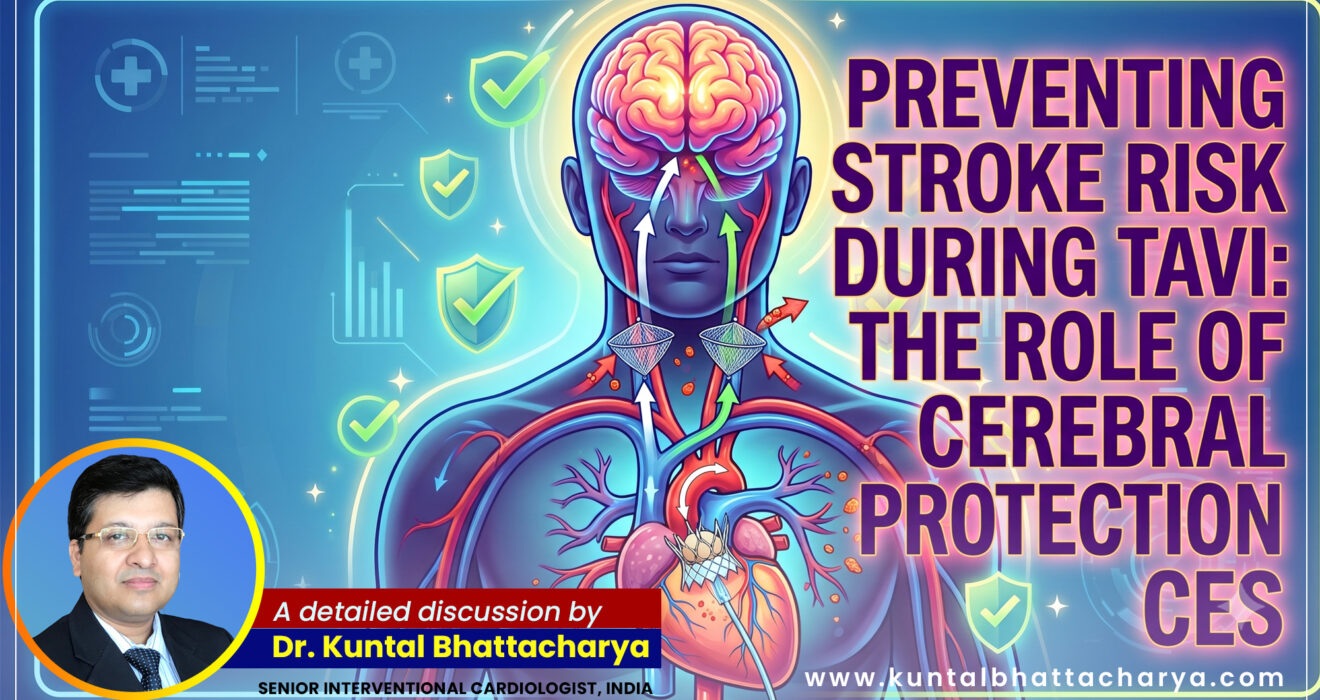
A cerebral embolic protection device (or CEP device TAVR) is a specialized, temporary filter system deployed within the aortic arch just before the main TAVI procedure begins. Its sole purpose is to act as a safety net, capturing any rogue particles that break away during the valve replacement.
The Sentinel Device TAVR: How It Works
The most widely recognized and rigorously tested CEP device globally is the Sentinel Cerebral Protection System. As an Adult Heart Doctor in Kolkata who prioritizes patient safety, I consider the use of such devices a massive leap forward in neuroprotection in TAVI.
Here is exactly how the Sentinel device TAVR functions:
-
Access: Before the main valve catheter is inserted in the groin, a small secondary catheter is inserted into the radial artery in the right wrist.
-
Deployment of Filters: The catheter is advanced up into the aortic arch. The device features two tiny, parachute-like polyurethane mesh filters. One filter is deployed in the brachiocephalic artery (which supplies the right side of the brain), and the second is deployed in the left common carotid artery (which supplies the left side of the brain).
-
The TAVI Procedure: With the “safety nets” securely in place, the interventional cardiologist proceeds with the actual TAVI valve replacement.
-
Capture and Removal: As the new valve is implanted and the old calcified valve is crushed outward, any resulting embolic debris that travels toward the brain is safely caught inside the mesh filters.
-
Extraction: Once the TAVI is complete, the filters—along with all the captured dangerous debris—are collapsed back into the catheter and safely removed from the patient’s body through the wrist.
The concept is beautifully intuitive. Clinical studies have shown that in nearly all patients where a CEP device is used, some amount of debris is captured—proving that particles do break loose during TAVI. By capturing this debris, we significantly answer the question of How to prevent stroke during TAVI, shielding our patients from devastating neurological complications.
Patient Guide: Navigating Structural Heart Disease Care in Kolkata
A diagnosis of severe aortic stenosis can be overwhelming for patients and their families. When you are looking for an Interventional Cardiologist in Kolkata for specialized procedures like TAVI, navigating the healthcare landscape requires careful thought.
1. Finding the Right Adult Cardiologist in Kolkata
TAVI is a highly complex, precision-driven procedure. It should not be performed by just any general cardiologist; it requires a specialist with extensive training in structural heart interventions. When searching for a Doctor in Heart Disease in Kolkata, look for a specialist who routinely performs high-volume complex procedures and has a dedicated “Heart Team” (which includes interventional cardiologists, cardiac surgeons, and cardiac anesthetists) to evaluate every case.
My practice is deeply rooted in this collaborative approach. At Narayana Hospital RN Tagore Hospital, we meticulously plan every step of the TAVI Treatment in Kolkata, ensuring that advanced safety measures, such as the potential use of a CEP device TAVR, are discussed with the family beforehand.
2. Where to Go for Advanced Cardiac Care
If you are seeking Treatment for Heart Disease in Kolkata, your choice of hospital is just as critical as your choice of doctor. TAVI requires a state-of-the-art Hybrid Cath Lab—a room that functions as both an advanced imaging suite and a fully equipped surgical theater. Institutions like Narayana Health RN Tagore Hospital in Mukundapur represent the pinnacle of cardiac infrastructure in Eastern India, equipped to handle any unforeseen TAVR complications with immediate surgical backup.
For comprehensive outpatient evaluations, I consult patients at RxVital Healthcare on Purbachal Main Road, where we conduct initial screenings, echocardiograms, and detailed treatment planning in a comfortable, focused environment.
3. Overlapping Conditions: Coronary Artery Disease Treatments in Kolkata
It is extremely common for patients with aortic stenosis to also suffer from blockages in their coronary arteries. Often, a patient requires both a TAVI for their valve and a complex angioplasty for their blockages. Therefore, it is crucial to consult an expert who excels in Coronary Artery Disease treatments in Kolkata as well. A skilled interventional cardiologist can often stage these procedures safely, managing both conditions using minimally invasive techniques without ever needing to crack the chest.
4. Specialized Care: The Best Doctor for Women Heart Disease Treatment in Kolkata
I frequently see families searching for the best doctor for Women Heart Disease Treatment in Kolkata. This is a vital search because women often present with different symptoms and have anatomically smaller blood vessels than men, which can make catheter-based procedures more challenging. Furthermore, women tend to be older when they undergo TAVI. Therefore, having a specialist who understands the nuances of female cardiac anatomy and actively utilizes advanced safety protocols—like cerebral embolic protection—is essential for ensuring optimal outcomes for female patients.
Frequently Asked Questions (FAQs) by Cardiac Patients
Over my years of practice, I have gathered the most common questions that patients and their families ask—both in my clinic and on Google—when facing a major cardiac diagnosis in Kolkata.
How do I find the best doctor for Heart Disease Treatment in Kolkata?
Finding the “best” doctor is about identifying the right specialist for your specific structural or coronary issue. Look for an Adult Cardiologist in Kolkata with specialized fellowships (like FSCAI), a strong track record of successful complex interventions, and affiliations with top-tier hospitals like RN Tagore Hospital. A great doctor will transparently discuss the risks of the procedure and explain the safety protocols—like embolic protection—they intend to use.
What options are available for Treatment for Heart Disease in Kolkata?
Kolkata is a premier medical hub in Eastern India. The Treatment for Heart Disease in Kolkata ranges from advanced medical management and preventive cardiology to highly complex interventional procedures. We routinely perform complex angioplasties (using IVUS/OCT imaging and rotablation), pacemaker and ICD implantations, and structural heart therapies like TAVI Treatment in Kolkata for high-risk valve patients.
What exactly is the TAVI stroke risk, and should I be worried?
While TAVI is a lifesaver, stroke remains a recognized complication, historically occurring in a small percentage of patients (around 2% to 4%) due to embolic debris breaking loose during the procedure. However, you should not let this fear deter you from a necessary life-saving treatment. The risk is manageable, especially with the advent of neuroprotection in TAVI using a cerebral embolic protection device, which significantly reduces the chances of disabling strokes.
Does the Sentinel device TAVR make the procedure take much longer?
No. Incorporating a Sentinel device TAVR into the procedure is highly efficient in experienced hands. It typically only adds about 10 to 15 minutes to the overall procedure time, but the neurological safety benefits it provides for the patient are immeasurable.
Is TAVI better than open-heart surgery for everyone?
Not necessarily for everyone. When discussing TAVI vs open heart valve replacement, TAVI is undoubtedly the superior choice for elderly, frail, or high-surgical-risk patients. However, for younger, healthier patients (typically under the age of 65) or those with bicuspid aortic valves, open-heart surgery might still be recommended. The decision is always made by a multidisciplinary Heart Team tailored to your unique anatomy.
Are there specialized doctors for women’s heart health in Kolkata?
Yes. The best doctor for Women Heart Disease Treatment in Kolkata is one who recognizes that women often experience atypical symptoms (like extreme fatigue, back pain, or nausea instead of crushing chest pain). Such a specialist uses advanced diagnostic imaging to detect subtle microvascular diseases and tailors interventional procedures to accommodate the typically smaller vascular anatomy of female patients.
Conclusion: Safeguarding Your Mind and Heart
The evolution of Aortic stenosis treatment from aggressive open-heart surgery to the elegant, minimally invasive TAVI procedure represents the very best of medical innovation. However, true medical excellence is not just about adopting new techniques; it is about relentlessly refining them to make them safer.
The integration of the cerebral embolic protection device into TAVR protocols is a testament to this commitment. By actively capturing embolic debris, we are dramatically reducing the TAVI stroke risk and providing our patients with the ultimate peace of mind. We are ensuring that as we heal the heart, we are fiercely protecting the brain—preserving the memories, cognition, and personality of the patients we treat.
If you or a loved one are suffering from severe aortic stenosis, shortness of breath, or unexplained fainting spells, do not ignore the symptoms. Early evaluation is the key to preventing irreversible heart failure. As a dedicated Interventional Cardiologist in Kolkata, my mission is to provide you with world-class, safe, and compassionate care right here in our city.
From the desk of Dr. Kuntal Bhattacharya (Senior), Best Interventional Cardiologist in Kolkata & Heart Specialist Doctor in Kolkata, associated with Rabindranath Tagore International Institute of Cardiac Sciences, Kolkata.
Disclaimer:
The information provided in this article is intended for general educational and informational purposes only. It does not constitute medical advice, nor is it intended to be a substitute for professional medical diagnosis, treatment, or consultation. Every patient’s medical condition is unique, and treatments like TAVI or Angioplasty carry specific indications and potential risks. Always seek the direct advice of a qualified healthcare provider or a specialized Interventional Cardiologist with any questions you may have regarding a medical condition or before making any decisions about your cardiac treatment plan. Never disregard professional medical advice or delay in seeking it because of something you have read in this article.
Follow Dr. Kuntal Bhattacharya on Facebook & Youtube for regular updates.
Read Also:
- Why a Stress Test (TMT) is Crucial for Early Heart Disease Detection
- Left Main Angioplasty: A Minimally Invasive Alternative to Bypass in 2026
- Life with an AICD: Managing Sudden Cardiac Death Risk Effectively
- TAVI for High-Risk Patients: Why Age is No Longer a Barrier to Heart Care
- Understanding Your Echocardiogram Results: A Simple Guide for Patients
- How 3D Imaging Enhances Precision in TAVI Procedures in Kolkata
- Identifying Asymptomatic Heart Disease in Young Adults in 2026: The Silent Killer
- The Role of FFR in Deciding the Right Treatment for Heart Blockages
- Leadless Pacemakers vs. Traditional Pacemakers: Pros and Cons for 2026
- Managing Complex Coronary Artery Disease in 2026: A Cardiologist’s Guide
- How IVUS and OCT Technology Revolutionized Angioplasty Success in Kolkata
- Choosing the Right Coronary Angioplasty Doctor in Kolkata 2026: A Patient’s Guide
- Life After TAVI/TAVR Treatment: Patient Advice from a Cardiologist in Kolkata
- Why Choose TAVI/TAVR Over Open Heart Surgery in 2025?
Stay Healthy. Stay Informed.