
Life with an AICD: Managing Sudden Cardiac Death Risk Effectively
Table of Contents
ToggleAn ultimate guide to ‘Life with an AICD: Managing Sudden Cardiac Death Risk Effectively’ – a detailed guide by Dr. Kuntal Bhattacharya, Senior Interventional Cardiologist, Narayana Health – RN Tagore Hospital, Kolkata
As a cardiologist who has spent over two decades navigating the intricate pathways of the human heart, I have often seen the shadow that the fear of “Sudden Cardiac Death” (SCD) casts over a family. In my clinic at RN Tagore Hospital, Kolkata, I meet patients every day who have survived a close call or have been told their heart is “weak.” The phrase itself—Sudden Cardiac Death—is heavy. It feels unpredictable, final, and uncontrollable.
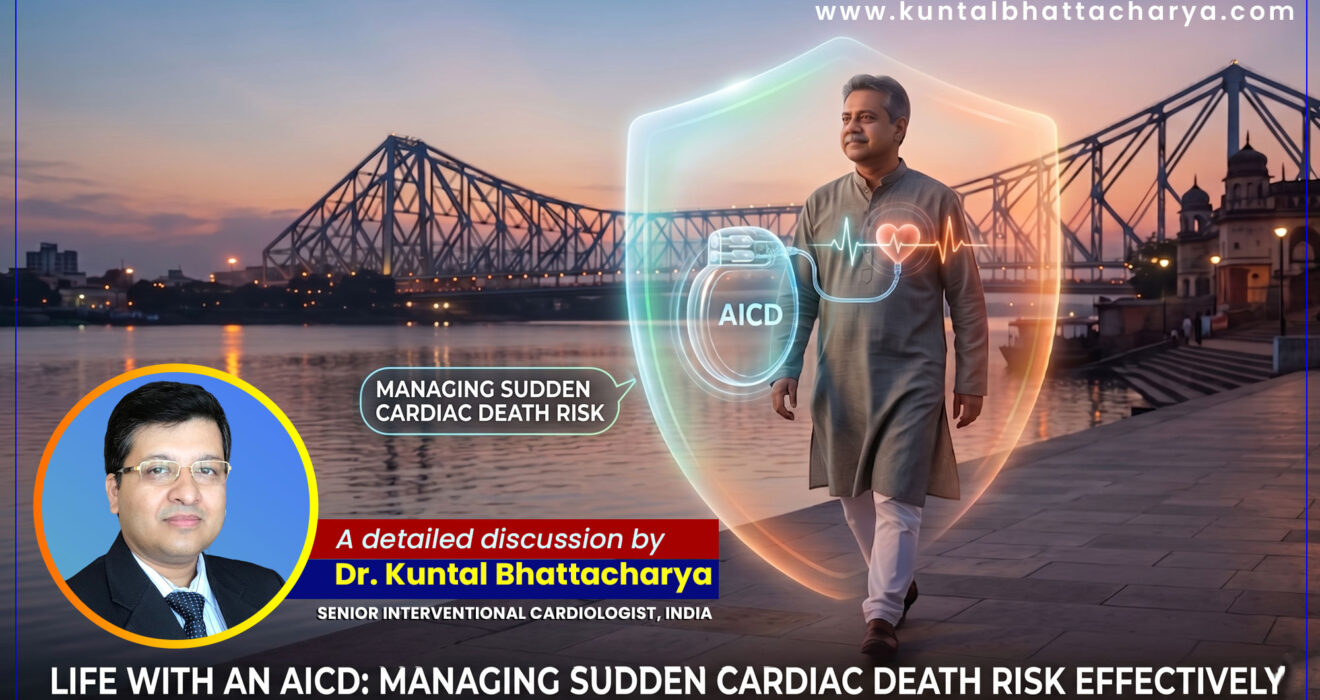
However, modern medicine has gifted us a remarkable “guardian angel” for the heart: the Automated Implantable Cardioverter Defibrillator (AICD). Living with an AICD is not just about having a device in your chest; it is about reclaiming your life while Managing Sudden Cardiac Death Risk with precision and confidence.
In this comprehensive guide, I aim to walk you through the journey of life with an AICD—from the moment of diagnosis to the nuances of daily living in a city as vibrant as Kolkata.
Section 1: Understanding the Threat – What is Sudden Cardiac Death?
To understand why an AICD is necessary, we must first understand what it prevents. Unlike a heart attack, which is a “plumbing problem” (a blockage in the blood flow), Sudden Cardiac Death is usually an “electrical problem.”
When the heart’s electrical system malfunctions, it can trigger dangerously fast rhythms called Ventricular Tachycardia (VT) or Ventricular Fibrillation (VF). In these moments, the heart stops pumping blood effectively. Within seconds, the person loses consciousness, and without immediate intervention, the result is fatal.
This is where the AICD comes in. It is a sophisticated, battery-powered device implanted under the skin that monitors every single heartbeat. If it detects a life-threatening rhythm, it delivers a precisely timed electrical shock to “reset” the heart back to its normal rhythm.
Section 2: The AICD Procedure – A Stepping Stone to Safety
Many patients ask me, “Dr. Bhattacharya, is this a major open-heart surgery?” The answer is no.
The implantation of an AICD is a minimally invasive procedure performed in a specialized Cath Lab. As an Interventional Cardiologist in Kolkata, I perform this under local anesthesia and conscious sedation. We make a small incision near the collarbone, create a “pocket” for the device, and thread the leads (wires) through a vein into the heart.
The procedure usually takes about one to two hours. Most patients at Narayana Hospital RN Tagore Hospital are discharged within 24 to 48 hours. The goal is to get you back to your family and your routine as safely and quickly as possible.
Section 3: Living Your Best Life with an AICD
Once the device is in, the real journey begins. Adapting to an AICD is as much a psychological shift as a physical one. Here is how you can manage your daily life effectively:
1. Physical Activity and Sports
I always tell my patients: “An AICD is there to let you live, not to stop you from living.”
- Walking: This is the best exercise. Start slow and gradually increase your pace.
- Avoid Contact Sports: You should avoid sports where there is a high risk of a direct blow to the chest (like football or rugby), as this could damage the device or dislodge the leads.
- Arm Movement: For the first few weeks, avoid lifting your arm on the device side above shoulder level to allow the leads to secure themselves.
2. Electronic Interference – Myths vs. Reality
In our tech-driven world, this is a major concern.
- Mobile Phones: You can use them! Just keep the phone at least 6 inches away from the device. Use the ear opposite to the side of the implant.
- Household Appliances: Microwaves, vacuum cleaners, and TVs are perfectly safe.
- Airport Security: Inform the security personnel that you have an AICD. You will have an ID card—carry it always. While walking through the metal detector is usually fine, don’t linger inside it. If they use a handheld wand, ask them not to hold it directly over the device.
3. Medical Procedures and MRIs
Historically, AICD patients couldn’t have MRIs. However, most modern devices we use today are MRI-conditional, meaning they are safe under specific settings. Always inform any Adult Heart Doctor in Kolkata or your dentist about your device before any procedure involving electrocautery or radiation.
Section 4: Complex Coronary Artery Disease Treatments in Kolkata
It is important to remember that an AICD treats the rhythm, but it doesn’t treat the underlying blockages. Many patients requiring an AICD also suffer from Complex Coronary Artery Disease (CAD).
If you or a loved one is dealing with multiple blockages, calcified (hardened) arteries, or “Left Main” disease, you need specialized care. In Kolkata, we have moved far beyond simple stenting.
What to do if you need an Interventional Cardiologist in Kolkata for Complex CAD:
- Seek Advanced Imaging: Look for centers that use IVUS (Intravascular Ultrasound) or OCT (Optical Coherence Tomography). These “cameras inside the artery” allow us to see the blockage with microscopic detail.
- Atherectomy Techniques: For very hard, calcified blockages, we use Rotablation (a diamond-tipped burr that drills through calcium) or IVL (Intravascular Lithotripsy), which uses sonic pressure waves to crack the calcium.
- Where to Go? Kolkata is a healthcare hub for Eastern India. Premier institutions like Narayana Hospital RN Tagore Hospital (RTIICS), Apollo Multispeciality, and BM Birla Heart Research Centre offer 24/7 emergency cardiac care and advanced Cath Labs for complex interventions.
Section 5: Emergency Protocol – When the Device Fires
The most common fear is: “What does the shock feel like?”
Patients describe it like a “kick in the chest.” While it is startling, remember: that shock just saved your life.
If your AICD delivers a shock:
- Stay Calm: Sit or lie down immediately.
- Contact Your Doctor: If you feel fine after one shock, call your cardiologist’s office to schedule a device check.
- Call an Ambulance: If you receive multiple shocks (an “ICD storm”) or if you feel chest pain, breathlessness, or dizziness after a shock, head to the nearest emergency room immediately.
Section 6: Finding the Right Care in Kolkata
Kolkata has become a destination for cardiac excellence. When looking for an Interventional Cardiologist in Kolkata for Complex Coronary Artery Disease treatments, ensure the hospital has:
- A 24/7 dedicated Cardiac Emergency/Chest Pain Center.
- Advanced Cath Labs equipped with IVUS, OCT, and Rotablation.
- A dedicated “Heart Failure Clinic” for long-term management.
At RN Tagore Hospital (RTIICS), Mukundapur, we pride ourselves on being a high-volume center where we handle the most “challenging” cases that are often turned away elsewhere. Whether it is a complex angioplasty or a life-saving AICD implant, the goal is always the same: precision and empathy.
Final Words of Encouragement
Receiving an AICD is not the end of your active life; it is the beginning of a protected one. By Managing Sudden Cardiac Death Risk with technology and supporting it with a heart-healthy lifestyle—low salt, no smoking, and regular walks—you can enjoy many more sunsets by the Hooghly or festive evenings during Durga Puja.
Don’t let the fear of “what if” stop you. Your device is on duty 24/7, so you don’t have to be. Stay regular with your check-ups, keep your heart-health team close, and live your life to the fullest.
Stay Heart-Healthy!
Dr. Kuntal Bhattacharya
MBBS, MD, DM (Cardiology), FSCAI
Senior Interventional Cardiologist
Narayana Hospital – RN Tagore Hospital, Kolkata
Summary Table: Managing Life with an AICD
| Activity | Recommendation |
| Household Chores | Safe (Microwaves, TVs, Laptops) |
| Travel | Safe (Carry ICD ID card; avoid lingering in metal detectors) |
| Exercise | Walking is excellent; avoid heavy contact sports |
| Mobile Phones | Keep 6 inches away from the device; use the opposite ear |
| Medical Exams | Inform doctors/dentists; MRI must be “MRI-conditional” |
| Shocks | Sit down immediately; contact your clinic or emergency |
For consultations regarding AICD, Pacemakers, or Complex Coronary Artery Disease treatments in Kolkata, you can visit Dr. Kuntal Bhattacharya at Narayana Hospital RN Tagore Hospital, Mukundapur.
How has the journey with your heart health been so far, and are there specific lifestyle activities you’re most concerned about resuming?
Section 7: FAQs – AICD: Managing Sudden Cardiac Death Risk
What is the lifespan of an AICD battery?
Typically, the battery lasts between 7 to 10 years, depending on how often it needs to pace or shock the heart. We monitor the battery levels during your routine follow-up clinic visits.
Can I drive with an AICD?
There are usually restrictions for the first few months after implantation or after a shock has occurred. This is because the underlying arrhythmia (not the device) could cause you to lose consciousness. Always check with your cardiologist before resuming driving.
Is an AICD the same as a Pacemaker?
No. A pacemaker is primarily for a heart that beats too slowly. An AICD can do everything a pacemaker does, but its primary job is to stop a heart that is beating too fast (SCD risk).
Will I feel the device under my skin?
Yes, you will feel a small, firm bump. Most patients get used to it within a few weeks and forget it’s even there.
Can I travel internationally?
Absolutely. Just carry your device identification card. If you are going on a long flight, make sure to stay hydrated and move your legs to prevent clots, as you would normally.
What are the best Coronary Artery Disease treatments in Kolkata?
Treatment varies from lifestyle changes and medication to advanced Coronary Angioplasty. For complex cases, we use technologies like Rotablation and IVL to ensure the best long-term outcomes.
Who is the best Adult Heart Doctor in Kolkata for device therapy?
Kolkata has many world-class experts. Look for a "Senior Interventional Cardiologist" who specializes in "Electrophysiology" or "Device Therapy." Research their experience with AICD and CRT-D implantations.
Disclaimer: This blog post is for informational and educational purposes only and should not be considered a substitute for professional medical advice, diagnosis, or treatment. Always seek the advice of a qualified and experienced cardiologist in your area with any questions you may have regarding a medical condition.
Follow Dr. Kuntal Bhattacharya on Facebook & Youtube for regular updates.
Read Also:
- How 3D Imaging Enhances Precision in TAVI Procedures in Kolkata
- Identifying Asymptomatic Heart Disease in Young Adults in 2026: The Silent Killer
- The Role of FFR in Deciding the Right Treatment for Heart Blockages
- Leadless Pacemakers vs. Traditional Pacemakers: Pros and Cons for 2026
- Managing Complex Coronary Artery Disease in 2026: A Cardiologist’s Guide
- How IVUS and OCT Technology Revolutionized Angioplasty Success in Kolkata
- Choosing the Right Coronary Angioplasty Doctor in Kolkata 2026: A Patient’s Guide
- Life After TAVI/TAVR Treatment: Patient Advice from a Cardiologist in Kolkata
- Why Choose TAVI/TAVR Over Open Heart Surgery in 2025?
- Understanding TAVI / TAVR: The Future of Heart Valve Treatment
- Early Signs of Heart Valve Problems and When to Seek a TAVI Doctor
- Angioplasty vs. Bypass Surgery in 2025: What Should You Choose?
- How to Find the Best TAVI and TAVR Doctor in Kolkata in 2025?
Stay Healthy. Stay Informed.