
What is a Calcified Lesion? Advanced Solutions for Hardened Arteries
Table of Contents
Toggle‘What is a Calcified Lesion? Advanced Solutions for Hardened Arteries’ – a detailed guide by Dr. Kuntal Bhattacharya, Senior Interventional Cardiologist, Narayana Health – RN Tagore Hospital, Kolkata
Welcome to this comprehensive guide on one of the most challenging conditions we face in modern cardiology: calcified lesions. I am Dr. Kuntal Bhattacharya, a Senior Consultant Interventional Cardiologist with over 22 years of clinical experience, currently practicing at NH Rabindranath Tagore International Institute of Cardiac Sciences (RN Tagore Hospital) in Mukundapur, Kolkata.
Over the decades, having successfully treated thousands of patients and completed hundreds of complex surgeries, I have witnessed firsthand how heart disease has evolved. Today, due to changing lifestyles, rising diabetes, and increasing life expectancy, we are seeing more complex, heavily hardened blockages in patients than ever before. If you or a loved one has been told that your arteries are “hardened” or that you have “calcium in your heart,” this detailed article is designed to help you understand your condition and the advanced treatments available to you.
Understanding the Foundation: What is a Calcified Lesion?
When we talk about heart blockages, most people imagine a soft, fatty substance like butter or grease clogging up a kitchen pipe. In the early stages of heart disease—medically known as atherosclerosis—this is a somewhat accurate comparison. Cholesterol and fatty deposits build up inside the inner walls of your coronary arteries (the blood vessels that supply oxygen-rich blood to your heart muscle). This is called soft plaque.
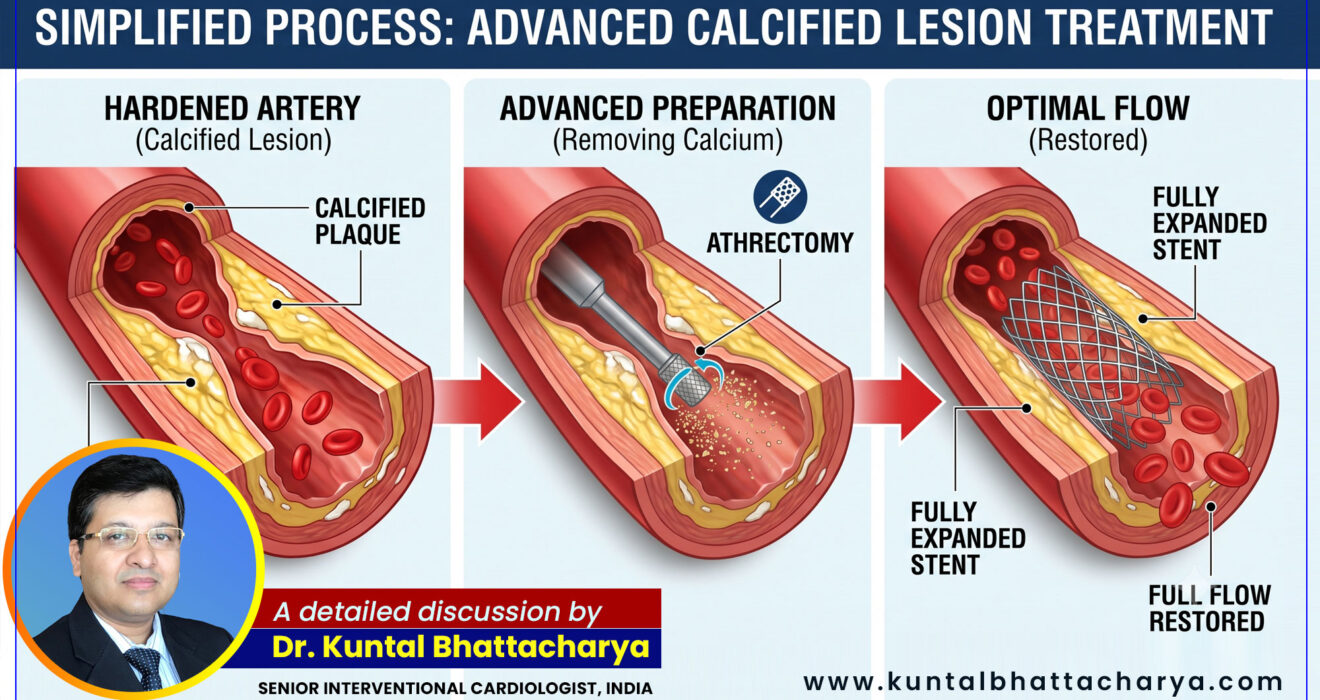
However, if this plaque is left untreated over many years, the body attempts to heal the continuous inflammation by depositing calcium into the plaque. Over time, this calcium crystallizes and transforms the once soft plaque into a hard, bone-like structure. This is what cardiologists call a calcified lesion.
The Plumbing Analogy
Think of your arteries as the plumbing system in your house. Soft plaque is like a buildup of sludge. It restricts the flow of water, but a plumber can relatively easily push through it or flush it out. A calcified lesion, on the other hand, is like severe limescale or mineral buildup that has calcified into concrete. Standard tools cannot easily clear it. When an artery becomes heavily calcified, it loses its natural elasticity. It becomes rigid, narrow, and highly resistant to standard balloon angioplasty and stenting procedures.
Why Do Arteries Harden?
Several risk factors contribute to the accelerated calcification of arteries. While aging is a primary factor—simply put, the older the plaque, the more time it has had to calcify—there are other significant accelerators:
- Diabetes Mellitus: High blood sugar levels accelerate vascular inflammation and rapid calcium deposition in the arteries.
- Chronic Kidney Disease (CKD): Kidneys help regulate calcium and phosphorus levels in the blood. When kidney function declines, abnormal calcium deposits often end up in the arterial walls.
- Hypertension (High Blood Pressure): The continuous high-pressure force against the arterial walls causes microscopic damage, promoting plaque formation and subsequent calcification.
- Genetics and Lifestyle: A strong family history of heart disease, smoking tobacco, a diet high in saturated fats, and a sedentary lifestyle significantly increase the risk of developing early and severe calcification.
The Hidden Dangers of Hardened Arteries
A calcified lesion is not just a structural problem; it is a profound functional problem for the human heart. When the arteries become rigid and narrowed, the heart muscle is starved of oxygen-rich blood, especially during moments of physical exertion, stress, or excitement.
Symptoms to Watch Out For
Because calcification happens gradually over many years, your body might adapt in the early stages, hiding the warning signs. However, as the hardened blockage becomes severe and flow is critically restricted, you may experience:
- Angina (Chest Pain): A squeezing, heavy, or burning sensation in the chest that may radiate to the left arm, neck, jaw, or upper back.
- Unexplained Shortness of Breath: Feeling winded after walking short distances, doing light household chores, or climbing a single flight of stairs.
- Severe Fatigue: A generalized, overwhelming feeling of tiredness, resulting from the heart working overtime to pump blood through narrowed, rigid pipes.
- Palpitations or Dizziness: Irregular heartbeats or feeling lightheaded due to inadequate blood supply to the heart muscle.
The real danger of a calcified lesion lies in the complexity it adds to treatment. If a patient with severe calcification suffers a heart attack, the hardened nature of the blockage makes emergency angioplasty significantly more challenging. Standard medical balloons may simply burst when inflated against the sharp, rock-like calcium spikes. Furthermore, if a stent is placed but cannot expand fully due to the surrounding bone-like calcium, it leads to a high risk of future complications like stent thrombosis (sudden blood clotting inside the stent) or restenosis (gradual re-narrowing).
Advanced Diagnostic Tools: Seeing the Calcium
Before we can safely treat a calcified lesion, we must understand its depth, thickness, and precise location. A standard coronary angiogram (an X-ray video taken with special dye) can show us where the artery is narrowed and often reveals dark shadows indicating calcium. However, it does not give us the full three-dimensional picture.
As an experienced Interventional Cardiologist in Kolkata, I heavily rely on advanced intracoronary imaging techniques to see inside the artery from the inside out:
- Intravascular Ultrasound (IVUS): A microscopic ultrasound probe is guided into the artery, giving us a cross-sectional, real-time view of the vessel wall. It accurately measures how much calcium is present and whether it is superficial (near the blood flow) or deep within the artery wall.
- Optical Coherence Tomography (OCT): This technology uses infrared light to create incredibly high-resolution, microscopic images of the artery. OCT helps us measure the exact thickness and angle of the calcium ring, allowing us to choose the precise specialized tool needed to crack it.
Advanced Solutions for Coronary Calcification
When dealing with bone-like calcium in the coronary arteries, standard angioplasty balloons and stents are simply not enough. We must prepare the vessel first by breaking, drilling, or modifying the calcium so the permanent stent can expand perfectly. Today, we have several cutting-edge technologies at our disposal to ensure safe and highly successful outcomes.
Rotablation (Rotational Atherectomy)
Introduced a few decades ago but continually refined, rotablation is a highly effective tool for drilling through hard, impenetrable plaque. We use a tiny, diamond-encrusted burr attached to a flexible catheter. Powered by compressed air, this microscopic burr spins at incredibly high speeds—up to 150,000 to 200,000 revolutions per minute inside the artery.
As we gently advance this spinning diamond burr through the calcified blockage, it acts like a microscopic sander. It shaves away the hard calcium into particles that are smaller than red blood cells. These microscopic dust particles are then safely washed away by the bloodstream and naturally cleared by the body’s filtering systems (the liver and spleen). Rotablation effectively creates a smooth, wider, and flexible channel in the previously rigid artery, allowing a stent to be delivered and expanded safely.
Intravascular Lithotripsy (IVL)
One of the most revolutionary advancements in modern interventional cardiology is Intravascular Lithotripsy (IVL). If you are familiar with how urologists break kidney stones using sound waves, IVL uses the exact same principle—but brilliantly miniaturized for the heart’s tiny, delicate arteries.
During an IVL procedure, a special balloon catheter equipped with multiple sonic emitters is delivered exactly to the site of the calcified blockage. Once perfectly in position, the balloon is inflated with a fluid mixture, and we activate the emitters. They generate localized, pulsatile sonic shockwaves.
These pressure shockwaves travel harmlessly through the soft, healthy arterial tissue, but when they hit the hard, bone-like calcium, they aggressively crack it. By creating micro-fractures in the calcium ring, the rigid artery suddenly becomes flexible again. We can then deploy a stent normally, which easily pushes the fractured calcium outward, restoring normal, unimpeded blood flow. IVL has dramatically increased the safety and success rates of treating deeply calcified arteries, especially in elderly and fragile patients.
Orbital Atherectomy
Similar in concept to rotablation, orbital atherectomy uses a diamond-coated crown. However, instead of spinning straight ahead like a traditional drill, it rotates in an elliptical (orbital) motion. As the rotational speed increases, centrifugal force causes the crown to orbit in a wider path, sanding down the calcium. This continuous sweeping motion not only removes superficial calcium but also deeply alters the flexibility of the vessel, making stent placement much easier.
When Calcium Affects Heart Valves: The Role of TAVI
Arteries are not the only parts of the cardiovascular system susceptible to calcification. One of the most common and critical areas where calcium builds up is the aortic valve—the main “door” that allows oxygen-rich blood to leave the heart and be pumped to the rest of the body.
When heavy calcium builds up on the delicate leaflets of the aortic valve, they become stiff, rigid, and cannot open fully. This life-threatening condition is known as Severe Calcific Aortic Stenosis. The heart has to pump much harder to push blood through the narrowed opening, eventually leading to severe heart failure, fainting spells, and unfortunately, a high risk of sudden cardiac death if left untreated.
Historically, the only way to fix a calcified aortic valve was through major open-heart surgery. This involves opening the chest bone, stopping the heart, putting the patient on a heart-lung bypass machine, and manually cutting out the calcified valve to sew in a new one. However, many elderly patients or those with multiple health issues (like lung disease or kidney failure) are simply too fragile to survive the trauma of open-heart surgery.
What is TAVI?
Enter TAVI (Transcatheter Aortic Valve Implantation), also widely known as TAVR (Transcatheter Aortic Valve Replacement). TAVI is a groundbreaking, minimally invasive procedure designed to replace a narrowed, calcified aortic valve without ever opening the chest.
Instead of major surgery, a collapsed, artificial heart valve (made of biological tissue supported by a flexible metal frame) is mounted onto a delivery catheter. This catheter is usually inserted through a small puncture in the femoral artery in the groin. Under continuous X-ray guidance, we guide the new valve up to the beating heart and position it directly inside the old, calcified valve.
Once perfectly placed, the new valve is expanded—either by inflating a balloon or allowing a self-expanding metal frame to open at body temperature. It powerfully pushes the old, calcified leaflets out of the way and immediately takes over the job of regulating blood flow. The procedure usually takes just 1 to 2 hours, the patient remains conscious or under light sedation, and they are often walking the very next day and discharged within 3 to 5 days.
The TAVI Procedure in Kolkata
For patients seeking advanced structural heart interventions, Kolkata has firmly established itself as a premier medical hub in Eastern India. As a dedicated TAVI doctor in Kolkata, I evaluate each patient’s suitability for the procedure using advanced 3D CT scans. These scans allow us to measure the exact millimeter dimensions and calcium distribution of your specific aortic root.
We perform the TAVI procedure kolkata in a state-of-the-art Hybrid Cath Lab with a dedicated, multi-disciplinary Heart Team, ensuring the absolute highest standards of safety, hygiene, and precision. The availability of the latest generation imported valves means we can safely tailor the procedure to the specific, unique anatomy of each patient, ensuring a perfect fit and long-lasting results.
Understanding the TAVI Cost in Kolkata
Cost is a highly significant factor for many families when planning advanced cardiac procedures. The TAVI cost in Kolkata generally ranges between ₹18 Lakhs to ₹35 Lakhs. This cost variation depends on several crucial factors:
- Type of Valve Used: There are different types of TAVI valves (e.g., self-expanding valves made of shape-memory nitinol vs. balloon-expandable valves). Imported, next-generation valves designed specifically to reduce complications like paravalvular leaks are typically priced at the higher end of the spectrum.
- Hospital Infrastructure: Leading corporate hospitals equipped with hybrid Cath Labs and advanced intensive care unit (ICU) setups ensure maximum safety but may carry slightly higher procedural charges.
- Patient’s Medical Condition: If a patient requires prolonged ICU care or has complex vascular access issues requiring alternative entry points (like accessing through the shoulder artery instead of the groin), the overall cost may vary.
Compared to costs in Western countries (which can easily exceed $100,000), undergoing the TAVI procedure in India offers world-class clinical outcomes and identical technology at a fraction of the price, making Kolkata a highly sought-after destination for patients across the country and neighboring nations.
Finding the Right Care: Your Next Steps
Being diagnosed with heavily calcified arteries or severe aortic stenosis can feel overwhelming and frightening. The most critical step you can take for your health is to consult with a highly experienced Adult Heart Doctor in Kolkata who specializes exclusively in complex interventions and structural heart disease.
Why Choose an Expert Interventional Cardiologist in Kolkata?
Managing and treating calcified lesions requires a highly specialized skill set. Not every cardiologist is formally trained in advanced techniques like Rotablation, IVL, or TAVI. It requires years of dedicated, specialized training, a high annual volume of complex cases, and a deep, nuanced understanding of vascular biomechanics. When you choose an expert, you are not just getting a doctor; you are getting access to a comprehensive, collaborative Heart Team approach.
At Narayana Health RN Tagore Hospital in Mukundapur, we evaluate every complex case collaboratively. Whether it is deciding between a complex angioplasty using IVL or recommending bypass surgery, our ultimate goal is to provide a balanced, honest opinion and evidence-based treatment tailored specifically to your body’s needs.
What to Do When You Need Care
If you or a family member has been advised to undergo a high-risk angioplasty or a valve replacement, here is a simple roadmap:
- Gather Your Medical Reports: Collect all your previous medical records, including your latest ECG, Echocardiogram, and most importantly, your Coronary Angiogram CD and reports.
- Book a Specialized Consultation: Always seek an expert second opinion for complex conditions. You can schedule an appointment with me at RN Tagore Hospital or my dedicated clinic, RxVital Healthcare.
- Ask Direct Questions: Do not hesitate to ask your consulting doctor about their specific experience with calcified lesions, the exact tools they plan to use, the risks involved, and the expected recovery timeline.
FAQ's on Advanced Solutions for Hardened Arteries
Here are detailed answers to some of the most common questions I receive from patients and their families regarding advanced heart treatment in Kolkata and TAVI.
1. How do I find the best Interventional Cardiologist in Kolkata for calcified blockages?
When looking for a specialist, review their specific clinical experience, qualifications (such as a DM in Cardiology and international fellowships), and the volume of complex procedures they perform annually. Look for a doctor who is affiliated with a reputed, high-volume tertiary care center like Narayana RN Tagore Hospital. Such hospitals have the vital, expensive infrastructure (IVUS, OCT, Rotablation, IVL machines) required to handle complex calcified lesions safely and effectively.
2. Is Intravascular Lithotripsy (IVL) safe for older, fragile patients?
Yes, absolutely. In fact, IVL is often considered much safer for elderly patients with highly fragile arteries compared to aggressive high-pressure ballooning, which carries a risk of violently tearing the artery (a condition called dissection). Because IVL uses sonic pressure waves to gently crack the calcium without injuring the surrounding soft, healthy tissue, it is a highly predictable, gentle, and safe procedure.
3. Am I a candidate for TAVI instead of traditional open-heart surgery?
Originally, TAVI was approved strictly for elderly patients considered high-risk or inoperable for open-heart surgery. However, thanks to extensive global clinical trials and the proven long-term durability of the valves, TAVI is now officially approved and widely recommended for intermediate and even low-risk patients. Your age, previous chest surgeries, overall frailty, and existing medical conditions will dictate your eligibility. A detailed evaluation by our structural Heart Team will determine the safest and most effective path for you.
4. What is the recovery time like after a TAVI procedure?
Because TAVI is a minimally invasive procedure with no large chest incisions, recovery is remarkably fast. Most patients are awake shortly after the procedure concludes, sitting up in bed the same day, and walking the very next morning. The typical hospital stay is just 3 to 5 days, compared to the standard 7 to 10 days for open-heart surgery. Complete recovery and a return to normal, light daily activities usually occur within 1 to 2 weeks.
5. Are there financing and insurance options available for advanced heart treatment in Kolkata?
Advanced cardiac procedures involve significant costs due to the imported technologies, specialized hardware, and advanced hospital infrastructure required. However, most leading corporate hospitals in Kolkata, including RN Tagore Hospital, have robust tie-ups with major health insurance providers. Many private insurance policies cover TAVI and complex angioplasties (like IVL and Rotablation), though pre-authorization is usually strictly required. Patients should thoroughly check their policy limits, co-pay clauses, and room rent caps with their insurance agent prior to admission.
6. Can I naturally reverse or prevent arterial calcification once it starts?
Unfortunately, once calcium has formed and hardened in the arteries, it cannot be dissolved by diet, supplements, or oral medication. However, you can absolutely prevent it from worsening. Strict control of blood pressure, managing diabetes aggressively, lowering LDL (bad cholesterol) with prescribed statins, entirely quitting smoking, and engaging in regular cardiovascular exercise are the fundamental pillars of preventing the further progression of atherosclerosis.
It’s from the desk of Dr. Kuntal Bhattacharya (Senior), Best Interventional Cardiologist in Kolkata & Heart Specialist Doctor in Kolkata, associated with Rabindranath Tagore International Institute of Cardiac Sciences, Kolkata.
Disclaimer
The information provided in this blog post is for educational and informational purposes only and is not intended to be a substitute for professional medical advice, diagnosis, or treatment. Always seek the advice of your physician or other qualified health provider with any questions you may have regarding a medical condition or dietary changes. Never disregard professional medical advice or delay in seeking it because of something you have read on this website.
Follow Dr. Kuntal Bhattacharya on Facebook & Youtube for regular updates.
Read Also:
- Life with an AICD: Managing Sudden Cardiac Death Risk Effectively
- ECG vs. Echocardiogram: Which Heart Test Do You Actually Need?
- Heart-Healthy Diet: Incorporating Bengali Flavors Without the Oil
- Understanding Your Echocardiogram Results: A Simple Guide for Patients
- How 3D Imaging Enhances Precision in TAVI Procedures in Kolkata
- Identifying Asymptomatic Heart Disease in Young Adults in 2026: The Silent Killer
- The Role of FFR in Deciding the Right Treatment for Heart Blockages
- Leadless Pacemakers vs. Traditional Pacemakers: Pros and Cons for 2026
- Managing Complex Coronary Artery Disease in 2026: A Cardiologist’s Guide
- How IVUS and OCT Technology Revolutionized Angioplasty Success in Kolkata
- Choosing the Right Coronary Angioplasty Doctor in Kolkata 2026: A Patient’s Guide
- Life After TAVI/TAVR Treatment: Patient Advice from a Cardiologist in Kolkata
- Why Choose TAVI/TAVR Over Open Heart Surgery in 2025?
Stay Healthy. Stay Informed.