

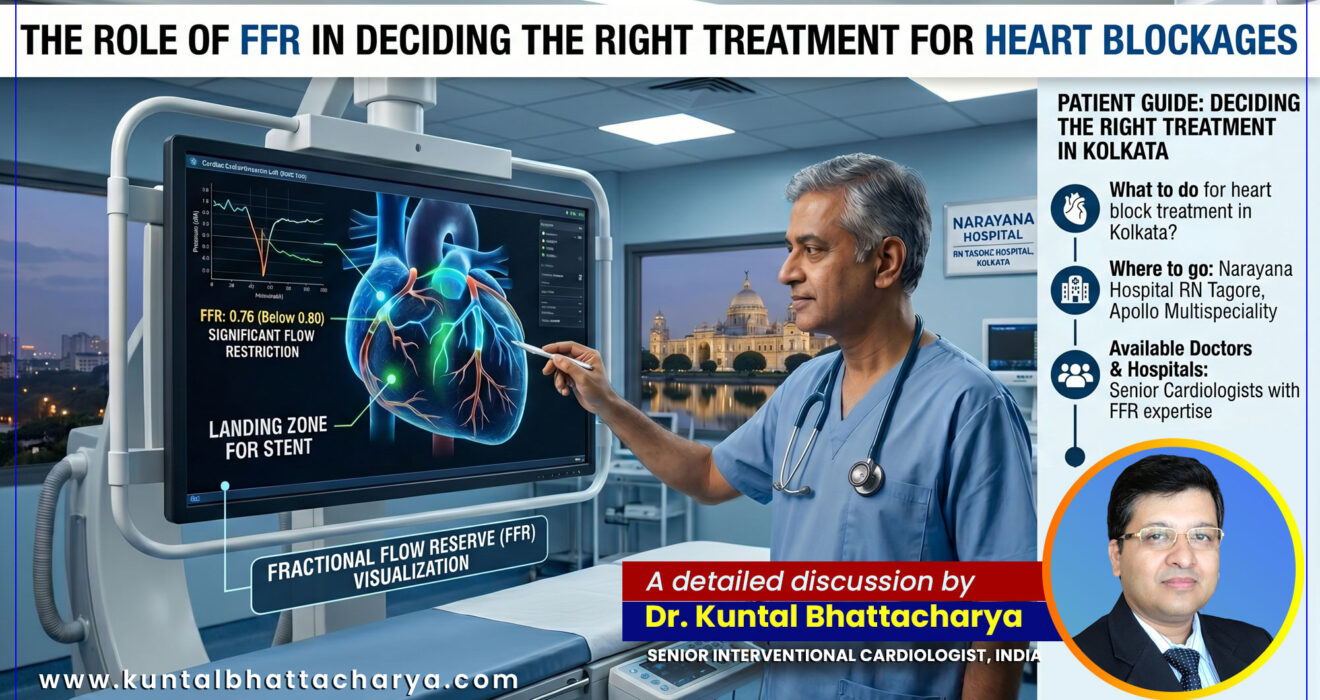
The Role of FFR in Deciding the Right Treatment for Heart Blockages
Table of Contents
Toggle‘The Role of FFR in Deciding the Right Treatment for Heart Blockages’ – a detailed guide by Dr. Kuntal Bhattacharya, Senior Interventional Cardiologist, Narayana Health – RN Tagore Hospital, Kolkata
In my years of practice at RN Tagore Hospital, Kolkata, I have encountered thousands of patients who come to me with a single, harrowing question: “Doctor, the angiogram shows a blockage. Do I absolutely need a stent, or can I manage with medicine?”
For a long time, cardiologists made this decision based on what we saw with our eyes on a 2D screen—a process we call “Visual Estimation.” But the human eye, as advanced as it is, can be deceived. A 70% blockage might look significant, but it might not actually be restricting blood flow to the heart muscle. Conversely, a 50% blockage might be more dangerous than it appears.
This is where FFR (Fractional Flow Reserve) enters the picture. It has shifted the paradigm from “treating the blockage” to “treating the patient’s physiology.” As an Interventional Cardiologist in Kolkata, I believe that understanding the role of FFR is crucial for any patient seeking the best Treatment for Heart Blockages in Kolkata.
Section 1: The “Visual-Functional Mismatch” – Why Angiography Isn’t Enough
To understand FFR, we must first understand the limitations of a standard Coronary Angiogram. An angiogram is essentially a “road map” of your heart’s arteries. We inject dye and take X-ray pictures to see where the “traffic jams” (blockages) are.
However, a road map only tells you where the road narrows; it doesn’t tell you how much the traffic is actually slowing down.
In cardiology, we call this the Visual-Functional Mismatch.
- The Over-estimation: Sometimes, a blockage looks “tight” (say, 80%), but the heart muscle is getting plenty of blood. Putting a stent here might not make the patient feel any better and adds unnecessary risk.
- The Under-estimation: A blockage might look “mild” (say, 50%), but because of its length or position, it is severely starving the heart of oxygen. Ignoring this could lead to a heart attack.
Section 2: What is FFR (Fractional Flow Reserve)?
FFR is a procedure used to determine the functional significance of a coronary narrowing. It measures the blood pressure and flow through a specific part of the coronary artery.
How it works (The Water Pipe Analogy):
Imagine a garden hose with a kink in it. To know if that kink is a problem, you wouldn’t just look at it. You would measure the water pressure before the kink and after the kink. If the pressure drops significantly after the kink, you know the flow is restricted.
In the Cath Lab, we use a specialized, incredibly thin “Pressure Wire.” We navigate this wire across the blockage. We then give a medication (usually Adenosine) to simulate the heart during exercise (hyperemia).
- The FFR Value: We calculate the ratio of the pressure after the blockage to the pressure before the blockage.
- The Magic Number (0.80): If the ratio is above 0.80, the flow is adequate, and the patient can usually be treated safely with medicines alone. If it is below 0.80, the blockage is significant, and a stent or bypass surgery is likely required to prevent future heart damage.
Section 3: Why FFR is a Game-Changer for Patients in Kolkata
As an Adult Heart Doctor in Kolkata, I see a high prevalence of Coronary Artery Disease treatments in Kolkata due to our unique lifestyle factors—rich diet, high stress, and genetic predisposition. FFR offers three primary benefits to our local community:
Avoiding Unnecessary Stenting
Kolkata patients are often (rightfully) concerned about “over-treatment.” FFR provides objective, scientific proof. If the FFR is 0.85, I can look my patient in the eye and say, “You don’t need a stent today. Your heart is getting enough blood. Let’s focus on your diet and medication.”
Identifying “Silent” Dangers
In cases of multi-vessel disease, where there are several blockages, FFR helps us identify the “culprit.” We only fix what needs fixing. This leads to shorter procedures, less dye use (protecting the kidneys), and better long-term results.
Cost-Effectiveness
While the FFR wire itself adds a small cost to the procedure, it often saves the patient the much larger cost of an unnecessary stent and the lifelong cost of additional blood-thinning medications.
Section 4: The Procedure – What Does the Patient Experience?
Many people ask, “Is it a separate surgery?” No. FFR is performed during your diagnostic angiogram or at the start of an angioplasty.
- Preparation: You are on the Cath Lab table, usually under local anesthesia.
- The Wire: Through the same catheter used for the angiogram, the Pressure Wire is inserted. You won’t feel this wire inside your arteries.
- The “Flush”: We inject the medicine to dilate the vessels. You might feel a brief “warm” sensation or a slight heaviness in the chest for about 30 seconds. This is normal.
- The Decision: Within minutes, the computer screen gives us the FFR number. We discuss the result with you immediately.
Section 5: Choosing the Best Doctor for Heart Block Treatment in Kolkata
Kolkata is blessed with some of the finest cardiac minds in the country. However, heart care is a team sport. When looking for a Doctor in Heart Blockages in Kolkata, consider the following “Gold Standards”:
Where to Go?
- Narayana Hospital – RN Tagore Hospital (RTIICS), Mukundapur: We are a high-volume center with dedicated physiology labs. We routinely use FFR and its newer, non-drug counterparts like iFR and RFR.
- Apollo Multispeciality Hospitals: Excellent infrastructure for complex coronary interventions.
- BM Birla Heart Research Centre: A historic institution with a focus on cutting-edge research and treatment.
What to Look For in an Interventional Cardiologist in Kolkata:
- Experience in Physiological Assessment: Ensure the doctor is comfortable using FFR/iFR and doesn’t rely solely on visual estimation.
- Complex Case Portfolio: Ask if they handle “Left Main” or “Multi-vessel” disease using advanced tools like IVUS or OCT alongside FFR.
- Patient-Centric Approach: The best doctor for Heart Block Treatment in Kolkata is one who explains the “Why” behind the “What.”
Section 6: Actionable Advice – What Should You Do?
If you have been told you have a heart blockage, follow these steps:
- Ask for the Percentages: Don’t just settle for “you have a blockage.” Ask specifically where it is and what the estimated percentage is.
- Request a Physiological Study: If the blockage is in the “Grey Zone” (50% to 70%), ask your Adult Heart Doctor in Kolkata, “Can we perform an FFR to see if this blockage is actually stopping blood flow?”
- Second Opinions: Heart care is life-altering. If you are unsure, take your angiogram CD to a senior Interventional Cardiologist in Kolkata at a tertiary care center like RN Tagore Hospital for a second look.
Final Thoughts from RN Tagore Hospital
The heart is an amazing organ, capable of incredible resilience. But it deserves precision care. In the past, we treated every narrowing we saw. Today, thanks to FFR, we treat only what truly threatens your life and well-being.
If you are navigating the complexities of Coronary Artery Disease treatments in Kolkata, remember that you have the right to ask for the most advanced, evidence-based care. Don’t just fix a “shadow” on a screen—fix the flow that keeps you alive.
Stay Heart-Healthy!
Dr. Kuntal Bhattacharya
Senior Interventional Cardiologist
Narayana Hospital – RN Tagore Hospital, Kolkata
Summary Table: Angiography vs. FFR
| Feature | Standard Angiography | FFR (Functional Study) |
| Primary Goal | See the anatomy/structure | Measure the actual blood flow |
| Decision Base | Visual percentage (%) | Physiological ratio (0.80) |
| Outcome | May lead to over-stenting | Precise, evidence-based treatment |
| Standard at | All Cardiac Centers | Advanced Tertiary Care Centers |
How has your perspective on stenting changed after learning about physiological testing, and what questions would you now ask your cardiologist during your next visit?
Section 7: FAQs – Right Treatment for Heart Blockages
Is FFR safe?
Yes. FFR adds very little risk to a standard angiogram. The wire is extremely flexible and fine. The medication used is processed by the body in seconds.
Will insurance cover FFR?
Most major insurance providers and TPA services in India now recognize FFR as an essential diagnostic tool for deciding the Treatment for Heart Blockages in Kolkata and cover it under the procedure cost.
What if my FFR is 0.81?
An FFR of 0.81 is technically "negative," meaning no stent is required. We would manage you with "Optimal Medical Therapy" (OMT)—statins, blood pressure medicine, and lifestyle changes.
Can FFR be done after a heart attack?
Usually, FFR is most accurate for "stable" blockages. In the middle of an acute heart attack, the physiology of the heart is changing too fast for a stable FFR reading. However, it can be used a few days later to check other secondary blockages.
Who is the best Doctor in Heart Blockages in Kolkata?
Look for senior consultants at major cardiac centers (RN Tagore, Apollo, Manipal) who have FSCAI (Fellow of the Society for Cardiovascular Angiography and Interventions) credentials or extensive international experience.
Can FFR replace an Angiogram?
No. They work together. The angiogram shows us the structure, and the FFR shows us the function. You need both for a complete picture.
Disclaimer: This blog post is for informational and educational purposes only and should not be considered a substitute for professional medical advice, diagnosis, or treatment. Always seek the advice of a qualified and experienced cardiologist in your area with any questions you may have regarding a medical condition.
Follow Dr. Kuntal Bhattacharya on Facebook & Youtube for regular updates.
Read Also:
- Identifying Asymptomatic Heart Disease in Young Adults in 2026: The Silent Killer
- How 3D Imaging Enhances Precision in TAVI Procedures in Kolkata
- Leadless Pacemakers vs. Traditional Pacemakers: Pros and Cons for 2026
- Managing Complex Coronary Artery Disease in 2026: A Cardiologist’s Guide
- How IVUS and OCT Technology Revolutionized Angioplasty Success in Kolkata
- Choosing the Right Coronary Angioplasty Doctor in Kolkata 2026: A Patient’s Guide
- Life After TAVI/TAVR Treatment: Patient Advice from a Cardiologist in Kolkata
- Why Choose TAVI/TAVR Over Open Heart Surgery in 2025?
- TAVI and TAVR Procedures in Kolkata in 2025
- Understanding TAVI / TAVR: The Future of Heart Valve Treatment
- Early Signs of Heart Valve Problems and When to Seek a TAVI Doctor
- Angioplasty vs. Bypass Surgery in 2025: What Should You Choose?
- Modern Technology in Cardiac Devices in 2025
- How to Find the Best TAVI and TAVR Doctor in Kolkata in 2025?
Stay Healthy. Stay Informed.