

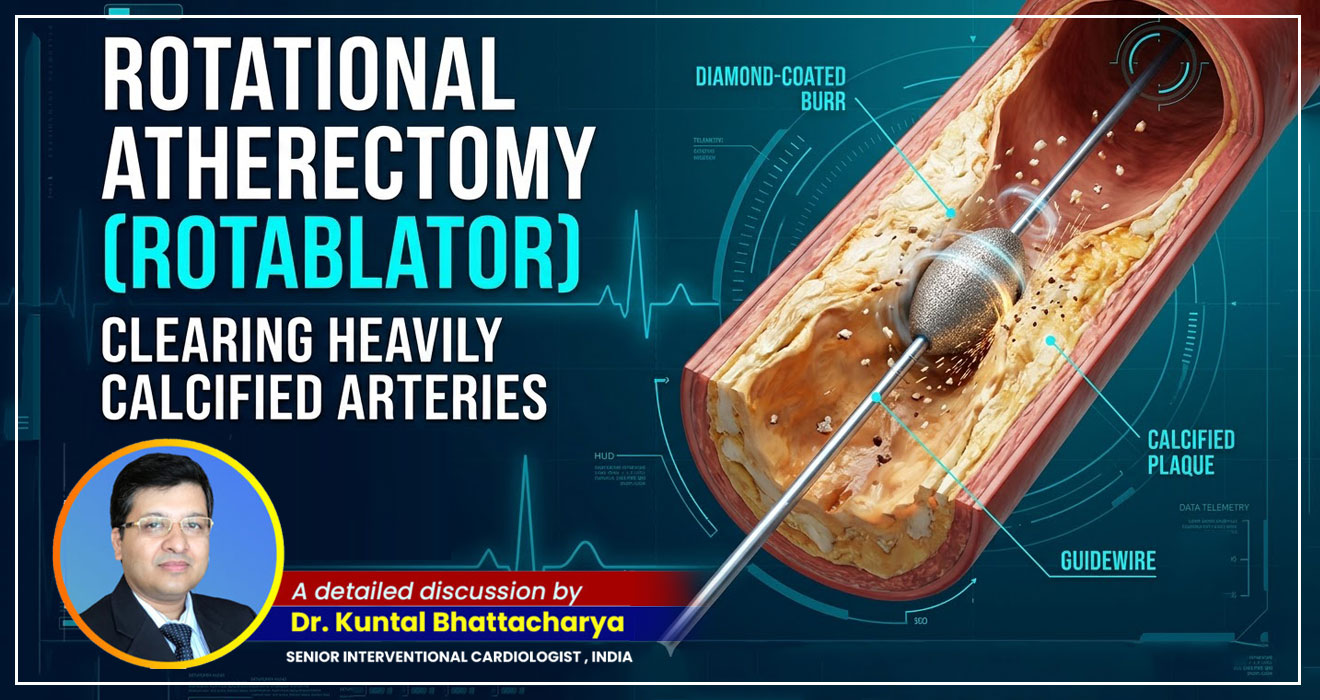
Rotational Atherectomy (Rotablator): Clearing Heavily Calcified Arteries
Table of Contents
Toggle‘Rotational Atherectomy (Rotablator): Clearing Heavily Calcified Arteries’ – A detail guide on Dr. Kuntal Bhattacharya (Senior), Senior Consultant Interventional Cardiologist, Narayana Hospital (RN Tagore Hospital), Mukundapur, Kolkata
Welcome to an in-depth exploration of one of the most fascinating and life-saving advancements in modern cardiology. Over the past two decades of my practice as an interventional cardiologist in Eastern India, I have witnessed a dramatic shift in the types of heart blockages presenting in our catheterization laboratories. Years ago, blockages were primarily soft cholesterol plaques. Today, driven by rising rates of diabetes, chronic kidney disease, and an aging population, we are increasingly facing a much tougher opponent: heavily calcified arteries.
When calcium deposits inside the heart’s arteries, it turns a soft blockage into something resembling solid rock or bone. Traditional treatments, like standard balloon angioplasty, simply bounce off these hardened walls. In the past, patients with such severe calcification had no choice but to undergo open-heart bypass surgery. Today, thanks to a marvel of medical engineering known as the Rotablator, we can literally drill through these rock-hard blockages from the inside out, without making a single surgical incision on the chest.
This comprehensive guide is designed to help patients and their families understand everything about this advanced technology, from how the procedure works to what to expect during recovery. If you or a loved one has been diagnosed with rock-hard coronary blockages, this detailed walk-through will empower you with the knowledge you need to make confident, informed healthcare decisions.
Understanding the Enemy: Why Do Arteries Calcify?
To appreciate the brilliance of rotational atherectomy, you must first understand what we are fighting against. Many patients are confused when they hear they have “calcium” in their heart arteries. They often ask, “Did I drink too much milk?” or “Should I stop taking my calcium supplements?” The answer to both is no.
The Biology of Coronary Calcification
The calcium inside your arteries is not related to your dietary calcium intake. Instead, it is the result of a biological healing process gone completely wrong. When you have high blood pressure, high cholesterol, or high blood sugar (diabetes), the delicate inner lining of your blood vessels (the endothelium) gets damaged. Your body tries to heal this damage by sending inflammatory cells, cholesterol, and fats to “patch” the area, forming a plaque.
If this condition persists over many years, the body attempts to stabilize this dangerous, inflammatory plaque by depositing calcium into it. It is essentially your body’s misguided attempt to wall off the disease. Over time, this calcium hardens, forming a rigid, bony ring inside the artery. This condition is prevalent in patients with advanced age, long-standing diabetes mellitus, and chronic kidney disease (CKD)—conditions that are unfortunately very common in our demographic in Kolkata and surrounding regions.
Why Standard Balloon Angioplasty Fails Here
In a standard angioplasty, we navigate a microscopic deflated balloon into the narrowed artery and inflate it at high pressure. The balloon squashes the soft cholesterol plaque against the artery walls, clearing the path for blood flow, and then a metal stent is deployed to keep it open.
However, a standard balloon cannot expand against solid bone. If we try to inflate a balloon inside a heavily calcified artery, one of two dangerous things will happen:
Dog-Boning Effect: The balloon inflates at the soft ends but remains pinched in the hard middle, failing to open the artery.
Arterial Rupture: If excessive pressure is applied, the hard calcium might shift abruptly, tearing the delicate artery wall—a life-threatening emergency. Furthermore, even if we somehow manage to force a stent into a calcified artery, the rock-hard calcium will prevent the stent from expanding fully. An under-expanded stent is highly dangerous, as it can attract blood clots (stent thrombosis) and cause a massive heart attack shortly after the procedure.
The Game Changer: Rotational Atherectomy Kolkata
To solve the problem of unyielding, bone-like blockages, medical science turned to the principles of engineering and physics. The solution is rotational atherectomy Kolkata, commonly known by its most famous brand name, the Rotablator.
What is the Rotablator?
Imagine a microscopic, diamond-encrusted drill bit. The Rotablator system consists of a tiny burr—shaped like a miniature football—coated with thousands of microscopic diamond crystals. This burr is attached to a flexible drive shaft and is powered by compressed nitrogen gas.
When activated by the cardiologist via a foot pedal, this diamond-tipped burr spins at an astonishing speed of 140,000 to 180,000 revolutions per minute (RPM). To put that into perspective, that is significantly faster than a high-speed dentist’s drill. We carefully advance this spinning burr directly into the rock-hard calcium blockage.
The Physics of Differential Cutting
One of the most common fears patients have when they hear about a “drill” inside their heart is, “Will it drill a hole through my artery?” The genius of the Rotablator lies in a physics principle called Differential Cutting.
Because the burr is spinning at such ultra-high speeds, it behaves differently depending on the texture of the tissue it touches.
When it touches hard, calcified plaque, the rigid calcium cannot yield, so the diamond crystals instantly grind the calcium down.
When it touches soft, healthy artery tissue, the elastic tissue simply deflects and bounces away from the burr without being damaged or cut. It is similar to how you can safely run a spinning cast-cutting saw over soft skin, but it will instantly cut through a hard plaster cast.
Where Does the Calcium Go?
Another highly critical question patients ask is, “Once you drill the calcium, where do the pieces go? Won’t they cause a stroke?” The Rotablator does not break the calcium into large chunks. It literally pulverizes the hard plaque into microscopic micro-particles. These particles are smaller than human red blood cells (usually less than 5 microns in size). Because they are so incredibly tiny, they safely wash downstream with your blood flow, pass harmlessly through the microscopic capillary beds, and are eventually filtered out and safely disposed of by your body’s natural waste systems, primarily the spleen and the liver.
Step-by-Step Guide to the Rotablator Procedure Kolkata
Undergoing any cardiac procedure can induce anxiety, but knowing exactly what happens inside the catheterization laboratory can bring immense peace of mind. Here is a detailed, step-by-step walkthrough of what you will experience during a rotablator procedure Kolkata.
1. Pre-Procedure Preparation
The journey begins days before the actual procedure. You will undergo standard blood tests to check your kidney function and blood counts. We will also optimize your medications, ensuring you are on appropriate blood thinners and hydration protocols. On the day of the procedure, you will be brought into the Cath Lab, an advanced, sterile room filled with high-tech X-ray monitors. You will remain awake but will be given a mild sedative to keep you relaxed and pain-free. Local anesthesia is injected into your wrist (radial artery) or groin (femoral artery)—the entry points for our catheters.
2. Advanced Intravascular Imaging
Before we introduce the drill, we must map the battlefield. In top-tier centers, we never perform rotablation blindly. We use advanced imaging tools like Intravascular Ultrasound (IVUS) or Optical Coherence Tomography (OCT). These microscopic cameras are sent inside your artery to measure the exact thickness, length, and distribution of the calcium ring. This helps the cardiologist select the precise millimeter size of the diamond burr required for your specific anatomy.
3. Advancing the RotaWire
A specialized, incredibly thin, and highly supportive guidewire (the RotaWire) is navigated through your blood vessels, up to your heart, and carefully pushed past the severe, calcified blockage. This wire acts as the absolute rail track for the drill.
4. The Drilling Phase (Rotablation)
The diamond-coated burr is advanced over the wire until it reaches the blockage. A continuous flush of special lubricating fluid (a mix of saline, blood thinners, and vessel-relaxing medications) is pumped through the system to keep the drill cool and wash away particles. When the foot pedal is pressed, you might hear a high-pitched whining sound in the room—this is the drill spinning at 160,000 RPM. The cardiologist gently and rhythmically advances the burr into the calcium in short, “pecking” motions, each lasting only a few seconds. This prevents the heart from being overwhelmed by the micro-particles and keeps the burr from overheating. The hard calcium is systematically pulverized into dust.
5. Ballooning and Stenting
Once the calcium has been successfully drilled away and a clear, smooth channel has been created, we remove the Rotablator. Now, the artery behaves like a normal, non-calcified vessel. We introduce a standard balloon to further stretch the newly drilled channel, and finally, we deploy a drug-eluting stent. Because the rigid calcium ring has been broken, the stent expands perfectly, embedding itself flush against the artery wall, restoring full, unrestricted blood flow to your heart muscle.
Who Needs Heavily Calcified Arteries Treatment Kolkata?
Not every heart blockage requires a Rotablator. It is a highly specialized tool reserved for the most complex anatomies. You might be a candidate for heavily calcified arteries treatment Kolkata if you meet certain clinical criteria:
Failed Previous Angioplasty: You underwent an angiogram or angioplasty attempt previously, and the doctor informed you that the balloon could not cross the blockage or could not expand due to “rock-hard” deposits.
Advanced Diabetics and CKD Patients: Patients with decades of uncontrolled blood sugar or those undergoing dialysis frequently develop severe, ring-like calcifications that mandate rotablation.
Alternative to Bypass Surgery: For elderly patients or those with severe lung or kidney issues who are considered “high risk” for traditional open-heart bypass surgery (CABG), rotablation offers a minimally invasive, life-saving alternative to clear complex, calcified multi-vessel disease.
Chronic Total Occlusions (CTO): Arteries that have been completely blocked for months or years often become heavily calcified. Clearing them frequently requires the use of specialized drilling technologies.
Understanding Rotablation Cost in Kolkata & Rotational Angioplasty Price Kolkata
One of the most practical and pressing concerns for patients and their families is the financial aspect of this advanced intervention. It is important to have a transparent understanding of the rotablation cost in Kolkata and what exactly you are paying for.
Why Does it Cost More Than Standard Angioplasty?
A rotational atherectomy is significantly more complex and resource-intensive than a standard balloon angioplasty. When you look at the rotational angioplasty price Kolkata, it reflects several highly specialized, single-use, imported consumables:
The Rotablator Burr and Advancer: The diamond-tipped drill bit and its complex pneumatic advancing mechanism are extremely sophisticated pieces of technology. For strict infection control and precise mechanical performance, this expensive hardware is strictly single-use. Once used on a patient, it is discarded.
Intravascular Imaging (IVUS/OCT): Using IVUS or OCT is a global standard of care when dealing with calcified lesions. The disposable imaging catheters add to the overall cost but are absolute lifesavers, ensuring the stent is perfectly placed and preventing future, catastrophic stent failures.
Specialized Wires and Microcatheters: Navigating through rock-hard blockages requires premium, specialized hardware that standard procedures do not require.
Drug-Eluting Stents (DES): Following the drilling, premium, advanced-generation stents are implanted to keep the artery permanently open.
While the upfront cost is higher than a simple angioplasty, investing in a properly executed rotational atherectomy prevents the catastrophic consequences of under-expanded stents, repeated hospital admissions for heart failure, or the need for emergency, high-risk bypass surgeries. Many top-tier comprehensive health insurance policies and corporate health schemes provide excellent coverage for these advanced, life-saving procedures.
Choosing Coronary Rotablation Hospitals Kolkata
The success of a rotational atherectomy depends less on the machine itself and heavily on the hands that operate it and the infrastructure supporting it. The Rotablator is an aggressive tool; in inexperienced hands, it can cause severe complications. Therefore, selecting the right institution among the many coronary rotablation hospitals Kolkata is the most critical decision a patient will make.
The Hallmarks of a Premier Rotablation Center
When seeking treatment for severe calcification, you must ensure the hospital has a comprehensive, ultra-modern cardiac ecosystem. At Narayana Hospital (RN Tagore Hospital), we provide a deeply integrated approach:
High-Volume Operator Experience: The interventional cardiologist performing your procedure must be highly trained and perform rotablation routinely. High-volume operators possess the tactile feedback, patience, and judgment required to safely peck through rigid calcium without damaging the healthy vessel wall.
Advanced Cath Lab Technology: The hospital must be equipped with the latest, high-definition digital catheterization labs integrated directly with IVUS and OCT imaging consoles, allowing the physician to see the microscopic results of the drilling in real-time.
Surgical Backup: Because rotablation is performed on the most complex, high-risk patients, it must only be done in a hospital that has a robust, 24/7 in-house cardiothoracic surgical team. In the extremely rare event of a severe complication (like a major arterial tear), having an expert surgical team ready on standby can mean the difference between life and death.
Specialized Cardiac Intensive Care (CCU): Post-procedure care is paramount. A dedicated, highly monitored CCU staffed by specialized cardiac nurses ensures that your recovery in the first 24 hours is smooth, safe, and closely watched.
Life After Rotablation: Protecting Your Newly Opened Arteries
Surviving the procedure is a monumental victory, but the ultimate goal is lifelong cardiovascular health. Once the diamond drill clears the calcium and the stent restores the blood flow, the responsibility of keeping that artery pristine shifts to you.
The Recovery Phase
Recovery from a rotablator procedure is remarkably fast, considering the complexity of the intervention. Most patients are up and walking the next day and are typically discharged within 48 to 72 hours. You will be advised to avoid heavy lifting or strenuous exercise for about a week to allow the puncture site in your wrist or groin to heal completely.
Medication Adherence is Non-Negotiable
The most critical aspect of your post-procedure life is your medication regimen. You will be prescribed Dual Antiplatelet Therapy (DAPT)—usually a combination of Aspirin and a stronger blood thinner like Ticagrelor or Prasugrel. These medications prevent your blood from clotting inside the newly implanted metal stent. Stopping these medications prematurely, even for a single day, can lead to a massive, fatal heart attack. Never alter or stop your cardiac medications without your interventional cardiologist’s explicit permission.
Lifestyle and Dietary Overhaul
The calcium buildup was a result of underlying metabolic diseases. If you do not change your lifestyle, the disease will simply attack another artery.
Diabetes Management: Keep your HbA1c strictly within the target range prescribed by your doctor. Uncontrolled sugar is the primary driver of rapid re-calcification.
Heart-Healthy Diet: Shift to a diet rich in high-fiber vegetables, whole grains, and lean proteins. Drastically cut down on saturated fats, red meats, and highly processed, sugary foods. Limit your salt intake to manage your blood pressure.
Zero Tobacco Tolerance: Smoking accelerates the hardening and calcification of arteries faster than almost any other factor. You must quit smoking and all forms of tobacco instantly and completely.
Supervised Exercise: Once cleared by your cardiologist, engage in daily, moderate cardiovascular exercise like brisk walking for 30 to 45 minutes to keep your heart muscle strong and your blood flowing efficiently.
Frequently Asked Questions (FAQs) on 'Rotational Atherectomy (Rotablator)'
To provide further clarity on this complex topic, I have addressed some of the most pressing questions patients and their families search for online when confronting a diagnosis of severe coronary calcification in our city.
What exactly is a rotational atherectomy Kolkata?
Rotational atherectomy is an advanced, minimally invasive cardiac procedure used to treat severe, rock-hard calcium blockages inside the heart’s arteries. It uses a microscopic, diamond-tipped burr spinning at ultra-high speeds (up to 180,000 RPM) to literally grind and pulverize the rigid calcium into microscopic dust, clearing a path so a life-saving stent can be safely and fully expanded.
How safe is the rotablator procedure Kolkata for elderly patients?
In the hands of an experienced, high-volume interventional cardiologist operating in a fully equipped tertiary care hospital, the procedure is remarkably safe and highly effective. In fact, for many elderly, frail patients who are deemed too high-risk to survive the trauma of open-heart bypass surgery, the Rotablator offers a much safer, minimally invasive lifeline to restore heart function and relieve severe chest pain.
Who is the right candidate for heavily calcified arteries treatment Kolkata?
Ideal candidates are patients whose coronary angiogram reveals severe, dense calcification that standard angioplasty balloons cannot crack. This is frequently seen in elderly patients, long-term diabetics, individuals suffering from chronic kidney disease (CKD), or those who have had a previous, failed attempt at standard stenting due to impenetrable, rock-hard blockages.
What factors determine the rotablation cost in Kolkata?
The total cost is determined by the extensive use of highly advanced, single-use imported technologies. This includes the expensive diamond-tipped Rotablator burr and drive system, the disposable imaging catheters required for Intravascular Ultrasound (IVUS) or OCT, the specialized supportive guidewires, the number of premium drug-eluting stents implanted, and the duration of stay in the specialized Cardiac Care Unit (CCU).
How do I choose between different coronary rotablation hospitals Kolkata?
You must choose a premier tertiary care facility that offers a comprehensive cardiac ecosystem. Look for hospitals like RN Tagore Hospital that boast state-of-the-art digital Cath Labs equipped with IVUS/OCT imaging, have a dedicated team of highly experienced interventional cardiologists who routinely perform complex rotablation, and crucially, maintain a 24/7 in-house cardiothoracic surgical team to provide an absolute safety net in case of rare emergencies.
Why is the rotational angioplasty price Kolkata higher than a normal angioplasty?
Standard angioplasty only requires a balloon and a stent. Rotational angioplasty requires those same items, plus the addition of the highly sophisticated pneumatic Rotablator drilling console, the single-use diamond burrs, specialized micro-catheters, and the mandatory use of advanced internal imaging cameras (IVUS/OCT) to guide the drill safely. While it requires a higher financial investment, it is absolutely essential to prevent the catastrophic failure of under-expanded stents in heavily calcified, rigid arteries.
About the Author: Dr. Kuntal Bhattacharya is a highly esteemed, Gold Medalist, and Senior Consultant Interventional Cardiologist at NH Rabindranath Tagore International Institute of Cardiac Sciences, Kolkata. With over 22 years of dedicated clinical experience, he is deeply committed to bringing the most advanced, compassionate, ethical, and personalized cardiovascular care to his patients across Eastern India, specializing in complex coronary interventions and the management of high-risk diabetic heart disease.
Follow Dr. Kuntal Bhattacharya on Facebook & Youtube for regular updates.
Read Also:
- Living with a Permanent Pacemaker: Myth vs. Reality for Active Seniors
- Life After Heart Valve Replacement: Diet and Exercise Tips for Seniors
- The Connection Between Diabetes and Heart Disease: How to Protect Yourself
- Pacemaker Battery Replacement: What to Expect During the Procedure
- Preventing Stroke Risk During TAVI: The Role of Cerebral Protection Devices
- Why a Stress Test (TMT) is Crucial for Early Heart Disease Detection
- Left Main Angioplasty: A Minimally Invasive Alternative to Bypass in 2026
- Life with an AICD: Managing Sudden Cardiac Death Risk Effectively
- TAVI for High-Risk Patients: Why Age is No Longer a Barrier to Heart Care
- Understanding Your Echocardiogram Results: A Simple Guide for Patients
- How 3D Imaging Enhances Precision in TAVI Procedures in Kolkata
- Identifying Asymptomatic Heart Disease in Young Adults in 2026: The Silent Killer
- The Role of FFR in Deciding the Right Treatment for Heart Blockages
- Leadless Pacemakers vs. Traditional Pacemakers: Pros and Cons for 2026
- Managing Complex Coronary Artery Disease in 2026: A Cardiologist’s Guide
- How IVUS and OCT Technology Revolutionized Angioplasty Success in Kolkata
- Choosing the Right Coronary Angioplasty Doctor in Kolkata 2026: A Patient’s Guide
- Life After TAVI/TAVR Treatment: Patient Advice from a Cardiologist in Kolkata
- Why Choose TAVI/TAVR Over Open Heart Surgery in 2025?
Stay Healthy. Stay Informed.
Disclaimer: This article is for general education only. It is not a substitute for professional medical advice, diagnosis or treatment, and reading it does not create a doctor–patient relationship. Every patient is different, and outcomes cannot be guaranteed. Always consult a qualified doctor about your own condition.