
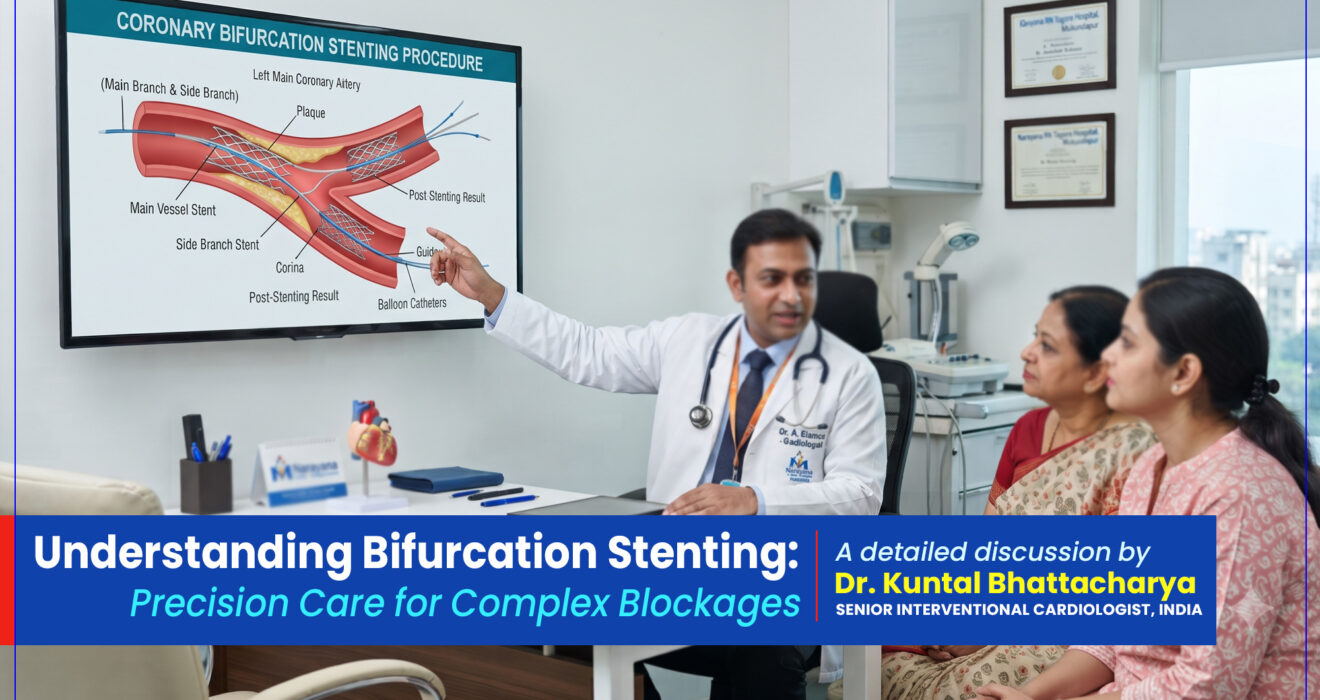
Understanding Bifurcation Stenting: Precision Care for Complex Blockages
Table of Contents
ToggleUnderstanding Bifurcation Stenting: Precision Care for Complex Blockages – From the desk of Dr. Kuntal Bhattacharya (Senior), Senior Consultant Interventional Cardiologist, Narayana Health – RN Tagore Hospital, Kolkata
In more than 22 years as an Interventional Cardiologist in Kolkata, I have sat across the table from thousands of worried patients and their families. Many of them walk in holding an angiogram report and ask me the same thing: “Doctor, it says bifurcation lesion. What does that mean? Is it very serious?”
It is a fair question. The word sounds heavy, and the report is full of terms that nobody has taken the time to explain. So I decided to write this guide in plain language, the way I would explain it in my consulting room at Mukundapur. I will use simple words, and whenever a medical term is unavoidable, I will explain it right there.
By the end of this article, you should understand what a bifurcation blockage is, how bifurcation stenting is done step by step, what the risks are, how recovery looks, and how to choose the right doctor and hospital for a procedure like this. If you are from Kolkata, from another district of West Bengal, or from a neighbouring state, and someone has told you that you need “complex angioplasty”, please read slowly, note down your questions, and take them to your cardiologist. An informed patient is a calmer patient, and a calmer patient usually does better.
What Is a Bifurcation Blockage?
The word bifurcation simply means a split into two. In the heart, it describes the spot where one coronary artery divides into two smaller arteries.
Think of a Road Junction
Picture a main road that splits into two roads at a Y-shaped junction. Traffic moves smoothly when all three roads are open. Now imagine a jam right at the junction itself. Vehicles back up on the main road, and both side roads get starved of traffic at the same time. That is exactly what happens in the heart when plaque (a mix of cholesterol, fat and calcium) builds up at a bifurcation.
The coronary arteries are the pipelines that bring oxygen-rich blood to your heart muscle. If the blockage sits at a splitting point, more than one area of the heart muscle may get less blood than it needs.
Where Do These Blockages Happen?
Bifurcations are found in several places in the heart:
- LAD and diagonal branches: The left anterior descending artery (LAD) is the largest pipeline in the heart. Along its length, it gives off smaller diagonal branches. The junction with a big diagonal is a very common site.
- Circumflex and obtuse marginal branches: The left circumflex artery (LCx) wraps around the back of the heart and also gives off branches.
- The right coronary artery: Near its end, the right artery splits into two smaller branches that supply the lower and back parts of the heart.
- The left main artery: This short “trunk” divides into the LAD and the circumflex. Because it feeds a very large part of the heart, a blockage at the left main bifurcation needs special attention. You can read more about it in my earlier article on left main angioplasty as an alternative to bypass.
Why Are They Harder to Treat Than Ordinary Blockages?
A simple blockage in a straight piece of artery is like clearing one pipe. A bifurcation is like repairing a plumbing joint where three pipes meet. Several things make it tricky:
- Two vessels are involved. Fixing the main vessel can accidentally squeeze the side branch.
- Plaque can shift. When a stent pushes plaque against the artery wall, the plaque may be pushed into the neighbouring branch, like squeezing a toothpaste tube at one end.
- The carina can move. The carina is the little ridge of tissue at the point where the two branches divide. A stent can shift it and narrow the side opening.
- The sizes are unequal. The main artery is usually wider than the branch, so one stent size rarely fits both perfectly.
- Calcium and angles. The split may be at a sharp angle or heavily calcified, which makes placing wires and stents harder.
Around 15 to 20 out of every 100 angioplasty procedures involve a bifurcation, so this is not rare. It simply needs more planning, more skill and more careful imaging than a straightforward case.
What Is Bifurcation Stenting?
The Simple Meaning
A stent is a tiny mesh tube, usually made of metal and coated with a medicine, that is placed inside a narrowed artery to hold it open. Bifurcation stenting is the technique of treating a blockage at a splitting point of an artery, so that blood can flow freely into the main artery and into the side branch.
The procedure is a type of coronary angioplasty. If you want a general overview of the basic procedure first, you can read about coronary angiogram and angioplasty here.
How It Differs from Regular Stenting
In regular angioplasty, the doctor usually places one stent in one vessel. In bifurcation stenting, the doctor has to protect two vessels at the same time. Sometimes one stent in the main artery is enough. In other cases, two stents are needed, placed in a carefully planned pattern. This is why bifurcation work is counted as part of complex angioplasty, and why it is best done by a doctor who performs such cases regularly.
Symptoms: How Would You Know?
Here is something many people do not realise: a bifurcation blockage does not have special symptoms of its own. The symptoms are the same as those of any significant heart blockage.
Common Warning Signs
- Chest pain, pressure, tightness or heaviness, often when you walk fast, climb stairs or feel stressed
- Pain that spreads to the left arm, jaw, neck, back or upper stomach
- Unusual breathlessness on activity
- Sweating, nausea or a feeling of unease along with discomfort
- Unexplained tiredness, especially in women, older adults and people with diabetes, who sometimes have no classic chest pain at all
The discomfort usually settles with rest. When it starts coming at lower and lower levels of effort, please do not wait.
Emergency Signs: Do Not Delay
Chest pain lasting more than 15 to 20 minutes, pain with heavy sweating, breathlessness, fainting or a sense of doom could be a heart attack. Please do not drive yourself, and do not wait for it to pass. Call for an ambulance and go straight to a hospital that has a 24-hour cardiac cath lab. In heart attacks, every minute counts.
Who Is at Risk?
Anyone can develop blocked arteries, but the risk goes up with:
- Diabetes, high blood pressure and high cholesterol
- Smoking or chewing tobacco
- A family history of heart disease at an early age
- Being overweight, a sedentary routine and a high-stress lifestyle
- Long-standing kidney disease
- Increasing age; in South Asians, blockages often appear at a younger age than in many other populations
If you fall into one or more of these groups, regular check-ups with an Adult Heart Doctor in Kolkata are a wise habit, even if you feel fine.
How Doctors Find a Bifurcation Blockage
Step One: Basic Tests
The journey usually begins with a conversation about your symptoms, followed by simple tests such as an ECG, an echocardiogram and a treadmill test (TMT). I have explained how these tests differ in my articles on ECG versus echocardiogram and on why the stress test matters. Sometimes a CT coronary angiogram is added.
Step Two: Coronary Angiography
The definitive picture comes from a coronary angiogram. A thin tube is passed through an artery in the wrist, and a special dye is injected so that your heart arteries show up clearly on an X-ray screen. This is where the doctor can see exactly where the blockage lies and whether it involves a split.
Step Three: Classifying the Blockage
Doctors often describe bifurcations with a system called the Medina classification. It uses three numbers, for example 1,1,1. The first number stands for the main artery before the split, the second for the main artery after the split, and the third for the side branch. A 1 means a significant blockage and a 0 means no significant blockage. So 1,1,1 means all three segments are narrowed, while 1,1,0 means the side branch is clear.
You do not need to memorise this. It simply helps the team choose the best technique.
Step Four: Imaging and Pressure Tests Inside the Artery
For complex blockages, an angiogram alone can be like judging a road by looking at a photograph from a distance. We often use extra tools:
- IVUS (intravascular ultrasound): A tiny ultrasound probe inside the artery shows the plaque, its size and the true width of the vessel.
- OCT (optical coherence tomography): A light-based probe gives a very detailed, high-resolution view of the artery wall and of how well the stent has opened.
- FFR (fractional flow reserve): A pressure wire measures whether a narrowing is really limiting blood flow, which helps us decide whether a branch truly needs treatment.
These tools help us stent only what needs to be stented and make sure the result is accurate. You can read more about advanced coronary imaging on my website.
Treatment Options: Is Stenting Always the Answer?
Not always. A good cardiologist never says “stent” before looking at the whole picture. Here are the main options.
Medicines and Lifestyle Changes
For some people with stable symptoms and blockages that are not high risk, medicines and lifestyle changes may be enough. These include medicines to control blood pressure, cholesterol, sugar and angina. I believe in balanced, evidence-based care, and I do not recommend a procedure when it is not needed.
Bifurcation Stenting (Angioplasty)
When the blockage is significant, causes symptoms or puts a large area of heart muscle at risk, stenting is often the right choice. It does not need a large cut or opening of the chest, and recovery is usually quick.
Bypass Surgery (CABG)
In certain situations, such as multiple blockages in several arteries combined with diabetes, or very complex anatomy, bypass surgery may give better long-term results. For some left main blockages, either option may be reasonable.
The Heart Team Approach
For difficult cases, the best decision is made together: the interventional cardiologist, the cardiac surgeon and the patient. Your age, other illnesses, kidney function, diabetes, the shape of the blockage and your own wishes all matter. If any doctor makes the decision for you without explaining the reasons, feel free to ask for a second opinion.
How Bifurcation Stenting Is Done: Step by Step
The details vary from patient to patient, but this is the general flow of the procedure at a well-equipped cath lab.
Step 1: Preparation and Consent
You will be asked not to eat for a few hours beforehand. Your blood tests, kidney function and medicines are reviewed, and you will be given antiplatelet tablets to keep the blood from clotting on the stent. The doctor explains the procedure, the benefits and the risks, and you sign a consent form. This is the right time to ask every question you have.
Step 2: Access Through the Wrist
The wrist (radial) route is preferred in most cases. The skin is numbed with a local anaesthetic, and a small tube called a sheath is placed in the artery. You stay awake and comfortable throughout. Many patients say it felt like a few pricks and some pressure, not pain.
Step 3: Taking Pictures and Making the Plan
A thin guiding catheter is moved up to the opening of the heart arteries. Dye is injected, and the team takes pictures from several angles to study the bifurcation. This is also when IVUS or OCT may be used to measure the vessel sizes and the length of the blockage.
Step 4: Placing Wires in Both Branches
Very thin, flexible guide wires are passed across the blockage into the main artery and also into the side branch. Think of the wires as railway tracks along which balloons and stents will travel. A wire in the side branch also works like a safety line, because it keeps the doorway to that branch easy to find if it needs to be treated later.
Step 5: Preparing the Artery
The blocked segment is opened with a small balloon. If the plaque is very hard or calcified, special tools can be used to prepare it first, such as high-pressure balloons, cutting or scoring balloons, rotational atherectomy (a tiny diamond-tipped burr that smooths calcium) or intravascular lithotripsy (sound waves that crack calcium). Good preparation is half the success of the procedure.
Step 6: Placing the Stent in the Main Artery
A drug-coated stent mounted on a balloon is placed across the blockage in the main vessel and expanded. The coating slowly releases medicine into the artery wall to reduce the chance of re-narrowing.
Step 7: Checking the Side Branch
Now comes the critical moment. The team checks whether the side branch is still open and flowing well. In many cases it is fine, and no further stent is needed. If it has been squeezed shut or is poorly opened, the doctor may open it with a balloon, and in some cases place a second stent.
Step 8: Kissing Balloons and Final Shaping
When both branches need treatment, the doctor often inflates two balloons side by side, one in each branch, at the same time. This is called the kissing balloon technique. It reshapes the stents at the junction so that both branches stay wide open. A step called the proximal optimisation technique (POT) is also commonly used to expand the stent in the larger part of the main artery so that it fits snugly against the wall.
Step 9: The Final Check
Finally, dye pictures are taken again, and IVUS or OCT may be repeated to confirm that the stents are fully expanded, well pressed against the wall and not leaving any gaps. Only then are the wires and catheters removed. A small band is placed on the wrist to prevent bleeding.
The whole procedure usually takes somewhere between 45 minutes and two hours, depending on the complexity.
Common Techniques Used for Bifurcation Stenting
You may hear your doctor mention some of these terms. Here is what they mean in everyday language.
Provisional Stenting: The First Choice in Most Cases
Here, one stent is placed in the main artery, and the side branch is stented only if it really needs it. Most expert groups, including the European Bifurcation Club, consider this the default approach for the majority of bifurcation blockages because it is simpler and uses less metal.
Planned Two-Stent Techniques
When both the main artery and the side branch are heavily diseased, or when the side branch is large and important, two stents may be planned from the beginning. The common methods are:
- T-stenting and TAP: The side branch stent meets the main stent at a right angle, like the letter T. In TAP, a small part of the side stent protrudes into the main artery to cover the opening.
- Culotte: The two stents overlap in the main vessel, like the two legs of a pair of trousers joining at the top.
- Crush and DK crush: The side branch stent is deliberately squeezed against the wall by the main vessel stent. In DK crush, balloon “kissing” is done twice, which helps both branches open fully. This technique is often considered for complex blockages at the left main bifurcation.
- V-stenting or simultaneous kissing stents: Two stents are placed side by side at the very start of both branches.
Which Technique Is Right for You?
There is no single best technique for everyone. The right choice depends on the size of the vessels, the angle of the split, how much plaque and calcium there is, how important the side branch is, and what imaging shows. A skilled operator knows several techniques and picks the one that suits your artery, not the one that is most convenient.
Choosing the Right Doctor and Hospital in Kolkata
When families come to me, they often tell me what they typed into the search bar: bifurcation stenting doctor Kolkata, best doctor for bifurcation angioplasty Kolkata, cardiologist for bifurcation stenting Kolkata, or complex angioplasty specialist doctor Kolkata. Others search for a heart stent doctor in Kolkata, a top interventional cardiologist Kolkata, a coronary angioplasty doctor Kolkata or the best heart doctor for stenting Kolkata. Some even look for a vascular and stenting specialist doctor Kolkata, or an expert cardiologist for complex blockages Kolkata.
Behind every one of those searches is the same wish: “I want someone experienced, honest and available when I need them.” Since I cannot tell you who is best for you from a search result, here is what I would look at if a member of my own family needed this procedure.
What Really Makes a Difference
- Training and experience in complex procedures. Ask whether the doctor is an interventional cardiologist, with formal training in cardiology (such as DM) and regular experience in bifurcation, left main and calcified blockages.
- A fully equipped cath lab. IVUS, OCT, FFR, calcium-modification tools and backup support such as intra-aortic balloon pump should be available on the same premises.
- Cardiac surgery and ICU backup. Complex angioplasty should happen in a hospital where a heart surgery team and a cardiac intensive care unit are ready if needed.
- Honest counselling. A good doctor tells you the benefits, the risks and the alternatives, including when you may not need a stent.
- Follow-up support. Care does not end when you leave the cath lab. You should be able to reach your care team when you have a question.
Questions Worth Asking Your Doctor
- Why do I need stenting rather than medicines or bypass?
- Will you use imaging such as IVUS or OCT?
- How many stents do you expect to place, and why?
- What are the specific risks in my case?
- How long will I need blood-thinning tablets?
- What happens if something unexpected occurs during the procedure?
Complex Angioplasty at NH RN Tagore Hospital
I am a Senior Consultant Interventional Cardiologist at NH Rabindranath Tagore International Institute of Cardiac Sciences in Mukundapur, Kolkata. My main areas of interest are interventional cardiology and device therapy, and I try to give equal importance to evidence-based medical management and to intervention in carefully selected cases. Patients who come with complicated blockages are guided through every stage: careful diagnosis, a clear explanation of options, precise treatment and long-term follow-up. Whether you are looking for an Interventional Cardiologist in Kolkata for a second opinion or for a planned procedure, my team and I are happy to hear you out.
Risks and Complications: An Honest Conversation
Every medical procedure carries some risk, and I always make sure patients hear about it before they say yes. Bifurcation stenting is generally done safely when planned well, but because it is more complex, the risks can be somewhat higher than in a simple angioplasty. Possible risks include:
- Side branch closure, when the branch gets squeezed shut during stenting. This can cause chest pain or a small heart attack.
- Bleeding or bruising at the wrist or groin site, or bleeding related to blood-thinning tablets.
- Allergic reaction or kidney strain from the dye, particularly in people with kidney disease or diabetes.
- Stent clotting (stent thrombosis), which is rare but serious, and is the main reason why you must never stop your antiplatelet tablets on your own.
- Re-narrowing (restenosis) of the stented area over time, which is somewhat more likely at bifurcations than in straight segments.
- Rare, serious events such as a tear in the artery, heart attack, stroke, the need for emergency surgery, or death.
I do not quote one single success percentage, because it would be misleading. The outcome depends on how complex the blockage is, how much calcium is present, how strong your heart muscle is, whether you have diabetes or kidney disease, and how early you reach a hospital. What I can promise is careful planning, the use of imaging when needed, and complete honesty at every step.
Recovery and Aftercare
In the Hospital
Most patients stay one to two nights. After a wrist procedure, you can often sit up, eat and walk within a few hours. If you go through a complex case, I may keep you under observation a little longer. Your blood tests, ECG and wrist site are checked before discharge.
The First Week at Home
- Keep the wrist dry and avoid lifting heavy weights with that hand for about a week, or as advised.
- Light walking is encouraged. Many people with desk jobs return to work within a few days to a week, if there are no problems.
- Watch for swelling, bleeding or a lump at the access site, new chest pain, breathlessness, fainting or black stools, and call your doctor or come to the hospital without delay.
Your Medicines Are Your Lifeline
After stenting, you will usually be given two antiplatelet tablets (a combination like aspirin with clopidogrel, ticagrelor or prasugrel) for a period decided by your doctor, which is often around six months to a year depending on your condition. After that, one tablet is generally continued for life. You will also get medicines for cholesterol (statins), blood pressure and diabetes.
Please do not stop, skip or change any of these medicines without speaking to your cardiologist, even if you feel completely well, even if a dentist or another doctor suggests it. Always inform other doctors and dentists that you have a stent.
Follow-Up Visits
Plan on a check-up in the first few weeks and then at regular intervals. Your doctor may repeat an ECG, an echocardiogram or a TMT, and review your cholesterol, sugar and kidney tests.
Living Well After Stenting
A stent fixes a pipe. It does not change the reason the pipe got blocked. The next chapter of your health is in your hands:
- Eat sensibly. You do not have to give up Bengali food. Just go lighter on deep-fried items, ghee, sweets, red meat, packaged snacks and extra salt (pickles and dried fish count). Fish, vegetables, dal, fruits, whole grains and nuts are your friends.
- Move every day. Aim for about 30 minutes of brisk walking on most days, after your doctor says it is fine. Cardiac rehabilitation, if available, is very helpful.
- Stop tobacco completely. This is the single most powerful thing a heart patient can do.
- Keep numbers in range. Blood pressure, blood sugar and LDL cholesterol need regular checks. Depending on your risk, the target for LDL cholesterol is often below 55 or 70 mg/dL, and your doctor will set the right goal for you.
- Manage stress and sleep. Seven to eight hours of sleep and a few minutes of calm breathing or meditation can make a real difference.
- Maintain a healthy weight and limit alcohol.
Cost and Insurance for Bifurcation Stenting in Kolkata
Patients and families naturally ask about cost, and it is a fair thing to ask. I will not quote a number here because the final amount depends on several things: the number and type of stents, whether imaging tools like IVUS or OCT or calcium-modification devices are used, the room category you choose, the length of your stay, and the tests and medicines required. Bifurcation cases may cost more than simple angioplasty because they need more equipment and more time.
My practical suggestions:
- Ask the hospital for a written estimate before a planned procedure.
- Check your health insurance policy and ask the hospital’s insurance desk about cashless approval.
- Do not delay treatment out of worry over cost without first speaking to the hospital team. They can often help you plan.
Frequently Asked Questions About Bifurcation Stenting
1. What is bifurcation stenting?
It is a type of angioplasty used to treat a blockage located where a heart artery divides into two branches. The doctor uses one or two stents, along with balloons and imaging, so that blood flows well into both the main artery and the side branch.
2. Is bifurcation stenting a major surgery?
No. It is not an open-heart surgery. It is done through a small puncture, usually in the wrist, while you are awake under local anaesthesia. There is no big cut on the chest, and most people go home in a day or two.
3. How long does bifurcation angioplasty take?
A simple case may take 45 minutes to an hour. A complex one, with calcium, two stents or detailed imaging, can take up to two hours or somewhat longer.
4. Is bifurcation stenting riskier than normal angioplasty?
It is technically more demanding, so some risks, such as side branch closure or later re-narrowing, are a little higher. Careful planning, imaging and an experienced team help reduce these risks. Your doctor can tell you how it applies to your case.
5. How many stents are needed for a bifurcation blockage?
Often just one, with the side branch treated only if needed. Some cases need two stents, and the number depends on the size, location and severity of disease in both branches.
6. Can a bifurcation blockage be treated with medicines alone?
Sometimes, if the blockage is not severe, symptoms are mild and the area at risk is small. But in many cases, especially with significant symptoms, a large area of heart muscle at risk or a recent heart attack, stenting or bypass is recommended along with medicines.
7. Which is better for a bifurcation blockage: a stent or bypass surgery?
There is no universal answer. For many single or double bifurcation blockages, angioplasty works very well. In people with extensive disease in several arteries, especially with diabetes, bypass surgery may be advised. A Heart Team discussion helps decide.
8. What is the kissing balloon technique?
It means inflating two balloons together, one in each branch, so that both branches are shaped and opened properly at the junction. It helps stop one branch from being squeezed by treatment of the other.
9. What is the recovery time after bifurcation stenting?
Hospital stay is usually one to two days. Most people resume light daily activity in a few days and return to a desk job within about a week. Heavy exercise should wait until your doctor allows it.
10. How long does a stent last? Can it block again?
A stent is meant to stay in your artery for life. However, an artery can narrow again inside the stent, or new plaque can form elsewhere, especially if risk factors like smoking, sugar and cholesterol are not controlled. This is why regular follow-up and medicines matter.
11. Can I live a normal life after bifurcation stenting?
Most people go back to a full and active life. With regular medicines, a heart-friendly lifestyle and timely check-ups, you can enjoy work, travel, family time and even light sports as advised by your doctor.
12. Will I feel pain during the procedure?
The access site is numbed. You may feel pressure, and some people feel a brief chest discomfort or warmth when the balloon is inflated or dye is injected. Tell the team immediately if you feel anything, and they will help.
13. How do I choose a cardiologist for bifurcation stenting in Kolkata?
Look for an interventional cardiologist who regularly performs complex angioplasty, works in a hospital with full cath lab, imaging and surgical backup, and explains your options honestly. Do not hesitate to ask about their experience and to take a second opinion.
14. Can I have an MRI or travel by air after getting a stent?
Modern stents are generally safe for MRI, but you should always tell the technician about your stent. Air travel is usually fine once your doctor confirms that you have recovered. Keep your stent card and medicine list with you.
When Should You Meet a Heart Specialist?
Please see a cardiologist soon if you notice chest discomfort on exertion, unusual breathlessness, palpitations or fainting, or if you already have a report that mentions a bifurcation lesion and you are unsure what to do. Early advice often means more options and a safer path.
If you are searching for an Interventional Cardiologist in Kolkata, you are welcome to consult me at NH RN Tagore Hospital. You can also read about my work in complex angioplasty or learn more about me as a heart specialist doctor in Kolkata.
Book an appointment:
- NH RN Tagore Hospital: 124, Mukundapur, Kolkata, West Bengal 700099 — Phone: +91 9903215432
- RxVital Healthcare: 844 Purbachal Main Road, Kolkata, West Bengal 700078 — Phone: +91 9059500900
- Website: www.kuntalbhattacharya.com
A Final Word
A blockage at a bifurcation can sound frightening, but in today’s cardiology, with careful imaging, modern stents, advanced techniques and an experienced team, it is something that can be managed in a planned and safe way. What matters most is that you get a clear diagnosis, an honest explanation and treatment that is right for you. Please do not ignore your symptoms, do not stop your medicines and do not hesitate to ask questions. Your heart works for you every second of your life. It is worth giving it your full attention.
Follow Dr. Kuntal Bhattacharya on Facebook & Youtube for regular updates.
Read Also:
- Pacemaker Battery Replacement: What to Expect During the Procedure
- Preventing Stroke Risk During TAVI: The Role of Cerebral Protection Devices
- Why a Stress Test (TMT) is Crucial for Early Heart Disease Detection
- Left Main Angioplasty: A Minimally Invasive Alternative to Bypass in 2026
- Life with an AICD: Managing Sudden Cardiac Death Risk Effectively
- TAVI for High-Risk Patients: Why Age is No Longer a Barrier to Heart Care
- Understanding Your Echocardiogram Results: A Simple Guide for Patients
- How 3D Imaging Enhances Precision in TAVI Procedures in Kolkata
- Identifying Asymptomatic Heart Disease in Young Adults in 2026: The Silent Killer
- The Role of FFR in Deciding the Right Treatment for Heart Blockages
- Leadless Pacemakers vs. Traditional Pacemakers: Pros and Cons for 2026
- Managing Complex Coronary Artery Disease in 2026: A Cardiologist’s Guide
- How IVUS and OCT Technology Revolutionized Angioplasty Success in Kolkata
- Choosing the Right Coronary Angioplasty Doctor in Kolkata 2026: A Patient’s Guide
- Life After TAVI/TAVR Treatment: Patient Advice from a Cardiologist in Kolkata
- Why Choose TAVI/TAVR Over Open Heart Surgery in 2025?
Stay Healthy. Stay Informed.
Disclaimer: This article is for general education only. It is not a substitute for professional medical advice, diagnosis or treatment, and reading it does not create a doctor–patient relationship. Every patient is different, and outcomes cannot be guaranteed. Always consult a qualified doctor about your own condition.