

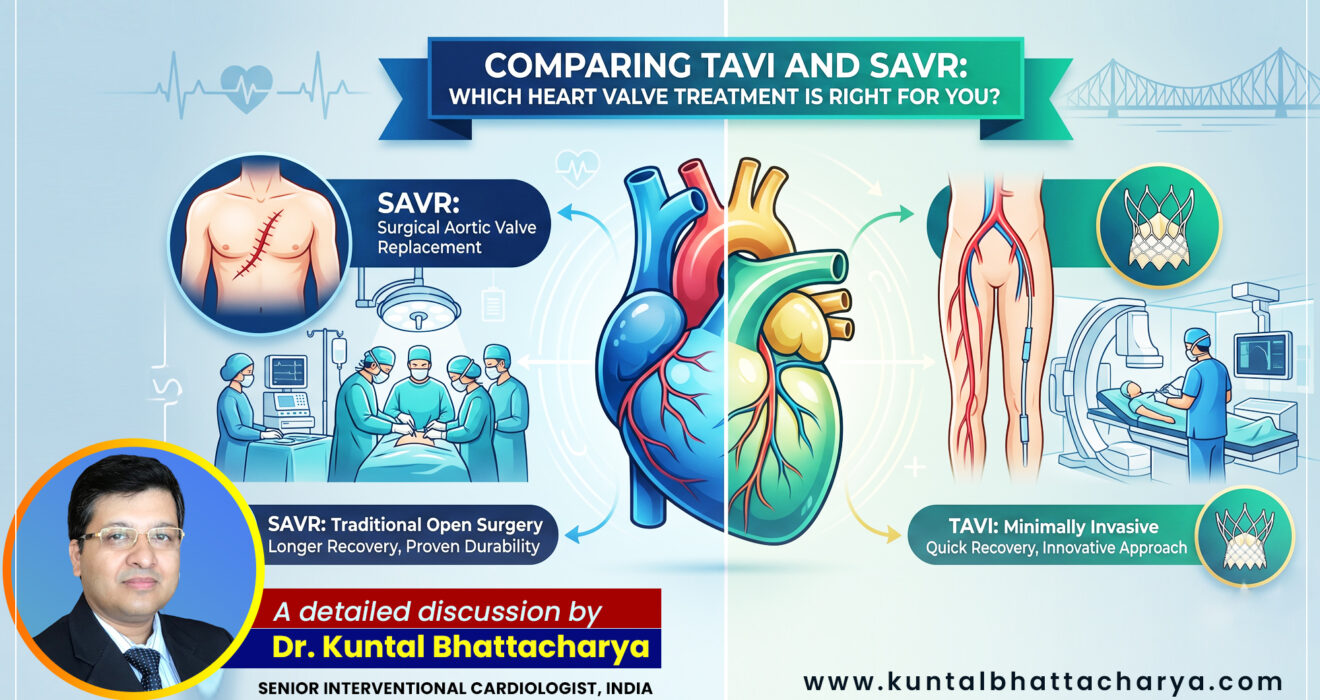
Comparing TAVI and SAVR: Which Heart Valve Treatment is Right for You?
Table of Contents
ToggleAn ultimate guide on ‘Comparing TAVI and SAVR: Which Heart Valve Treatment is Right for You?’ – by Dr. Kuntal Bhattacharya, Senior Interventional Cardiologist, Narayana Health – RN Tagore Hospital, Kolkata
Welcome to this comprehensive guide on advanced heart valve treatments. When you or a loved one is diagnosed with a severe heart valve condition, specifically aortic stenosis, it is entirely natural to feel overwhelmed and anxious. The heart is the engine of the human body, and any malfunction in its components can be a daunting prospect. As an experienced Adult Heart Doctor in Kolkata, I have witnessed firsthand the anxiety that patients and their families experience when told they need a heart valve replacement.
Historically, the only solution to a failing aortic valve was open-heart surgery. Today, medical science has advanced dramatically, offering minimally invasive alternatives that have revolutionized cardiac care. In this detailed article, we will compare the two primary methods for treating severe aortic stenosis: Transcatheter Aortic Valve Implantation (TAVI) and Surgical Aortic Valve Replacement (SAVR).
My goal is to demystify these procedures, explain the benefits and risks of each, and help you understand which treatment path might be the most appropriate for your unique clinical profile. Whether you are seeking general Treatment for Heart Disease in Kolkata or looking for highly specialized structural valve interventions, knowledge is your most powerful tool in the journey toward recovery.
Understanding the Aortic Valve and Aortic Stenosis
Before diving into the surgical and procedural details, it is crucial to understand the mechanics of your heart. The human heart has four valves that act as one-way doors to ensure blood flows in the correct direction. The aortic valve is the final gatekeeper, situated between the heart’s main pumping chamber (the left ventricle) and the aorta, the body’s main artery that supplies oxygen-rich blood to the rest of your system.
What happens during Aortic Stenosis?
Aortic stenosis occurs when the leaflets of the aortic valve become stiff, thick, and heavily calcified. In India, this can be due to age-related wear and tear, congenital defects (such as being born with a bicuspid aortic valve instead of a normal tricuspid one), or the lingering effects of childhood rheumatic fever. When the valve becomes narrowed (stenosed), it cannot open fully. Your heart muscle must then work much harder to pump blood through this narrowed, rigid opening, eventually leading to muscle exhaustion and heart failure.
Identifying the Symptoms
Because the heart compensates for a long time, many patients remain asymptomatic for years. However, as the narrowing becomes critical, undeniable symptoms emerge. These may include:
- Unexplained shortness of breath, especially during physical exertion or climbing stairs.
- Chest pain, tightness, or pressure (angina) that mimics a heart attack.
- Feeling dizzy, lightheaded, or even fainting (syncope) upon standing or walking.
- Extreme fatigue and exhaustion after minimal physical activity.
- Palpitations or a sensation of a rapid, irregular heartbeat.
When these symptoms appear, the condition is considered life-threatening, and immediate intervention is required. This is the precise moment when consulting a skilled Doctor in Heart Disease in Kolkata becomes an absolute necessity to prevent irreversible heart muscle damage or sudden cardiac events.
Diagnosing Heart Valve Issues Effectively
Accurate and prompt diagnosis is the cornerstone of effective cardiac treatment. When you visit our cardiology department at Narayana Hospital RN Tagore Hospital, we employ a battery of advanced diagnostic tests to evaluate the true severity of your condition before planning any intervention.
Essential Diagnostic Tools
- Echocardiogram (ECHO): This ultrasound of the heart is the primary, non-invasive test to confirm aortic stenosis. It allows us to see the valve in motion, measure the thickness of the valve leaflets, and calculate the pressure gradient of blood flowing through it.
- Electrocardiogram (ECG): An ECG measures the electrical activity of the heart and helps detect if the heart muscle has thickened (hypertrophy) due to the extra workload of pushing against a narrowed valve.
- Cardiac CT Scan: A specialized, high-resolution computed tomography scan provides a 3D image of the aortic valve. It measures the exact amount and distribution of calcium buildup and helps us precisely determine the required size of a replacement valve.
- Coronary Angiogram: Since many patients with valve disease also suffer from blockages in the heart arteries, an angiogram is performed to check for concurrent coronary artery disease.
Exploring Surgical Aortic Valve Replacement (SAVR)
For decades, Surgical Aortic Valve Replacement (SAVR) has been the undisputed gold standard for treating severe aortic stenosis. It is a highly effective, time-tested open-heart procedure that has saved millions of lives globally.
How is SAVR Performed?
SAVR is an open-heart surgery performed under general anesthesia. The cardiac surgeon makes an incision down the center of the chest (sternotomy) and divides the breastbone to directly access the heart. During the operation, the patient is placed on a cardiopulmonary bypass machine (a heart-lung machine), which temporarily takes over the function of breathing and pumping blood for the body.
The surgeon carefully removes the diseased, calcified aortic valve and sews a new mechanical or biological (tissue) valve in its place. Once the new valve is secured and tested for leaks, the heart is restarted, the heart-lung machine is disconnected, and the chest is meticulously closed.
The Reality of SAVR Treatment in Kolkata
The quality of SAVR Treatment in Kolkata is world-class, with premier centers like RN Tagore Hospital offering state-of-the-art surgical theaters, dedicated cardiac anesthesia teams, and specialized intensive care units tailored for smooth postoperative recovery. While it is undeniably an invasive procedure, the long-term success rates are exceptionally high.
Benefits of SAVR
- Proven Longevity: Mechanical valves placed during SAVR can last a lifetime (though they require lifelong blood-thinning medication). Tissue valves also have a well-documented, reliable lifespan of 10 to 15 years.
- Comprehensive Cardiac Fix: Open surgery allows the surgeon to address multiple cardiac issues simultaneously. For instance, if you also require bypass surgery for blocked arteries, or if you have an aneurysm in the ascending aorta, these issues can be definitively repaired during the same operation.
- Lower Risk of Paravalvular Leak: Because the surgeon physically sews the valve into place under direct vision, there is a very low risk of blood leaking around the edges of the newly implanted valve.
Risks and Recovery of SAVR
- Highly Invasive Nature: Because it is open-heart surgery, it carries inherent risks such as surgical bleeding, infection, and potential complications related to the use of the heart-lung machine.
- Longer Recovery Timeline: The typical hospital stay for SAVR is 5 to 7 days. Once discharged, it generally takes 6 to 8 weeks (or more) for the divided breastbone to heal completely and for the patient to safely return to strenuous physical activities.
The Minimally Invasive Revolution: Transcatheter Aortic Valve Implantation (TAVI)
Transcatheter Aortic Valve Implantation (TAVI), frequently referred to interchangeably as TAVR (Transcatheter Aortic Valve Replacement), is a groundbreaking, minimally invasive procedure. Initially pioneered strictly for elderly or frail patients deemed too high-risk to survive open-heart surgery, extensive clinical trials have now proven TAVI to be incredibly safe and highly effective across a much broader range of patients, including those at intermediate and even low surgical risk.
How is TAVI Performed?
As a dedicated Interventional Cardiologist in Kolkata, I routinely perform TAVI procedures in a highly specialized cardiac catheterization lab (Cath Lab). The procedure does not require opening the chest, nor does it require stopping the heart. In many cases, it can be done entirely without general anesthesia—utilizing only local anesthesia at the puncture site and mild conscious sedation.
A small puncture is made, usually in the femoral artery in the groin. A flexible, hollow tube called a catheter is carefully guided through the blood vessels, traveling up the aorta until it reaches the heart. Compressed at the tip of this catheter is a fully collapsible replacement valve—made of biological tissue, typically from a cow or pig, meticulously supported by a self-expanding or balloon-expandable metal stent frame.
Once the catheter is positioned exactly across the diseased, narrowed aortic valve, the new valve is expanded. The immense radial force of the new valve pushes the old, calcified leaflets out of the way, crushing them against the arterial wall, and the new valve immediately begins regulating blood flow. The delivery catheter is then withdrawn, and the small puncture in the groin is closed with a specialized device.
Delivering TAVI Treatment in Kolkata
The landscape of TAVI Treatment in Kolkata has evolved at a breathtaking pace. By utilizing cutting-edge imaging technology like OCT, IVUS, and advanced Hybrid Cath Labs, we can now perform this life-saving procedure with incredible, millimeter-level precision. Patients who previously had no surgical options due to advanced age, frailty, or multiple severe comorbidities now have a reliable second chance at an active, high-quality life.
Benefits of TAVI
- Minimally Invasive: No large chest incisions, no stopping the heart, and no reliance on a heart-lung machine.
- Rapid Recovery: Most TAVI patients are sitting up and walking within 24 hours and can be safely discharged home within 1 to 3 days. Return to normal daily activities usually takes just one to two weeks, rather than a matter of months.
- Less Physical Trauma: The physiological toll on the body is vastly reduced, making it ideal for fragile, elderly patients.
- Reduced Surgical Complications: TAVI significantly lowers the risk of major surgical bleeding, severe kidney injury, and prolonged intensive care stays compared to traditional open surgery.
Risks of TAVI
- Pacemaker Requirement: The expansion of the new metal-framed valve can sometimes put pressure on the heart’s delicate electrical conduction system, occasionally necessitating the implantation of a permanent pacemaker to regulate the heart rate.
- Vascular Complications: Because a relatively large catheter is navigated through the leg arteries, there is a small risk of injuring the blood vessel along the access route.
- Paravalvular Leak: Sometimes the new valve doesn’t seal perfectly against the heavily calcified, irregular shape of the old valve, leading to minor leaks. However, newer generation TAVI valves feature specialized sealing skirts that have drastically reduced this issue in recent years.
SAVR vs. TAVI: A Detailed Head-to-Head Comparison
Choosing between TAVI and SAVR is not a simple “one size fits all” decision. It requires an in-depth, personalized discussion with the best doctor for Heart Disease Treatment in Kolkata. To help you understand how cardiologists and cardiac surgeons evaluate these options, here is a breakdown of key procedural differences:
| Feature | Surgical Aortic Valve Replacement (SAVR) | Transcatheter Aortic Valve Implantation (TAVI) |
| Invasiveness | Open-heart surgery (dividing the sternum) | Minimally invasive (catheter through the groin) |
| Anesthesia | General anesthesia mandatory | Often done with local anesthesia and conscious sedation |
| Heart-Lung Machine | Yes, required to bypass the heart | No, the heart continues beating |
| Hospital Stay | Typically 5 to 7 days | Typically 1 to 3 days |
| Full Recovery Time | 6 to 8 weeks (requires extensive bone healing) | 1 to 2 weeks (groin puncture healing only) |
| Ideal Candidates | Younger patients, those needing complex multiple heart surgeries simultaneously, or patients with severe anatomical irregularities | Elderly patients (>70), those with high surgical risk, previous open-heart surgeries, or heavy chest radiation |
| Valve Options | Mechanical (lasts a lifetime) or Biological (10-15 years) | Biological only (current data shows excellent durability, with ongoing studies tracking beyond 10 years) |
Managing Co-existing Conditions: Coronary Artery Disease
It is extremely common for patients presenting with severe aortic stenosis to also suffer from significant blockages in their coronary arteries. In such complex cases, treating the valve alone is not enough; the blood supply to the heart muscle itself must also be restored.
As a specialist providing advanced Coronary Artery Disease treatments in Kolkata, I routinely assess valve patients for co-existing blockages. If a younger patient is undergoing SAVR, the cardiac surgeon will typically perform a Coronary Artery Bypass Graft (CABG) during the same open-heart operation. However, if a patient is selected for the less invasive TAVI route, we typically perform a percutaneous coronary intervention (angioplasty and stenting) to clear the blockages safely before, or occasionally during, the TAVI procedure.
Using advanced techniques like Intravascular Lithotripsy (IVL) to crack hardened calcium, Rotablation, and high-definition intravascular imaging (OCT/IVUS), we ensure that even the most severely calcified coronary arteries are treated safely and effectively, preparing the heart perfectly for the upcoming valve replacement.
A Special Note on Women’s Heart Health
Cardiovascular disease is frequently, and mistakenly, thought of primarily as a “man’s disease.” However, heart disease remains a leading cause of mortality among women. The presentation of aortic stenosis and coronary artery disease can be vastly different in women compared to men. Women often present with atypical, subtle symptoms such as profound, unexplained fatigue, persistent nausea, back pain, or indigestion, rather than the classic, sudden “crushing” chest pain often seen in men.
Because their symptoms can be far less obvious, women are frequently diagnosed at a later, more dangerous stage of the disease. Furthermore, women generally have smaller blood vessels and different anatomical structures, which can make interventional and surgical procedures technically more challenging.
If you are a woman experiencing unexplained breathlessness, weakness, or fatigue, it is imperative to seek out the best doctor for Women Heart Disease Treatment in Kolkata. Specialized care involves understanding these nuanced, easily missed symptoms, meticulously choosing appropriately sized valves for smaller heart anatomies, and utilizing delicate, precise interventional techniques to minimize vascular complications and maximize recovery outcomes.
Navigating Your Treatment Journey: What to Do and Where to Go
When you or a family member requires specialized cardiac intervention, the healthcare maze can feel overwhelming and confusing. Here is a step-by-step, actionable guide on what you should do when looking for top-tier Treatment for Heart Disease in Kolkata:
1. Recognize the Urgent Need for a Specialist
If your primary care physician detects a prominent heart murmur through a stethoscope, or if a routine echocardiogram shows narrowing of your valve, you must consult an expert immediately. You will need an Interventional Cardiologist in Kolkata to evaluate if modern, minimally invasive treatments are possible, working alongside a cardiac surgeon for a comprehensive evaluation. This collaborative, multi-expert approach is known worldwide as the “Heart Team” concept.
2. Choose the Right Healthcare Facility
Complex, life-saving procedures like TAVI and SAVR should absolutely only be performed in established centers of excellence. Narayana Hospital, RN Tagore Hospital (Mukundapur, Kolkata) stands out as a premier destination for advanced cardiac sciences in Eastern India. The facility boasts:
- State-of-the-art Hybrid Cath Labs specifically designed for complex structural heart interventions.
- Advanced imaging modalities for flawless pre-procedure planning and precise valve sizing.
- A dedicated multidisciplinary Heart Team comprising interventional cardiologists, cardiac surgeons, cardiac anesthetists, and highly specialized nursing staff working in perfect unison.
- Dedicated, technology-rich post-procedure cardiac intensive care units (ICU).
3. Prepare Thoroughly for Your Consultation
When visiting an Adult Heart Doctor in Kolkata, come prepared to maximize your time. Bring all previous medical records, especially physical copies of ECGs, Echocardiogram reports, Angiogram CDs, and any recent blood test reports. Prepare a comprehensive, written list of all current medications. Be entirely transparent about your symptoms, your lifestyle limitations, and your personal goals for recovery. Our goal is not just to mechanically fix the valve, but to fully restore your overall quality of life.
4. Embrace the Shared Decision-Making Process
The choice between TAVI and SAVR is a prime example of modern, shared medical decision-making. We will sit down with you and your family to discuss your anatomical suitability (based strictly on the CT scan results), your age, your general frailty, kidney and lung function, and your personal treatment preferences. We carefully weigh the long-term, proven durability of surgical valves against the rapid, gentle recovery of TAVI to tailor a treatment plan specifically for you.
Looking to the Future of Valve Therapy
The field of interventional cardiology is evolving at an unprecedented pace. We are currently seeing the exciting introduction of next-generation TAVI valves that feature thinner struts, advanced sealing skirts to virtually eliminate leaks, and smarter designs that make future access to the coronary arteries much easier.
Furthermore, we are now successfully performing life-saving “Valve-in-Valve” TAVI procedures. If a patient underwent an open-heart tissue valve surgery (SAVR) 10 or 15 years ago, and that aging tissue valve is now failing or deteriorating, we can frequently deploy a brand new TAVI valve inside the old surgical valve. This breakthrough completely spares the elderly patient from having to endure a highly risky second open-heart surgery.
Frequently Asked Questions (FAQs) – TAVI and SAVR
To help provide immediate, clear answers to common concerns, here are detailed responses to questions frequently searched by patients online when navigating cardiac care:
1. Where can I find the best Doctor in Heart Disease in Kolkata?
Finding the right specialist requires looking at their academic qualifications, volume of experience in complex procedures, and their hospital affiliations. Dr. Kuntal Bhattacharya brings over 25 years of experience, has independently performed over 12,000 Cath Lab procedures, and is a Senior Consultant at NH RN Tagore Hospital. Always seek a doctor who practices strict evidence-based medicine and operates within a highly equipped tertiary care hospital.
2. What is the overall success rate of TAVI Treatment in Kolkata?
With the advent of advanced pre-procedural imaging and modern, next-generation valves, the success rate of TAVI is exceptionally high, typically over 95%. Major complication rates have drastically reduced over the last decade, making it an incredibly safe and reliable alternative to open-heart surgery for appropriately indicated patients.
3. Who is considered the best doctor for Women Heart Disease Treatment in Kolkata?
The ideal doctor for female patients is one who deeply understands the unique physiological differences, the often atypical symptom presentations, and the specific anatomical challenges (such as smaller blood vessels) that women face. Dr. Kuntal Bhattacharya emphasizes a highly personalized, empathetic approach, ensuring women receive timely, accurate diagnoses and appropriately tailored interventions.
4. Are Coronary Artery Disease treatments in Kolkata done alongside valve treatments?
Yes, absolutely. If a patient has both blocked coronary arteries and a stenosed aortic valve, both critical issues need to be addressed to ensure survival and recovery. Depending on the patient’s overall health and the chosen valve treatment (TAVI or SAVR), the coronary blockages can be treated with advanced angioplasty and stenting prior to a TAVI procedure, or via bypass grafting simultaneously during a SAVR open-heart operation.
5. When do I specifically need an Interventional Cardiologist in Kolkata?
You need an Interventional Cardiologist when advanced, non-surgical, catheter-based treatments are required. This includes life-saving procedures like primary Angioplasty for acute heart attacks, treating complex chronic blockages, performing TAVI/TAVR for valve replacement, implanting pacemakers (including modern leadless pacemakers), and treating structural heart defects all without requiring open surgery.
6. Is Treatment for Heart Disease in Kolkata at par with international standards?
Undoubtedly, yes. Top hospitals like RN Tagore Hospital in Kolkata are fully equipped with the latest global technologies—including Intravascular Lithotripsy (IVL), Optical Coherence Tomography (OCT) for precision imaging, and the very latest generation of TAVI valves. The clinical expertise and procedural outcomes perfectly match the best global standards, providing world-class cardiac care right here in Eastern India.
7. How long will a biological tissue valve last compared to a mechanical valve?
A mechanical valve (utilized only in SAVR) is designed from durable materials to last a lifetime, but it strictly requires the patient to take strong blood thinners (anticoagulants) every single day forever to prevent fatal blood clots. A biological tissue valve (used universally in TAVI and as an option in SAVR) typically lasts 10 to 15 years and does not strictly require lifelong, heavy blood thinners. The choice between the two depends heavily on the patient’s age, bleeding risk, and lifestyle preferences.
8. Can I live a normal, active life after SAVR or TAVI?
Absolutely. The primary, overriding goal of both procedures is to completely eliminate debilitating symptoms like breathlessness, chest pain, and fainting, and to prevent the onset of fatal heart failure. After completing the respective recovery periods and participating in a guided cardiac rehabilitation program, the vast majority of patients return to a highly active, fulfilling life—including traveling, engaging in light sports, and enjoying regular daily activities without physical limitations.
Conclusion: Making the Right Choice for Your Heart
A diagnosis of severe aortic stenosis is undoubtedly a critical juncture in your health journey, but thanks to modern medical science, it is no longer a condition without hope or options. Whether the time-tested durability of Surgical Aortic Valve Replacement (SAVR) is best for your specific anatomy, or the minimally invasive brilliance and rapid recovery of a TAVI Treatment in Kolkata is optimally suited to your profile, the single most important step you can take is seeking timely, expert medical advice.
As an Interventional Cardiologist in Kolkata, my unwavering commitment is to ensure that every single patient receives compassionate, cutting-edge, and highly personalized care. Do not ignore or dismiss the warning symptoms of breathlessness, chest tightness, or unexplained fatigue. Early diagnosis opens the door to safer, less invasive, and much more effective treatments.
If you or a beloved family member are navigating these difficult and confusing choices, take control of your heart health today. Consult a specialist, ask difficult questions, and trust in the incredible advancements of modern cardiology to guide you safely back to a vibrant, healthy, and active life.
To book a consultation or for more clinical information:
You can reach out directly to the cardiology department at Narayana Hospital, RN Tagore Hospital (Mukundapur, Kolkata) to schedule a thorough, professional clinical evaluation. Let us work together to discover the safest and best pathway for your heart’s long-term health.
Disclaimer: The information provided in this blog post is for educational and informational purposes only and is not intended to be a substitute for professional medical advice, diagnosis, or treatment. Always seek the advice of your physician or other qualified health provider with any questions you may have regarding a medical condition or dietary changes. Never disregard professional medical advice or delay in seeking it because of something you have read on this website.
Follow Dr. Kuntal Bhattacharya on Facebook & Youtube for regular updates.
Read Also:
- Women and Heart Disease: Why Symptoms Often Go Unrecognized
- How CRT-D Improves Quality of Life for Heart Failure Patients in Kolkata
- ECG vs. Echocardiogram: Which Heart Test Do You Actually Need?
- Life with an AICD: Managing Sudden Cardiac Death Risk Effectively
- What is a Calcified Lesion? Advanced Solutions for Hardened Arteries
- Heart-Healthy Diet: Incorporating Bengali Flavors Without the Oil
- Understanding Your Echocardiogram Results: A Simple Guide for Patients
- How 3D Imaging Enhances Precision in TAVI Procedures in Kolkata
- Identifying Asymptomatic Heart Disease in Young Adults in 2026: The Silent Killer
- The Role of FFR in Deciding the Right Treatment for Heart Blockages
- Leadless Pacemakers vs. Traditional Pacemakers: Pros and Cons for 2026
- Managing Complex Coronary Artery Disease in 2026: A Cardiologist’s Guide
- How IVUS and OCT Technology Revolutionized Angioplasty Success in Kolkata
- Choosing the Right Coronary Angioplasty Doctor in Kolkata 2026: A Patient’s Guide
- Life After TAVI/TAVR Treatment: Patient Advice from a Cardiologist in Kolkata
- Why Choose TAVI/TAVR Over Open Heart Surgery in 2025?