
Identifying Asymptomatic Heart Disease in Young Adults in 2026: The Silent Killer
Table of Contents
Toggle‘Identifying Asymptomatic Heart Disease in Young Adults in 2026: The Silent Killer’ – a detailed guide by Dr. Kuntal Bhattacharya Senior Interventional Cardiologist, Narayana Health – RN Tagore Hospital, Kolkata
As we navigate through 2026, the medical community in Kolkata is facing a startling reality. The waiting rooms of our cardiac units, which were once filled primarily by the elderly, are now increasingly occupied by men and women in their 20s, 30s, and 40s. Many of these patients appear perfectly healthy—they are fitness enthusiasts, busy professionals, and young parents. Yet, beneath the surface, a “Silent Killer” is often at work.
In my years as an Interventional Cardiologist in Kolkata, nothing is more heart-wrenching than seeing a young person suffer a massive heart attack simply because they didn’t know they were at risk. This guide is dedicated to the youth of West Bengal and beyond, aiming to shed light on asymptomatic heart disease and how we can identify it before it strikes.
What is Asymptomatic Heart Disease?
The term “asymptomatic” means showing no symptoms. In the context of heart health, it refers to the silent progression of plaque buildup or structural issues within the heart that do not cause chest pain, breathlessness, or fatigue—until the condition reaches a critical tipping point.
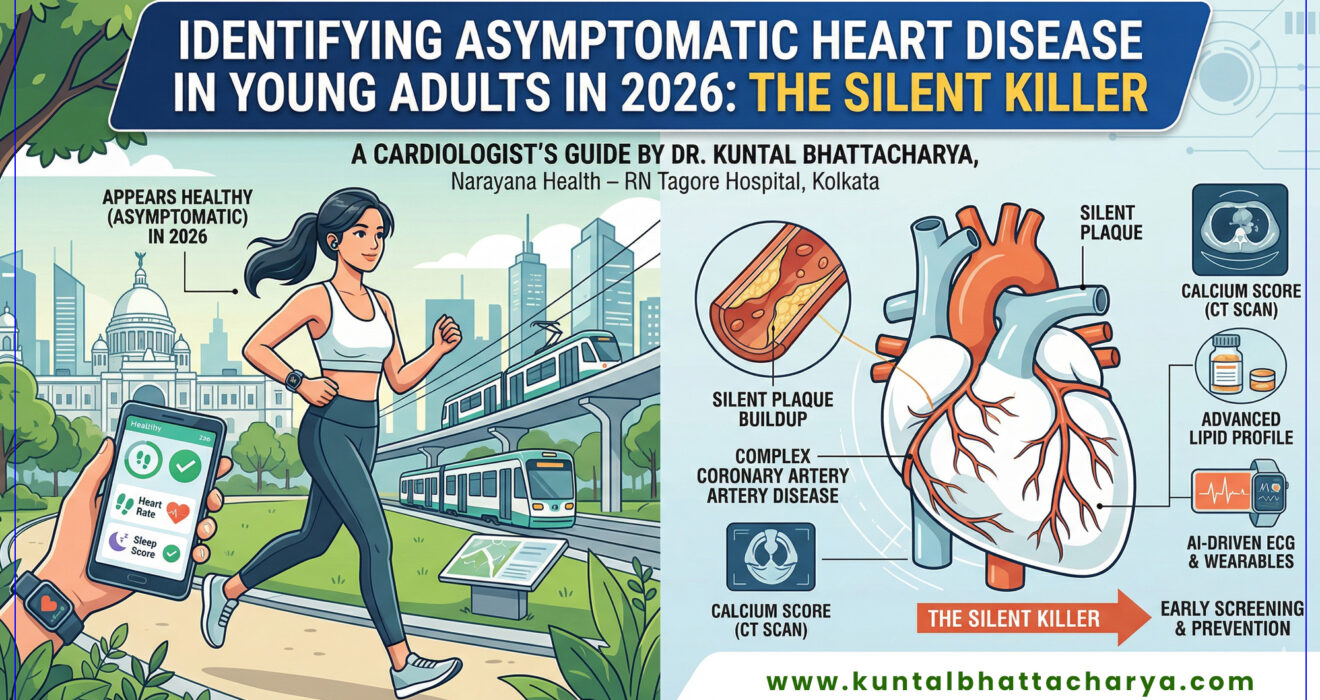
In 2026, we are seeing a rise in Complex Coronary Artery Disease among the youth. This isn’t just a single blockage; it is often a diffused, aggressive form of the disease that affects multiple vessels simultaneously. Because young bodies are resilient, the heart often “compensates” for these blockages, masking the warning signs until the artery is nearly 100% closed.
Why is 2026 Different? Understanding the Modern Causes
When we discuss Coronary Artery Disease causes in today’s world, we have to look at the unique environment of 2026. The traditional risk factors like smoking and high cholesterol are still there, but new triggers have emerged:
- The “Work-from-Anywhere” Strain: While flexibility is great, the boundary between work and life has vanished. Chronic, high-level cortisol (the stress hormone) is a direct contributor to arterial inflammation.
- The Post-Pandemic Legacy: Research continues to show that viral inflammations from previous years have left some young adults with “vulnerable plaque”—small deposits in the arteries that are prone to rupturing suddenly.
- Ultra-Processed Food Culture: Even with the rise of health cafes in Kolkata, the hidden sugars and trans fats in “quick-fix” meals are accelerating the aging of our blood vessels.
- Vaping and New-Age Tobacco: Many young adults switched from cigarettes to vapes, thinking they were safer. In reality, these devices cause significant damage to the lining of the coronary arteries.
- Air Quality: Living in a dense urban environment like Kolkata means our hearts are constantly battling the inflammatory effects of particulate matter.
Identifying the Silent Signs: Screening in 2026
If the disease is asymptomatic, how do we find it? As a leading Adult Heart Doctor in Kolkata, I recommend a proactive screening approach rather than waiting for symptoms.
1. The Calcium Score (CT Scan)
This is a non-invasive test that measures the amount of calcified plaque in your heart. In 2026, this has become a standard tool for young adults with a family history of heart disease. A high score in a 35-year-old is a major red flag for Complex Coronary Artery Disease.
2. Advanced Lipid Profiles
Standard cholesterol tests often miss the “small, dense LDL” particles that are most dangerous. In 2026, we look at markers like Apolipoprotein B (ApoB) and Lipoprotein(a), which provide a much clearer picture of your actual risk.
3. AI-Driven ECGs and Wearables
Many young Kolkatans wear smartwatches. While not a replacement for a hospital-grade ECG, these devices can now detect subtle rhythm changes or “Silent Ischemia” (lack of oxygen to the heart during sleep or exercise) that warrant a visit to a specialist.
The Reality of Complex Coronary Artery Disease in the Young
In younger patients, we often see “Soft Plaque.” Unlike the hard, calcified plaque found in the elderly, soft plaque is unstable. It can rupture like a small “pimple” inside the artery, causing a sudden blood clot. This is why many young people have a heart attack even though their arteries were only 30% or 40% blocked.
When this happens, it requires the expertise of an Interventional Cardiologist in Kolkata who is experienced in high-risk procedures. At RN Tagore Hospital, we use precision stenting to stabilize these vessels.
Advanced Treatments available in Kolkata:
- IVUS and OCT Imaging: We use tiny cameras inside the artery to see the plaque’s “vulnerability.”
- Drug-Eluting Stents: The latest 2026-gen stents are thinner and safer, reducing the risk of long-term complications.
- Bio-resorbable Scaffolds: In specific cases for young patients, we use “disappearing stents” that support the artery and then dissolve after a few years.
Where to Go: Seeking an Adult Heart Doctor in Kolkata
If you are a young adult and you have a family history of heart disease, or if you simply haven’t had your heart checked in years, it is time to act. Kolkata is home to some of the finest cardiac facilities in Asia.
Top Destinations for Heart Care:
- Narayana Health – RN Tagore Hospital (Mukundapur): This is where I lead a team dedicated to complex interventional cases. We specialize in treating young adults with aggressive heart disease.
- BM Birla Heart Research Centre: A pioneer in cardiac surgery and intervention.
- Apollo Multispecialty Hospitals: Known for its comprehensive health check-up packages tailored for young professionals.
- Medica Superspecialty Hospital: Equipped with state-of-the-art cath labs for emergency care.
When looking for Coronary Artery Disease treatments in Kolkata, ensure the hospital has a dedicated “Chest Pain Unit” and access to 24/7 primary angioplasty.
Asymptomatic Heart Disease in Young Adults (2026) FAQ
Why is "Silent" Heart Disease rising in young adults in 2026?
In 2026, we are seeing a sharp rise in Asymptomatic Heart Disease due to a combination of sedentary "screen-heavy" lifestyles, chronic mental stress, and the long-term vascular impact of post-pandemic health changes. Many young adults harbor subclinical atherosclerosis (early plaque buildup) or CKM (Cardiovascular-Kidney-Metabolic) syndrome without feeling any pain or breathlessness until a major event occurs.
What are the updated 2026 screening guidelines for young adults?
The 2026 AHA/ACC guidelines now recommend that cholesterol and lipid screenings begin at age 19. For those with a family history of heart disease or South Asian ancestry (a known "risk enhancer"), baseline screenings including blood pressure, HbA1c, and Lipoprotein(a) are advised by age 25 to detect hidden risks early.
Can I have heart disease if I am physically fit and go to the gym?
Yes. Physical fitness does not always equal vascular health. High-intensity exercise can sometimes trigger underlying, undiagnosed conditions such as Hypertrophic Cardiomyopathy (HCM) or electrical signaling issues like Long QT Syndrome. Furthermore, the use of unregulated pre-workout stimulants or anabolic supplements can place extreme stress on an otherwise "fit" heart.
What "subtle" signs should a young person never ignore?
Even asymptomatic disease often has whispers. You should seek a cardiac evaluation if you experience:
- Unexplained fainting or near-fainting (Syncope) during exertion.
- Extreme fatigue that isn't resolved by rest.
- Chest discomfort often mistaken for "acid reflux" or "gastric issues."
- A racing or fluttering heart (palpitations) at rest.
How does the 2026 PREVENT™ tool help young adults?
Unlike older models that only looked at 10-year risk, the AHA PREVENT™-ASCVD tool used in 2026 calculates 30-year lifetime risk. This is crucial for young adults, as it reveals how "borderline" numbers today can lead to significant heart damage by middle age, allowing for early intervention via the "Life’s Essential 8" protocol.
Does South Asian heritage increase the risk of silent heart disease?
Statistically, yes. South Asians often develop heart disease 5 to 10 years earlier than other populations. Genetic factors, combined with a higher biological tendency for "thin-fat" (visceral) adiposity and insulin resistance, mean that young Indians should be more aggressive with preventive screenings compared to global averages.
What Should You Do Now? A Step-by-Step Guide
If you are concerned about being a victim of the “Silent Killer,” here is what you should do:
- Don’t Ignore “Minor” Signs: That slight “indigestion” or “jaw pain” you get when you’re stressed might not be acidity. Get it checked.
- Know Your Numbers: By age 25, every adult in Kolkata should know their Blood Pressure, Blood Sugar, and LDL Cholesterol levels.
- Find a Trusted Specialist: Search for a qualified Adult Heart Doctor in Kolkata who understands the nuances of heart disease in the young.
- Ask About “Plaque Stability”: If you have a known blockage, ask your doctor if it is stable or vulnerable. This is where advanced imaging (IVUS/OCT) comes into play.
- The “Golden Hour”: If you or anyone around you experiences sudden, crushing chest pain, sweating, or pain radiating to the left arm, don’t wait. Go to the nearest cardiac emergency room immediately.
Living Heart-Healthy in Kolkata: 2026 Edition
Treating Complex Coronary Artery Disease is possible, but preventing it is better. Here is how we can protect our youth:
- Mindful Eating: Kolkata’s street food is legendary, but let it be a rare treat. Focus on high-fiber grains, lean proteins, and plenty of greens.
- The 150-Minute Rule: Aim for at least 150 minutes of moderate-intensity exercise per week. Even a brisk walk at Eco Park or along the Hooghly can make a difference.
- Digital Detox: High screen time is linked to high blood pressure. Give your heart a break from the blue light.
- Sleep Hygiene: 7-8 hours of quality sleep is when your heart and blood vessels repair themselves.
Final Thoughts from Dr. Kuntal Bhattacharya
As an Interventional Cardiologist in Kolkata, my mission is to move from “treatment” to “prevention.” In 2026, we have the most advanced Coronary Artery Disease treatments in Kolkata ever known to man. We have the “diamond drills” to break calcium and the “sonic waves” to open arteries. But the greatest tool we have is awareness.
Do not let heart disease be a “Silent Killer” in your life. Take charge of your health today. Whether you visit us at Narayana RN Tagore Hospital or any other reputed center, the most important thing is that you start the conversation.
Your heart has been beating for you since before you were born. It’s time you did something for it in return.
Summary Checklist for Young Adults
- Annual Check-up: Even if you feel “fine.”
- Lipid Profile: Check your ApoB and Lp(a) levels.
- Family History: Talk to your parents and relatives about their heart health history.
- Stress Management: Identify your triggers and find a healthy way to cope.
- Emergency Contact: Know where your nearest Interventional Cardiologist in Kolkata is located.
Disclaimer: This blog post is for informational and educational purposes only and should not be considered a substitute for professional medical advice, diagnosis, or treatment. Always seek the advice of a qualified and experienced cardiologist in your area with any questions you may have regarding a medical condition.
Follow Dr. Kuntal Bhattacharya on Facebook & Youtube for regular updates.
Read Also:
- Leadless Pacemakers vs. Traditional Pacemakers: Pros and Cons for 2026
- Managing Complex Coronary Artery Disease in 2026: A Cardiologist’s Guide
- How IVUS and OCT Technology Revolutionized Angioplasty Success in Kolkata
- Choosing the Right Coronary Angioplasty Doctor in Kolkata 2026: A Patient’s Guide
- Life After TAVI/TAVR Treatment: Patient Advice from a Cardiologist in Kolkata
- Why Choose TAVI/TAVR Over Open Heart Surgery in 2025?
- TAVI and TAVR Procedures in Kolkata in 2025
- Understanding TAVI / TAVR: The Future of Heart Valve Treatment
- Early Signs of Heart Valve Problems and When to Seek a TAVI Doctor
- Angioplasty vs. Bypass Surgery in 2025: What Should You Choose?
- Modern Technology in Cardiac Devices in 2025
- How to Find the Best TAVI and TAVR Doctor in Kolkata in 2025?
Stay Healthy. Stay Informed.
Stay vigilant. Stay healthy. Let’s make Kolkata a heart-healthy city for the generations to come.