
Why Choose TAVI/TAVR Over Open Heart Surgery in 2025?
Introduction:
A Comprehensive Guide in 2025 on “Why Choose TAVI/TAVR Over Open Heart Surgery in 2025?” by Dr. Kuntal Bhattacharya, Sr. Consultant Interventional Cardiologist, Kolkata
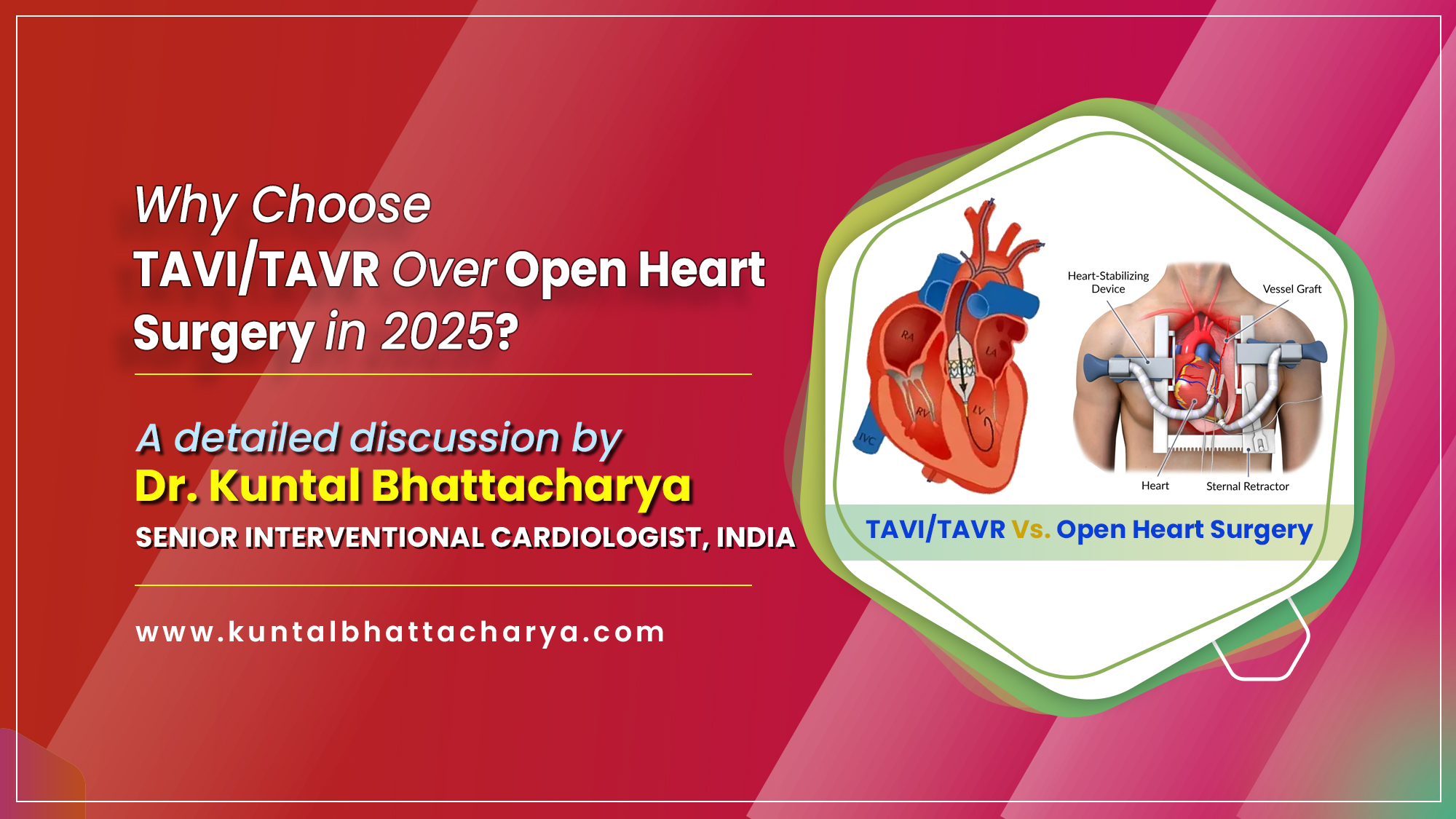
A Transcatheter Aortic Valve Implantation (TAVI), also known as Transcatheter Aortic Valve Replacement (TAVR), is a minimally invasive procedure to replace a narrowed aortic valve that fails to open properly (a condition called Aortic Stenosis). Instead of open-heart surgery, which involves a large chest incision, a new valve is implanted using a catheter inserted through a small opening, usually in the groin. This revolutionary approach offers patients a new lease on life with significantly reduced recovery time and surgical stress.
Read Also: How TAVI/TAVR Doctors in Kolkata treat Aortic Valve Disease?
Why TAVI/TAVR is the Future of Aortic Valve Replacement
A Vital Guide for My Cardiac Patients in Kolkata and Across India
As an Interventional Cardiologist specializing in Structural Heart Disease, I’ve had the privilege of witnessing and participating in one of the greatest revolutions in modern cardiac care: the widespread adoption of Transcatheter Aortic Valve Implantation (TAVI), also known as Transcatheter Aortic Valve Replacement (TAVR).
For many years, patients diagnosed with severe Aortic Stenosis—a dangerous narrowing of the aortic valve that chokes off blood flow from the heart—faced only one definitive solution: open-heart surgery, or Surgical Aortic Valve Replacement (SAVR). While SAVR is a robust procedure, it imposes significant physical strain, particularly on our elderly and high-risk patients who often have multiple complex health issues.
Today, I want to talk to you directly about why TAVI/TAVR is not merely an alternative, but the preferred, state-of-the-art solution for a growing number of patients here in Kolkata and across the subcontinent. This minimally invasive technique offers my patients a genuine second chance at a vigorous life, minimizing the burden of a major operation.
TAVI/TAVR: The Gentle Approach to a Critical Heart Condition
The philosophy behind TAVI is simple: achieve the best possible clinical outcome with the least possible trauma to the patient’s body. The procedure involves guiding a new, durable replacement valve (made of biological tissue) into the heart via a thin tube, or catheter, inserted through a small puncture, typically in the groin.
This revolutionary technique bypasses the need for the traditional, large-scale surgical approach, and the benefits are truly life-changing.
1. Eliminating the Trauma of Open-Heart Surgery
The biggest psychological and physical hurdle for my patients undergoing SAVR is the sternotomy—the cutting of the breastbone. TAVI completely eliminates this trauma.
- No Chest Incision: Avoiding the splitting and wiring of the breastbone means no lengthy, painful recovery period associated with a major wound. You can breathe, move, and sleep without the discomfort of a healing sternum.
- Reduced Systemic Stress: By not requiring the heart to be stopped and the blood to be diverted through a heart-lung machine (cardiopulmonary bypass), TAVI is considerably less taxing on the body’s other critical organs, such as the lungs and kidneys. This is a crucial factor for our frailest patients.
2. A Recovery Timeline That Defies Expectations
As an Interventional Cardiologist, the speed and quality of my patients’ recovery with TAVI consistently impress me. This procedure dramatically compresses the convalescence period compared to traditional surgery.
| Recovery Aspect | TAVI/TAVR Procedure | Open-Heart Surgery (SAVR) |
| Hospital Stay | Usually 2 to 5 days. We prioritize getting you home swiftly and safely. | Typically 7 to 10 days, often requiring subsequent rehabilitation. |
| Back to Normal Life | Within 1 to 2 weeks for most daily activities. | Requires 6 to 12 weeks of restricted activity (no lifting, driving). |
| Full Energy Levels | Regained rapidly, often within a month. | Can take 2 to 3 months or more. |
My goal is to have you back walking the paths of the Victoria Memorial or enjoying the adda with your family in days, not months.
3. Safety and Effectiveness Across the Spectrum
TAVI was initially developed as a compassionate option for patients considered “inoperable” or extremely high-risk for open surgery. Today, based on landmark clinical trials, it is recognized as a treatment with equivalent or superior outcomes compared to SAVR for patients across all surgical risk levels:
- High and Intermediate Risk: TAVI is the established standard of care, significantly reducing mortality and improving quality of life compared to medical management or SAVR.
- Low Risk: Even for younger, healthier individuals, the faster recovery and reduced trauma of TAVI make it a compelling choice, offering excellent long-term valve durability.
Your Personal Path: What I Need You to Know Before TAVI
As your consulting cardiologist, my priority is ensuring you are fully informed and prepared. The TAVI decision is a shared one, guided by the collective wisdom of our specialized Heart Team.
Key Insights from Your Cardiologist
- Preparation is Paramount (The TAVI-CT): Before we plan a single step, you must undergo a comprehensive, specialized CT scan—the TAVI-CT. This is my roadmap. It allows me to meticulously measure your valve, map the tortuosity of your arteries, and plan the exact size and trajectory of the new valve, ensuring precision and safety.
- It’s a Team Sport: While I, as the Interventional Cardiologist, lead the hands-on procedure, TAVI success relies on a multidisciplinary team: the Cardiac Surgeon, who provides critical backup and insight; the Cardiac Anaesthesiologist; and specialized nursing staff. You benefit from decades of combined expertise.
- Understanding Valve Longevity: The latest generation of TAVI valves are designed for durability, with clinical data supporting a lifespan comparable to surgically implanted biological valves, often 10-15 years or more. Crucially, the non-surgical nature of TAVI means that if the valve eventually wears out, a Valve-in-Valve TAVI can often be performed to replace it without needing open surgery again.
- The Lifelong Commitment: After TAVI, your heart function will improve almost immediately, but the work isn’t finished. You must commit to regular follow-up appointments and echocardiograms to monitor the new valve, alongside adherence to your prescribed medications (which may include short-term or long-term anti-platelet agents or blood thinners).
Addressing Your Concerns: Straight Answers on TAVI/TAVR
I understand that any heart procedure brings worry. Let me address the most frequent questions I receive from my patients and their families.
1. Is the TAVI procedure painful?
The simple answer is no. The procedure is performed in a high-tech catheterization laboratory (Cath Lab) under the care of our specialized anaesthesia team. Depending on your overall health, we use either conscious sedation (you are relaxed and comfortable, but able to follow simple commands) or general anesthesia (you are completely asleep). You will not feel the catheter advancing or the valve being implanted.
Post-procedure discomfort is minimal—usually just mild tenderness or bruising at the groin puncture site, which is easily managed with oral pain relief. The contrast with the severe, persistent pain of a chest incision is staggering.
2. Should I be worried about undergoing the procedure?
It is natural to be anxious. However, I want to reassure you: the greatest risk is often delaying the treatment of severe Aortic Stenosis. When left untreated, this condition leads to progressive heart failure and a severely limited life expectancy.
We perform this procedure meticulously. Every TAVI case is meticulously planned, reviewed by the entire Heart Team, and executed using the most advanced imaging technology. My focus is entirely on precision, safety, and a successful long-term outcome for you.
3. What are the specific risks I need to be aware of?
While TAVI is generally safer than SAVR for most patients, it is not risk-free. The two main risks we diligently monitor and manage are:
- Stroke: The risk of stroke during TAVI is small, and comparable to SAVR in many groups. We employ specialized techniques, and sometimes filter devices, to minimize this risk.
- Pacemaker Requirement: Because the new valve is placed very close to the heart’s natural electrical wiring, about 5% to 15% of TAVI patients may require a permanent pacemaker a few days after the procedure. This is a common and usually straightforward fix for a life-threatening valve problem.
We will discuss these risks in detail, tailored specifically to your unique anatomy, during your consultation.
TAVI/TAVR in Kolkata: My Commitment to Advanced Care
I am proud that Kolkata has emerged as a premier center for advanced cardiac procedures. The technology, expertise, and infrastructure required for a successful TAVI are now firmly established here, meaning you do not need to travel far for world-class care.
Read also: Understanding TAVI / TAVR: The Future of Heart Valve Treatment
Where You Can Find the TAVI/TAVR Procedure in Kolkata
My team and I perform these advanced procedures at some of the most technologically equipped hospitals in the city. The necessary facilities include a state-of-the-art Hybrid Operation Theatre/Cath Lab, advanced 3D imaging, and specialized post-procedure cardiac intensive care. Look for leading centers such as:
- NH Rabindranath Tagore International Institute of Cardiac Sciences (RN Tagore Hospital)
- Medica Superspecialty Hospital
- CK Birla Hospitals | BM Birla Heart Research Centre
- Apollo Gleneagles Hospitals, Kolkata
How to Get an Appointment for a TAVI Consultation with TAVI Doctor in Kolkata
If you have been diagnosed with severe Aortic Stenosis, the next crucial step is an expert consultation to discuss your candidacy for TAVI.
To secure an appointment for a Structural Heart Evaluation with me, Dr. Kuntal Bhattacharya (Senior):
- Identify My Primary Consultation Center: My primary practice and TAVI procedures are performed at major cardiac institutions like NH Rabindranath Tagore International Institute of Cardiac Sciences (RN Tagore Hospital) and my dedicated consulting center, RxVital Healthcare.
- Call the Cardiology Appointment Desk: The most direct way is to call the dedicated phone number for the Cardiology Department or the Structural Heart Clinic at the relevant hospital. Specify that you require an appointment for a ‘TAVI/Aortic Stenosis Consultation.’
- Organize Your Records: Please bring all prior reports, especially your recent Echocardiogram and any existing Angiogram or CT reports. This saves valuable time and allows us to formulate an assessment quickly.
- Referral: If you have a referring physician, ask them to send a formal referral note.
Read also: How to Book an Appointment for Heart Specialist Doctor Dr. Kuntal Bhattacharya in Kolkata in 2025
I dedicate myself to providing personalized, evidence-based care, and I look forward to reviewing your case and determining if TAVI can offer you the rapid, transformative recovery you deserve.
Your Next Steps: Taking Charge of Your Heart Health
A diagnosis of severe Aortic Stenosis is serious, but with modern advancements like TAVI/TAVR, it is no longer a source of dread—it is a clear, manageable health challenge. For my patients in Kolkata and elsewhere, the path forward is one of informed decision-making and proactive care.
- Educate Yourself: You have taken the crucial first step by reading this article.
- Consult a Heart Team: Do not delay the comprehensive evaluation. The sooner you are assessed, the sooner you can receive life-changing treatment.
- Ask Questions: Do not hesitate to ask your cardiologist every single question you have about the risks, benefits, and recovery.
TAVI/TAVR offers an unprecedented combination of procedural effectiveness, minimal invasion, and rapid return to a high quality of life. It is the treatment of today, and for many, it is simply the best path forward.
Disclaimer: This blog post is for informational and educational purposes only and should not be considered a substitute for professional medical advice, diagnosis, or treatment. Always seek the advice of a qualified and experienced cardiologist in your area with any questions you may have regarding a medical condition.
Follow Dr. Kuntal Bhattacharya on Facebook & Youtube for regular updates.
Read Also:
- TAVI and TAVR Procedures in Kolkata in 2025
- Understanding TAVI / TAVR: The Future of Heart Valve Treatment
- Angioplasty vs. Bypass Surgery in 2025: What Should You Choose?
- Treatment Areas for Advanced Cardiac Treatments in 2025
- Modern Technology in Cardiac Devices in 2025
- How to Find the Best TAVI and TAVR Doctor in Kolkata in 2025?