
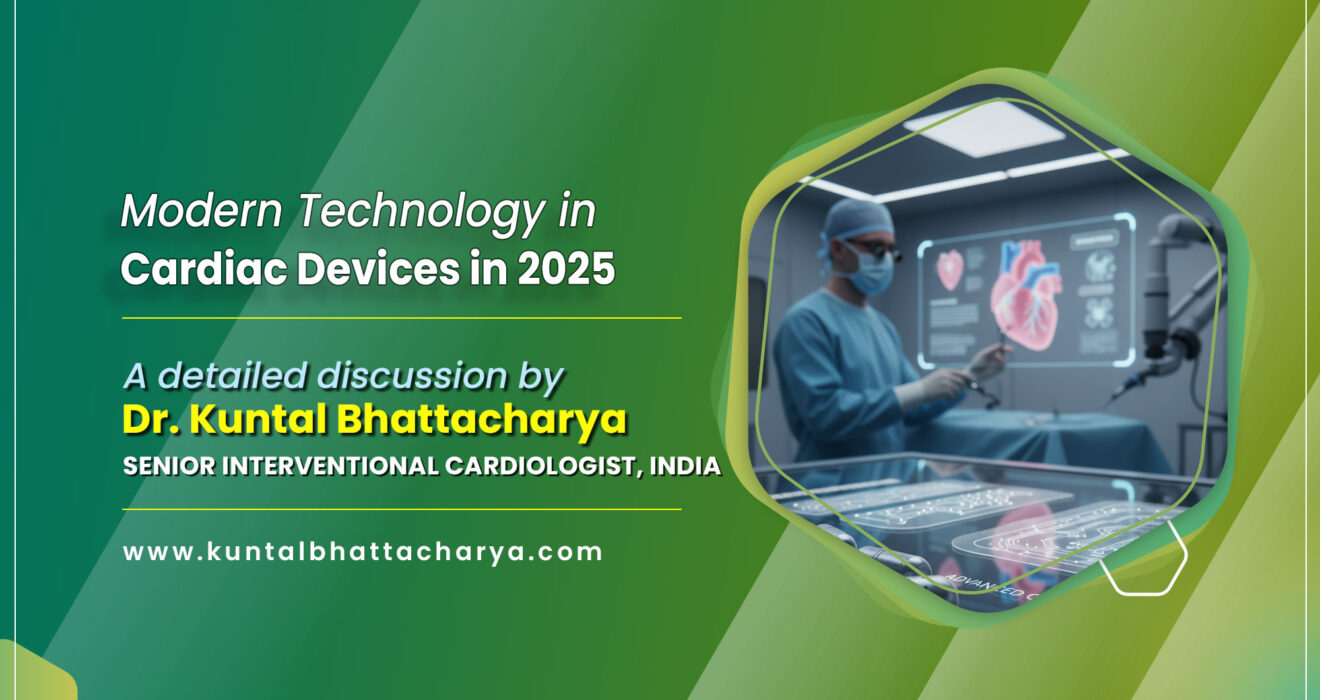
Modern Technology in Cardiac Devices in 2025
A Glimpse into the Future of Heart Care from Kolkata
Introduction
💻🩺 Modern Technology in Cardiac Devices in 2025: A Detailed Guide – By Dr. Kuntal Bhattacharya (Senior), Sr. Consultant Interventional Cardiologist, Kolkata
The landscape of cardiovascular medicine is undergoing a profound transformation, moving beyond reactive treatment toward proactive, personalized, and ultra-precise interventions. In 2025, cardiac devices are no longer mere symptom managers; they are intelligent systems powered by Artificial Intelligence (AI), deep learning, and advanced miniaturization. For interventional cardiologists like myself in Kolkata, these technologies are critical, offering life-saving options for patients with complex arrhythmias, structural heart disease, and coronary artery blockages. The focus has shifted to maximizing patient comfort, minimizing procedural risk, and providing continuous, insightful monitoring from the comfort of their homes. This detailed guide explores the revolutionary devices and technologies defining the future of heart care.
1. Evolution of Implantable Devices: The Era of Physiologic Pacing
The core philosophy of modern pacing technology is to mimic the heart’s natural electrical system as closely as possible, dramatically improving long-term heart function and clinical outcomes.
A. Leadless Pacemakers and Dual-Chamber Capabilities
The leadless pacemaker remains a breakthrough, eliminating the two major vulnerabilities of traditional systems: the subcutaneous pocket (reducing infection risk) and the transvenous leads (reducing risks of fracture, dislodgement, and vein occlusion).
- Miniaturization and Delivery: These tiny, fully self-contained devices are implanted directly into the Right Ventricle (RV) via a minimally invasive femoral vein access. Their continued evolution focuses on enhanced fixation mechanisms and longevity.
- Physiologic Pacing (Micra AV / Aveir DR Systems): The most significant advancement is the integration of accelerometer-based sensors to detect atrial mechanical movement. This allows the devices to synchronize pacing between the atrium and ventricle (V-A synchrony), essentially providing a dual-chamber pacing effect without a physical atrial lead. This is critical for patients with AV-block, ensuring a more natural heart rhythm and better hemodynamic function compared to simple RV pacing.
B. Conduction System Pacing (CSP)
CSP represents the gold standard for achieving truly physiologic heart contraction, directly addressing the limitations of traditional pacing that can induce poor synchrony and, potentially, heart failure.
- Left Bundle Branch Area Pacing (LBBAP): This technique involves placing the pacing lead directly into the tissue of the interventricular septum to capture the Left Bundle Branch system. This activation leads to a narrow QRS complex on the ECG, signifying a nearly normal electrical activation of the ventricles. Studies in 2025 consistently show that LBBAP is superior to conventional pacing in preserving or improving Left Ventricular Ejection Fraction (LVEF), offering a new avenue for Cardiac Resynchronization Therapy (CRT) in certain heart failure patients.
- Procedural Innovation: Advances in mapping and delivery sheaths, often guided by high-resolution intracardiac echocardiography (ICE), are reducing procedure times and fluoroscopy exposure, making these complex implantations more accessible and safer globally.
2. The Interventional Lab: AI, Robotics, and Advanced Imaging
In the catheterization lab, technology is combining intelligence with mechanical precision to treat complex coronary and structural heart disease.
A. AI-Driven Decision Support Systems
AI is now an indispensable co-pilot for interventional cardiologists, moving from post-procedural analysis to real-time decision-making.
- Intravascular Imaging Interpretation: AI algorithms are integrated with advanced intravascular imaging tools like Optical Coherence Tomography (OCT) and Intravascular Ultrasound (IVUS). The AI system can instantly process these images to auto-calculate critical measurements, classify plaque morphology (vulnerable vs. stable), and recommend the optimal stent size and length with an accuracy that surpasses human interpretation alone, thereby improving long-term patency and reducing restenosis risk.
- Predictive Modeling: Advanced machine learning models analyze patient-specific data (genetics, labs, historical imaging) in real-time to predict the risk of procedural complications, such as no-reflow or contrast-induced nephropathy. This allows the operator to modify the strategy instantly, enhancing patient safety.
B. Robotics in Percutaneous Coronary Intervention (PCI)
Robotic PCI platforms provide a sterile, stable, and ergonomic environment for performing complex procedures.
- Micron-Level Control: Robotic systems allow the physician to manipulate guidewires, balloons, and stents with a level of precision measured in fractions of a millimeter. This control is crucial for accessing and treating challenging lesions, particularly heavily calcified or tortuous vessels, or Chronic Total Occlusions (CTOs).
- Reduced Occupational Hazard: By allowing the interventional cardiologist to operate the system from a shielded control cockpit, robotic platforms drastically reduce the physician’s exposure to ionizing radiation, a significant long-term health benefit that promotes career longevity and safety.
3. The Digital Horizon: Continuous Monitoring and Tele-Cardiology
The most transformative trend is the democratization of continuous cardiac monitoring, shifting the point of care from the hospital to the patient’s home.
A. Medical-Grade Wearables and Biosensors
Wearable technology has evolved from consumer novelty to a clinical tool.
- Integrated Sensing: Next-generation wearables, including patches and smart clothing, are incorporating multi-sensor arrays to simultaneously measure single-lead ECG, Photoplethysmography (PPG) for blood pressure, SpO2, and respiratory rate. This continuous, multimodal data offers a holistic picture of cardiovascular stability.
- Asymptomatic Detection: AI is the engine behind these devices, analyzing continuous data streams to detect subtle, often asymptomatic, arrhythmias like Atrial Fibrillation (AF) or early signs of Heart Failure (HF) decompensation hours or days before the patient feels unwell. This proactive alert system allows for timely medication adjustments or remote physician intervention, preventing emergency room visits.
B. Remote Patient Monitoring (RPM) and Cyber Security
RPM is now standard for almost all implanted devices, from pacemakers to ICDs and Implantable Loop Recorders (ILRs).
- Seamless Data Flow: Devices automatically transmit performance and diagnostic data to the clinician via a secure home monitor, often utilizing low-power wireless protocols. The future involves truly passive, non-contact monitoring solutions, such as radio frequency sensors embedded in furniture or walls, that can track heart and lung movement without requiring the patient to wear or actively manage any device.
- The Cyber Security Mandate: As devices become more connected, the ethical and security challenges intensify. Robust, multi-layered encryption and authentication protocols are mandatory to protect sensitive patient data and prevent unauthorized access or manipulation of life-sustaining devices, which is a major focus for regulatory bodies globally in 2025.
Conclusion: The Human Element in a Technological Future
The technological trajectory in cardiac care promises a future with higher survival rates, fewer complications, and a superior quality of life for heart patients. While devices are becoming smarter, smaller, and more integrated, the expertise and judgment of the specialist remain the cornerstone of care. In advanced centers like those in Kolkata, the role of the interventional cardiologist, exemplified by myself, is evolving into that of a technology integrator—one who seamlessly combines diagnostic acumen with precise, robotically-assisted intervention and personalized, digitally-managed follow-up. The collaboration between machine intelligence and human compassion is what truly defines the future of cardiac device therapy.
FAQs
Q1: What is the most significant advancement in cardiac devices in 2025?
A1: The integration of AI and leadless technology in pacemakers and remote monitoring systems is one of the biggest advancements this year.
Q2: How do leadless pacemakers benefit patients?
A2: Leadless pacemakers are smaller, minimally invasive, and reduce the risk of complications, ensuring quicker recovery.
Q3: Can wearable devices replace traditional diagnostic tools?
A3: While wearables improve continuous monitoring, they complement but do not entirely replace traditional diagnostics.
Q4: Are AI-powered cardiac devices safe?
A4: Yes, AI-powered devices undergo rigorous testing and monitoring, ensuring safety and reliability for patients.
Q5: How to consult Dr. Kuntal Bhattacharya for advanced cardiac treatments?
A5: You can visit kuntalbhattacharya.com to book an appointment and learn more about his advanced cardiac care services.
Disclaimer: This article is for informational purposes only and does not constitute medical advice. Always consult with a qualified cardiac specialist for diagnosis and treatment related to your personal health condition.
Follow Dr. Kuntal Bhattacharya on Facebook & Youtube for regular updates.
Read Also:
- How to Book an Appointment for Heart Specialist Doctor Dr. Kuntal Bhattacharya in Kolkata in 2025
- Recovery and Care After CRT-P/D Implantation in 2025
- Leadless Pacemaker: Safe, Small, and Reliable Heart Solution
- How to Find the Best TAVI and TAVR Doctor in Kolkata in 2025?
- Advanced Heart Treatments by Interventional Cardiologists in Kolkata