
Leadless Pacemakers vs. Traditional Pacemakers: Pros and Cons for 2026
Table of Contents
Toggle‘Leadless Pacemakers vs. Traditional Pacemakers: Pros and Cons for 2026’ – From the desk of Dr. Kuntal Bhattacharya Senior Interventional Cardiologist, Narayana Health – RN Tagore Hospital, Kolkata
As a senior interventional cardiologist at Narayana Health – RN Tagore Hospital (RTIICS), Kolkata, I have witnessed the evolution of cardiac pacing firsthand. In 2026, we stand at a crossroads where medical technology has shrunk a life-saving machine from the size of a pocket watch to the size of a large vitamin capsule.
This comprehensive guide is designed for patients in Kolkata and across India who are facing the decision of pacemaker implantation. My goal is to provide a deep dive into the nuances of Leadless Pacemakers vs. Traditional Pacemakers, covering everything from technical pros and cons to specific insights on leadless pacemaker cost and availability in our city.
1. The Evolution of Pacing: From Wires to Wireless
For over 60 years, the transvenous pacemaker has been the “Gold Standard.” It has saved millions of lives, including those of many patients I treat daily as an Adult Heart Doctor in Kolkata. However, as with all technology, we have sought to eliminate its “weakest links.”
The Traditional Pacemaker (The Transvenous System)
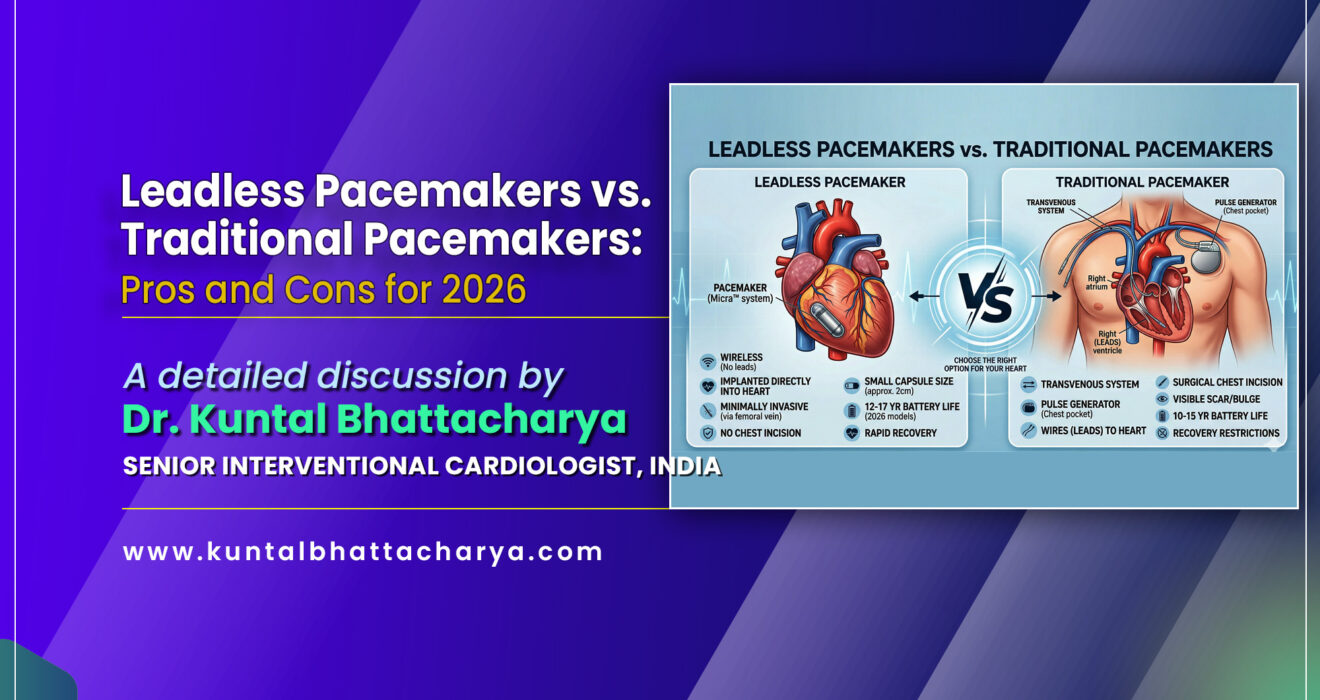
A traditional pacemaker involves a pulse generator placed in a surgical “pocket” under the skin of the chest. It connects to the heart via thin, insulated wires called leads.
- How it works: The leads are threaded through a vein into the heart chambers. They sense the heart’s rhythm and deliver electrical pulses when needed.
- The 2026 Perspective: While highly reliable, the “leads” and the “pocket” remain the primary sources of long-term complications, such as lead fractures, vein thrombosis, or pocket infections.
The Leadless Pacemaker (The Intracardiac Capsule)
Introduced as a revolutionary alternative, the leadless pacemaker (like the Micra™ or Aveir™ systems) is a self-contained device.
- How it works: It is implanted directly into the right ventricle of the heart using a catheter-based approach through the femoral vein (groin).
- The 2026 Perspective: In 2026, we now have dual-chamber leadless systems, expanding the candidate pool significantly. It eliminates the need for chest incisions and wires entirely.
2. Leadless Pacemakers vs. Traditional Pacemakers: In-Depth Comparison with Pros and Cons for 2026
Traditional Pacemakers: The Proven Workhorse
Pros:
- Versatility: Traditional systems can pace one, two, or even three chambers (CRT). This makes them indispensable for complex heart failure patients.
- Ease of Battery Replacement: When the battery dies (usually after 8–12 years), we simply open the small chest pocket and swap the generator. The leads usually stay in place.
- Affordability: In the context of Interventional Cardiologist in Kolkata services, the traditional route remains the most financially accessible for the general public.
Cons:
- Lead Complications: Leads can break, insulation can wear out, or they can become infected (endocarditis), which is a life-threatening condition.
- Surgical Scars: A visible lump and scar remain on the chest.
- Post-Op Restrictions: Patients must avoid lifting their arms or heavy weights for several weeks to prevent lead displacement.
Leadless Pacemakers: The Modern Marvel
Pros:
- No “Pocket” Issues: No risk of the skin thinning over the device or the pocket getting infected.
- No Lead Failures: Since there are no wires, there is zero risk of lead fracture or lead-related vein blockages.
- Aesthetic and Comfort: There is no visible sign that you have a pacemaker. You cannot feel it under your skin.
- Ultra-Fast Recovery: Most of my patients undergoing leadless pacemaker implantation in Kolkata are back to their morning walks within 48 hours.
Cons:
- Higher Initial Cost: The technology is significantly more expensive.
- Single-Chamber Limitation (Mostly): While dual-chamber leadless tech exists in 2026, it is still more complex to implant than single-chamber versions.
- Retrieval: While these devices can be “mapped” and retrieved, it is a more specialized procedure than a traditional generator change.
Read Also: Leadless Pacemaker: Safe, Small, and Reliable Heart Solution
3. The Kolkata Perspective: Cost, Surgery, and Hospitals
In Kolkata, we are fortunate to have world-class infrastructure. At RN Tagore Hospital (RTIICS), we have a dedicated Electrophysiology (EP) lab specifically for these advanced procedures.
Leadless Pacemaker Cost in Kolkata (2026)
The financial aspect is a major part of the decision-making process.
- Traditional Pacemakers: Generally cost between ₹1.5 Lakhs and ₹4.8 Lakhs, depending on the brand and whether it is a single/dual chamber.
- Leadless Pacemaker Cost: The price for a leadless pacemaker surgery in Kolkata currently ranges from ₹11 Lakhs to ₹15 Lakhs.
Note: Many high-end corporate insurance policies and international TPA services now provide coverage for leadless devices, recognizing their lower long-term complication rates.
Why Choose an Interventional Cardiologist in Kolkata?
Choosing a TAVI Doctor in Kolkata or an expert in leadless technology is vital because these procedures are “catheter-based.” They require the same high-level precision used in heart valve replacements (TAVI) and complex angioplasties.
As a senior Adult Heart Doctor in Kolkata, I emphasize that the skill of the operator in navigating the femoral vein and anchoring the device securely in the heart tissue is the most critical factor for success.
4. What Should You Do if You Need a Pacemaker?
If you have been told you need a pacemaker, follow these steps:
- Confirm the Diagnosis: Ensure you have had a 24-hour Holter monitor or an ECG that clearly shows the need for pacing.
- Consult a Specialist: Seek an Interventional Cardiologist in Kolkata who has specific experience in both leadless and traditional systems.
- Evaluate Your Lifestyle: If you are young, active, or have a high risk of infection (like being on dialysis), a leadless pacemaker is often the superior choice.
- Check Hospital Credibility: Ensure the hospital has a 24/7 Cardiac Emergency unit and a backup of Cardiac Surgeons. Narayana Hospital RN Tagore Hospital is a leading center for such advanced interventions.
5. Leading Doctors and Facilities in Kolkata
Kolkata is a hub for cardiac care in Eastern India. For those seeking leadless pacemaker implantation in Kolkata, some of the premier institutions include:
- Narayana Health – Rabindranath Tagore International Institute of Cardiac Sciences (RTIICS): My home base, known for the highest volume of cardiac procedures in the region.
- BM Birla Heart Research Centre: Another pioneer in cardiac care.
- Apollo Multispeciality Hospitals: Offers advanced electrophysiology services.
Read Also: Pacemaker Implantation: Choosing the Best Doctor in Kolkata
6. FAQs: What Patients in Kolkata are Searching for in 2026
Is the leadless pacemaker surgery painful?
No. We use local anesthesia at the groin site and mild sedation. Most patients feel only a slight pressure. There are no stitches on the chest, which significantly reduces post-operative pain compared to traditional surgery.
Can I travel and go through airport security?
Yes. Like traditional devices, leadless pacemakers are safe for travel. You will be provided with a patient ID card to show security personnel, though modern scanners rarely interfere with these devices.
How long does the battery last in 2026?
Current models have an estimated longevity of 12 to 17 years, depending on how often the heart requires pacing.
Why should I see a TAVI Doctor in Kolkata for a pacemaker?
A TAVI Doctor in Kolkata is an interventionalist specializing in “transcatheter” therapies. Since leadless pacemakers are implanted via a catheter (similar to a TAVI procedure), these doctors have the refined “hands-on” skill set required for a safe and precise implantation.
What happens when the leadless pacemaker battery dies?
Dr. Kuntal Bhattacharyya: In most cases, we can simply implant a new leadless pacemaker next to the old one. The old device is small enough that it does not interfere with heart function. Alternatively, in some patients, the old device can be retrieved.
Is “leadless pacemaker surgery in Kolkata” safe for elderly patients?
Dr. Kuntal Bhattacharya: It is often safer for the elderly. Because there is no major chest surgery and a lower risk of infection, older patients—especially those with fragile skin or multiple comorbidities—tend to heal much faster.
7. Conclusion: Making the Right Choice for Your Heart
In my years as an Interventional Cardiologist in Kolkata, I have learned that no two hearts are the same. While the Leadless Pacemaker is a triumph of 2026 medical engineering, the Traditional Pacemaker remains a reliable and life-saving tool.
At Narayana Hospital RN Tagore Hospital, we pride ourselves on being at the forefront of this technology. Whether you are looking for an Adult Heart Doctor in Kolkata for a routine check-up or a specialist for a complex leadless pacemaker implantation, our commitment is to provide you with the most advanced care with a human touch.
If you or a family member are experiencing symptoms like dizziness, fainting, or shortness of breath, do not wait. Early intervention is the key to a long, active life.
To schedule a consultation with Dr. Kuntal Bhattacharya regarding complex angioplasty, TAVI, or advanced cardiac care in Kolkata, please contact his office or visit his affiliated hospital’s cardiac department.
Disclaimer: This blog post is for informational and educational purposes only and should not be considered a substitute for professional medical advice, diagnosis, or treatment. Always seek the advice of a qualified and experienced cardiologist in your area with any questions you may have regarding a medical condition.
Follow Dr. Kuntal Bhattacharya on Facebook & Youtube for regular updates.