
How IVUS and OCT Technology Revolutionized Angioplasty Success in Kolkata
Table of Contents
ToggleA detailed discussion on “How IVUS and OCT Technology Revolutionized Angioplasty Success in Kolkata” by Dr. Kuntal Bhattacharya, Sr. Consultant Interventional Cardiologist, Kolkata
Cardiovascular disease remains the leading cause of mortality in India, and the bustling city of Kolkata is no exception. For decades, when a patient arrived with blocked arteries, our primary tool was X-ray angiography. This technique has saved countless lives, yet it has inherent limitations—limitations that sometimes led to stents blocking again (restenosis) or clotting (thrombosis).
As a practicing Interventional Cardiologist in Kolkata who has witnessed the evolution of cardiac care firsthand, I can confidently state that we are in a new era. The guess work is vanishing. The revolution that has dramatically increased the success and longevity of angioplasty isn’t a new stent, but rather advanced intravascular imaging.
Specifically, two technologies—IVUS (Intravascular Ultrasound) and OCT (Optical Coherence Tomography)—are changing how we treat coronary artery disease in Eastern India. If you or a loved one are preparing for or considering an angioplasty, understanding these tools is essential.
The Problem with Traditional Angiography: Living in the Shadows
To appreciate the value of IVUS and OCT, we must understand the “old” way. A conventional angiogram involves injecting a dye (contrast) into the arteries and taking X-ray pictures. This creates a two-dimensional “shadowgram” of the artery lumen (the hollow tube through which blood flows).
While excellent for spotting major blockages, a 2D shadowgram has flaws:
- It’s Outside-In: We are looking at the effect of the blockage on blood flow, not the blockage itself.
- It Overlooks Details: Angiography cannot tell us if the blockage is soft fat, hard calcium, or a blood clot.
- It Prone to Measurement Errors: We cannot always determine the exact diameter of the vessel, which is crucial for choosing the right stent size.
This sometimes resulted in “optimal angiography, suboptimal stent implantation.” We thought we did a perfect job based on the X-ray, but microscopic issues inside the artery were lurking. This is where modern imaging changes the game.
What is IVUS? (The Sonar of the Heart)
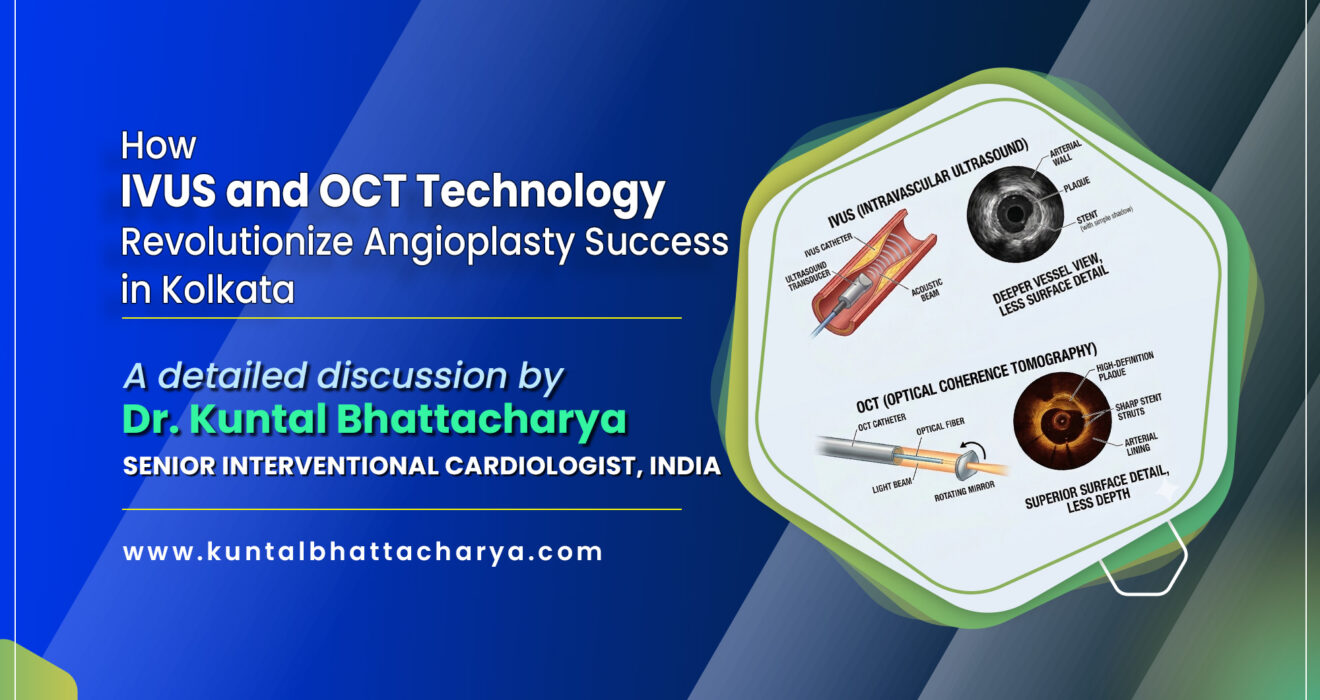
Intravascular Ultrasound (IVUS) is a technology that uses sound waves to create a 360-degree cross-sectional image of the artery from the inside.
How it Works:
A tiny ultrasound probe, smaller than a grain of rice, is threaded into the coronary artery during the angioplasty. It emits sound waves that bounce off the artery walls.
Why IVUS is Vital:
- Seeing Through the Wall: Unlike X-rays, IVUS can “see” through the blood and into the layers of the artery wall. It tells us how much “gunk” (plaque) is actually there.
- Mapping Calcium: In many Kolkata patients, we see “calcified” blockages—hard, rock-like deposits. IVUS identifies exactly where the calcium is, so we can use tools like Rotablation to clear it before placing a stent.
- Perfect Sizing: IVUS gives us the exact measurement of the artery. This ensures I select a stent that fits perfectly, preventing “under-sizing,” which is a leading cause of stent failure.
What is OCT? (The HD Camera of the Heart)
If IVUS is like sonar, Optical Coherence Tomography (OCT) is like a high-definition, microscopic camera. Instead of sound, it uses near-infrared light to provide images with a resolution 10 times higher than IVUS.
The Power of Resolution:
OCT provides such a clear image that we can see details at the level of a few microns. It’s like switching from an old tube TV to a 4K Ultra-HD screen.
Why I Use OCT:
- Detailed Plaque Analysis: It tells me if a blockage is “unstable” or likely to rupture and cause a heart attack.
- Stent Precision: After placing a stent, OCT allows me to see if there are tiny gaps between the stent and the artery wall (malapposition). If I see a gap, I can fix it immediately.
- Post-Procedural “Check-up”: It ensures that the edges of the stent haven’t caused any tiny tears (dissections) in the healthy part of the artery.
IVUS vs. OCT: Which One Do You Need?
As an interventional cardiologist, I often get asked which technology is “better.” The truth is, they are complementary.
- Choose IVUS for: Deep imaging, looking at the “Left Main” artery (the most important vessel), and patients with complex kidney issues (since it requires less contrast dye).
- Choose OCT for: Extreme precision, detailed looks at stent placement, and understanding the microscopic nature of a blockage.
In my practice in Kolkata, I tailor the choice based on the patient’s specific anatomy and the complexity of the blockage.
Why Precision Imaging is a “Must” for Kolkata’s Heart Patients
Kolkata is the heart of Eastern India, but it also faces a high burden of complex coronary artery disease. Factors like a diet rich in saturated fats, high rates of diabetes, and urban stress lead to blockages that are often:
- Multi-vessel: Affecting many parts of the heart.
- Diffuse: Long blockages that require multiple stents.
- Calcified: Hardened blockages that are difficult to treat with simple balloons.
For these “complex” cases, “blind” stenting is no longer the gold standard. By using IVUS or OCT, we reduce the chance of the patient needing a repeat procedure in a few years. Precision leads to longevity.
The 4 Stages of an Imaging-Guided Angioplasty
When you come to me for a procedure at NH Rabindranath Tagore International Institute of Cardiac Sciences, we follow a structured “Precision Protocol”:
Stage 1: The Pre-Check (Pre-PCI)
Before a stent even enters your body, we use IVUS or OCT to “measure the land.” We determine the length of the blockage and the diameter of the healthy artery. This prevents guesswork.
Stage 2: Lesion Preparation
If the imaging shows heavy calcium, we use specialized balloons or “diamond-drills” (Rotablation) to crack the calcium. Without imaging, we might not realize the calcium is there until the stent fails to open.
Stage 3: Stent Optimization
We place the stent. But we don’t stop there.
Stage 4: The Final Scan (Post-PCI)
We run the IVUS/OCT probe one last time. We check:
- Is the stent fully expanded?
- Is it covering the whole blockage?
Are the “landing zones” healthy?
Only when the scan is perfect do we finish the procedure.
How These Technologies Directly Benefit Patients in Kolkata
For the average patient reading this, the question is simple: How does this help me?
The integration of IVUS and OCT into interventional cardiology has a singular goal: better long-term results.
Studies have shown that angioplasty procedures performed with imaging guidance (especially in complex blockages) result in:
- Significant reduction in major adverse cardiac events (MACE).
- Lower rates of stent thrombosis (clotting inside the stent).
- Reduced need for repeat procedures (restenosis).
- Fewer heart attacks.
By using these tools, we are not just fixing the artery for today; we are optimizing it for the next 10, 15, or 20 years.
Guidance for Cardiac Patients in Kolkata: When to Ask for IVUS or OCT
Kolkata has established itself as a premier medical hub in Eastern India, rivaling cities like Mumbai or Delhi. As an Adult Heart Doctor in Kolkata, I recommend that any patient scheduled for an angioplasty ask their cardiologist the following question: “Is imaging (IVUS/OCT) needed for my case?”
While not every simple angioplasty requires imaging, it is critical in several scenarios, which we frequently encounter in Kolkata:
- Left Main Stem Blockages: The main artery supplying the heart. Mistake here are critical.
- Long Blockages: Complex lesions covering significant distance.
- Calcified Blockages: The hardened, “stony” arteries common in elderly patients or diabetics.
- Diabetic Patients: Diabetics often have smaller vessels and more complex disease patterns, making imaging-guided precision essential.
- Previous Stent Failures: If your stent has blocked again, you absolutely need imaging (preferably OCT) to understand why.
- Uncertainty on Angiogram: Anytime the 2D X-ray is ambiguous.
Seeking an Interventional Cardiologist in Kolkata: The Human Aspect
When you face the possibility of a cardiac procedure, it is natural to feel overwhelmed. The technology I describe is advanced, but the practice of cardiology still relies on human expertise and compassion.
If you are looking for an Interventional Cardiologist in Kolkata to perform these advanced procedures, you need to ensure two things: The Expert and The Infrastructure.
The Expert
Choosing your cardiologist is the most crucial decision. Look for:
- Experience: A senior cardiologist who has not just used IVUS/OCT a few times, but has integrated them into their daily practice for years.
- Reputation: Speak to former patients, general practitioners, and check hospital reviews.
- Holistic Approach: An excellent interventionalist should also advise on lifestyle, medication management, and other complex procedures if needed. (For example, many patients with advanced aortic valve issues may also need a TAVI Doctor in Kolkata—the expertise in one complex field often carries into others).
The Infrastructure
These technologies are expensive and require a state-of-the-art Catheterization Laboratory (Cath Lab). When selecting a hospital in Kolkata:
- Corporate & Major Hospital Networks: The leading corporate hospitals in Kolkata (e.g., Apollo Multispecialty Hospital, AMRI, Fortis, Medica Superspecialty, Rabindranath Tagore International Institute of Cardiac Sciences) have Cath Labs equipped with IVUS and/or OCT systems.
- Dedicated Cardiac Units: Ensure the hospital has a robust cardiac emergency team and post-operative ICU care.
Available Doctors & Hospital Guidance in Kolkata
The field of cardiology in Kolkata is vibrant, with many excellent professionals. While I am proud to offer these services to my patients, I emphasize that many of my colleagues are also highly skilled.
Where to Go: For IVUS and OCT treatments, you will need to access the prominent tertiary care hospitals. The major networks mentioned above all have advanced cardiac centers.
Doctors: Look for cardiologists affiliated with these major institutions who specialize in Interventional Cardiology. You can find them by searching online for:
- “Interventional Cardiologist at [Hospital Name] Kolkata”
- “Adult Heart Doctor specializing in angioplasty in Kolkata”
Always seek a consultation first. Ask specifically about their usage statistics for IVUS/OCT and their personal experience with complex stenting.
Conclusion: Investing in Your Heart’s Future
We have come a long way from the days of “fixed and forget” angioplasty. The goal today is Precision Interventional Cardiology.
By seeing inside the artery with microscopic clarity, we, as cardiologists, can ensure that every step of the angioplasty—from preparing the blockage to selecting the stent and checking its final placement—is optimized for perfection.
As you search for an Adult Heart Doctor in Kolkata or an Interventional Cardiologist in Kolkata, remember that the quality of the technology they use is just as important as the skill of their hands. IVUS and OCT have revolutionized how we save lives in our city. By demanding this level of precision, you are making the best possible investment in the long-term health of your heart.
Be well, and remember that heart health is a lifelong commitment, not just a one-time procedure.
FAQs (Frequently Asked Questions) Searched by Kolkata Patients
Based on my consultations with patients, here are answers to the most common questions regarding IVUS and OCT.
Is an IVUS or OCT procedure more dangerous than a standard angioplasty?
Does IVUS/OCT increase the time of the procedure?
Will the procedure use more dye (contrast)?
Why doesn’t every cardiologist in Kolkata use this technology automatically?
- Cost: Imaging catheters are single-use disposable items and significantly add to the procedure’s cost.
- Training & Time: Learning to interpret IVUS/OCT images accurately takes years of experience. Many doctors prefer the faster, more traditional route for simple blockages.
Are IVUS and OCT covered by insurance in India?
Do I need to travel outside Kolkata (e.g., to Delhi, Chennai, or abroad) for this?
To schedule a consultation with Dr. Kuntal Bhattacharya regarding complex angioplasty, TAVI, or advanced cardiac care in Kolkata, please contact his office or visit his affiliated hospital’s cardiac department.
Disclaimer: This blog post is for informational and educational purposes only and should not be considered a substitute for professional medical advice, diagnosis, or treatment. Always seek the advice of a qualified and experienced cardiologist in your area with any questions you may have regarding a medical condition.
Follow Dr. Kuntal Bhattacharya on Facebook & Youtube for regular updates.
Read Also:
- Choosing the Right Coronary Angioplasty Doctor in Kolkata 2026: A Patient’s Guide
- Life After TAVI/TAVR Treatment: Patient Advice from a Cardiologist in Kolkata
- Why Choose TAVI/TAVR Over Open Heart Surgery in 2025?
- TAVI and TAVR Procedures in Kolkata in 2025
- Understanding TAVI / TAVR: The Future of Heart Valve Treatment
- Early Signs of Heart Valve Problems and When to Seek a TAVI Doctor
- Angioplasty vs. Bypass Surgery in 2025: What Should You Choose?
- Treatment Areas for Advanced Cardiac Treatments in 2025
- Modern Technology in Cardiac Devices in 2025
- How to Find the Best TAVI and TAVR Doctor in Kolkata in 2025?