
Aortic valve stenosis – Symptoms, causes and treatments in Kolkata, India
Table of Contents
Toggle‘Aortic valve stenosis – Symptoms, causes and treatments in Kolkata, India’ – a detailed guide by Dr. Kuntal Bhattacharya Senior Interventional Cardiologist, Narayana Health – RN Tagore Hospital, Kolkata
Navigating the Narrow Path: A Comprehensive Guide to Aortic Valve Stenosis in 2026
As we navigate the medical landscape of 2026, the field of cardiology has reached a point of incredible sophistication. When I began my career as a cardiologist, many of the treatments we now consider “standard” were the stuff of science fiction. Today, we are witnessing a paradigm shift in how we manage heart valve disease, specifically Aortic valve stenosis. This guide is designed to be your comprehensive resource—a roadmap for patients, caregivers, and the curious—on what it means to live with this condition and how the medical community in Kolkata is fighting back.
The Heart’s Gatekeeper: Understanding Aortic Valve Stenosis
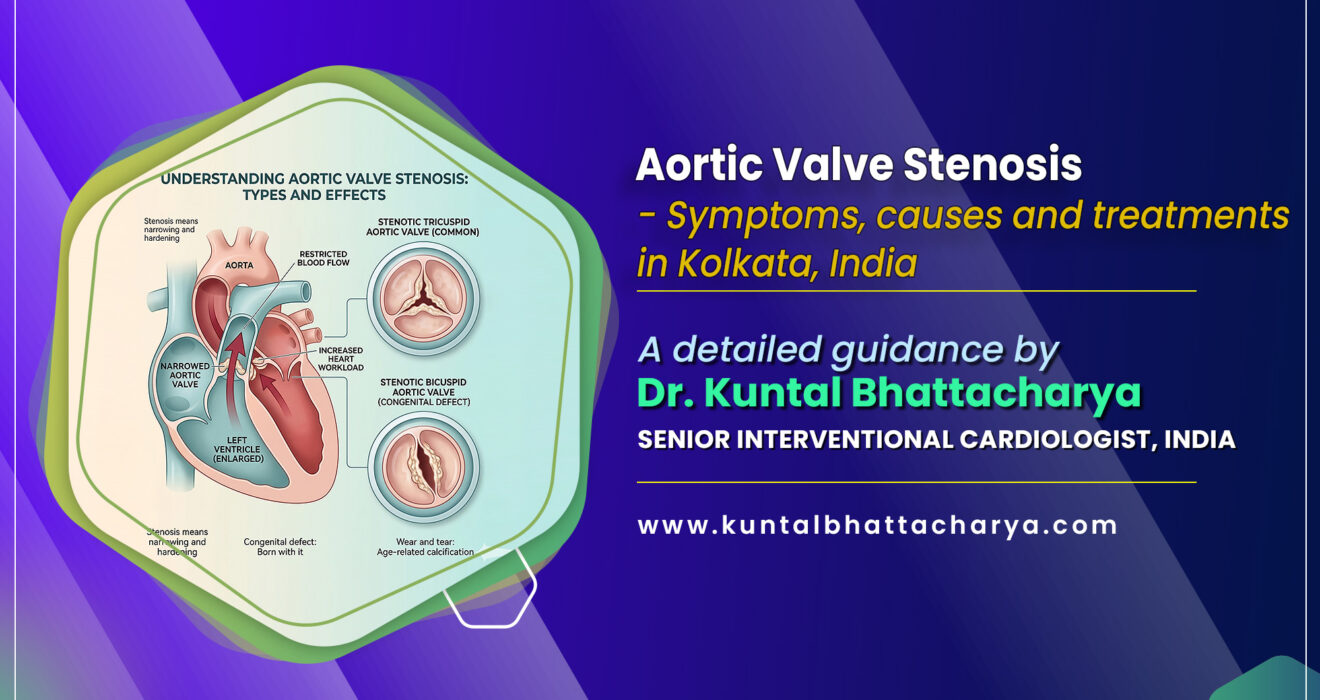
To understand stenosis, we must first understand the valve itself. Think of your heart as a powerful, four-chambered engine. The aortic valve is the final “exit door.” When the left ventricle (the heart’s main pumping chamber) contracts, it pushes oxygen-rich blood through this valve into the aorta, which then distributes that life-giving blood to your brain, your organs, and your limbs.
In a healthy individual, this valve consists of three thin, flexible leaflets that open wide and close tight with every single heartbeat—roughly 100,000 times a day. However, in Aortic valve stenosis, this exit door becomes narrow. The leaflets become stiff, thickened, or fused together.
Imagine trying to pump water through a garden hose that someone is stepping on. To get the same amount of water out of the other end, you have to increase the pressure. Your heart does exactly that. It works harder and harder to force blood through the narrow opening. Over months and years, this extra workload causes the heart muscle to thicken (hypertrophy) and eventually weaken, leading to heart failure.
Identifying the Warning Signs: Aortic valve stenosis Symptoms
In 2026, one of the biggest challenges I face as an Adult Heart Doctor in Kolkata is the “compensation phase.” The human heart is remarkably resilient; it can struggle for years without the patient feeling significant distress. Often, patients unconsciously slow down—they take the elevator instead of the stairs or stop going for their morning walks at Victoria Memorial—and they blame it on “getting older.”
However, once Aortic valve stenosis Symptoms appear, the condition has usually reached a critical stage. We categorize these symptoms into a classic triad:
- Chest Pain (Angina): This isn’t always a sharp pain. Often, it is a feeling of heavy pressure or squeezing in the chest, especially during physical activity. It happens because the thickened heart muscle requires more oxygen than the narrowed valve can allow through.
- Fainting or Lightheadedness (Syncope): This is a red-flag symptom. It typically occurs during exertion when the body demands more blood, but the narrow valve creates a “bottleneck,” leading to a sudden drop in blood flow to the brain.
- Shortness of Breath (Dyspnea): Initially, this happens only during exercise. As the stenosis worsens, you might feel breathless while talking, eating, or even lying flat at night.
Other subtle symptoms to watch for:
- A noticeable decrease in energy levels or “easy fatigability.”
- Heart palpitations—the sensation of a rapid, fluttering heartbeat.
- Swelling in the ankles and feet (edema), which suggests the heart is struggling to keep up with the body’s needs.
If you or an elderly family member in Kolkata are experiencing these, it is imperative to seek a consultation with an Interventional Cardiologist in Kolkata immediately.
Why Does the Valve Fail? Aortic valve stenosis causes
Understanding Aortic valve stenosis causes is vital for prevention and early screening. While the results are the same—a narrow valve—the journeys to that point vary:
- Calcific Disease (Age-Related): This is the most common cause we see in our Kolkata clinics. Over decades, calcium deposits (similar to scale in a pipe) build up on the valve leaflets. In 2026, as our population lives longer, we are seeing a significant rise in this “wear and tear” version of the disease.
- Congenital Issues (Bicuspid Valve): Some people are born with an aortic valve that has only two leaflets instead of three. This valve doesn’t open as efficiently and tends to become stenotic much earlier in life—often in a patient’s 40s or 50s.
- Rheumatic Heart Disease: Though less common in the West, Rheumatic heart disease remains a major factor in India. A childhood throat infection (strep throat) that wasn’t properly treated can lead to an immune response that scars the heart valves.
- Radiation Therapy: Patients who have had radiation to the chest for cancers like lymphoma or breast cancer can develop valve stiffness years later.
The Diagnostic Journey in 2026 Kolkata
When you visit us at RN Tagore Hospital, we don’t just rely on history. We use a suite of advanced diagnostic tools to “see” the heart in high definition:
- Physical Examination: I listen for a specific “whooshing” sound, called a heart murmur, using a stethoscope.
- Echocardiogram (Echo): This is our primary tool. It uses sound waves to create a video of your heart. In 2026, we use 4D-Strain imaging to detect very early signs of heart muscle fatigue that older machines might miss.
- Cardiac CT Scan: This is crucial for planning Aortic valve stenosis treatments in Kolkata, especially if we are considering non-surgical options. It helps us measure the valve to the millimeter.
- Stress Testing: Sometimes, we monitor your heart’s reaction while you walk on a treadmill to see how the valve behaves under pressure.
Breakthroughs in Care: Aortic valve stenosis treatments in Kolkata
The most exciting part of my job in 2026 is telling a patient, “We can fix this without a large incision.” For decades, the only option was open-heart surgery. While still a gold standard for many, we now have revolutionary alternatives.
TAVI / TAVR: The Modern Miracle
Transcatheter Aortic Valve Implantation (TAVI) is the flagship of Aortic valve stenosis treatments in Kolkata.
- The Procedure: Instead of opening the chest, we make a tiny puncture in the groin (the femoral artery). Using specialized catheters and real-time X-ray guidance, we thread a folded artificial valve up to the heart. Once inside the diseased valve, we expand the new valve, which pushes the old leaflets out of the way and takes over the job immediately.
- Why TAVI? There is no heart-lung machine, no large scar, and significantly less pain. Most patients at Narayana Hospital are sitting up and eating the same evening and are discharged within 48 to 72 hours.
- For Whom? In 2026, TAVI is no longer just for the “very old.” It is an excellent option for intermediate-risk patients and those who want a faster return to their daily lives.
Surgical Aortic Valve Replacement (SAVR)
For younger patients or those with complex anatomy, traditional surgery remains a highly effective option. Our surgical colleagues at RN Tagore are masters of “minimal access” surgery, where the incision is much smaller than in years past, leading to better cosmetic results and faster healing.
Medical Management
It is important to note: There is no pill that can “un-narrow” a heart valve. Medicines can help manage blood pressure or reduce fluid buildup (swelling), but they are a bridge to a mechanical fix, not a cure for the stenosis itself.
Seeking an Interventional Cardiologist in Kolkata: Where to Go?
Kolkata has become a global hub for cardiac excellence. When you are looking for an Adult Heart Doctor in Kolkata for valve disease, you should look for a “Heart Team” approach.
Why Narayana Hospital – RN Tagore Hospital, Mukundapur?
At RN Tagore, we pride ourselves on being a high-volume center. In cardiology, volume equals expertise. Our facility features:
- Dedicated Structural Heart Teams: A group of doctors including interventionalists, surgeons, and imaging specialists who meet to discuss every single case.
- State-of-the-Art Cath Labs: Equipped with the latest 2026 imaging technology to ensure the new valve is placed with sub-millimeter precision.
- International Protocols: We follow the same safety and procedural guidelines used in London or New York, but tailored for our Indian context and demographics.
What Should You Do Next?
If you have been diagnosed or suspect you have a problem, do not panic. The technology of 2026 is on your side.
- Don’t Ignore the Symptoms: If you can’t walk to the local market without stopping for breath, something is wrong.
- Get an Expert Opinion: Ensure you see an Interventional Cardiologist in Kolkata who specializes in structural heart disease.
- Ask About TAVI: Ask if your anatomy is suitable for a transcatheter approach.
- Check the Facility: Ensure the hospital has a 24/7 cardiac emergency backup and a robust intensive care unit.
Frequently Asked Questions (FAQs) on Aortic Valve Stenosis
Is Aortic Valve Stenosis a “Heart Attack”?
No. A heart attack is a blockage in the blood vessels (arteries) of the heart. Stenosis is a “plumbing” problem with the valve itself. However, severe stenosis can lead to heart failure or sudden cardiac arrest if ignored.
Can I wait until my symptoms get worse before seeking treatment?
I strongly advise against this. Once symptoms like fainting or severe breathlessness appear, the risk of sudden death increases dramatically. Early intervention protects the heart muscle from permanent damage.
How long does a replacement valve last?
Both surgical and TAVI valves are designed to be extremely durable. In 2026, we see many valves lasting 15 years or more. If a TAVI valve eventually wears out, we can often perform a “Valve-in-Valve” procedure—placing a second TAVI valve inside the first one.
Is the treatment covered by insurance in India?
Most private insurance providers in India now cover TAVI and SAVR. Additionally, many government schemes and corporate panels at hospitals like RN Tagore help make these life-saving treatments affordable.
What is the recovery time for TAVI in Kolkata?
Usually, you spend one night in the ICU for monitoring and one or two nights in a regular room. Most patients return to light housework within a week and full activity within a month.
Can lifestyle changes like diet and yoga cure Aortic Stenosis?
While yoga and a healthy diet are wonderful for your general well-being and blood pressure, they cannot physically open a calcified heart valve. Think of it like a rusty hinge; you can clean the rest of the door, but the hinge itself needs a mechanical repair.
Closing Thoughts from Dr. Kuntal Bhattacharya
Living in Kolkata, we are part of a vibrant, bustling city. We want to be able to enjoy our Durga Pujo, our family gatherings, and our daily walks. A diagnosis of Aortic Valve Stenosis does not have to mean the end of that lifestyle.
In 2026, my message to you is one of optimism. We have the tools, we have the technology, and most importantly, we have the heart to care for yours. If you are struggling with your breathing or feeling that your “engine” is losing power, come and see us. Let’s work together to get your heart back in rhythm.
To schedule a consultation with Dr. Kuntal Bhattacharya regarding complex angioplasty, TAVI, or advanced cardiac care in Kolkata, please contact his office or visit his affiliated hospital’s cardiac department.
Disclaimer: This blog post is for informational and educational purposes only and should not be considered a substitute for professional medical advice, diagnosis, or treatment. Always seek the advice of a qualified and experienced cardiologist in your area with any questions you may have regarding a medical condition.
Follow Dr. Kuntal Bhattacharya on Facebook & Youtube for regular updates.
Read Also:
- Leadless Pacemakers vs. Traditional Pacemakers: Pros and Cons for 2026
- Managing Complex Coronary Artery Disease in 2026: A Cardiologist’s Guide
- How IVUS and OCT Technology Revolutionized Angioplasty Success in Kolkata
- Choosing the Right Coronary Angioplasty Doctor in Kolkata 2026: A Patient’s Guide
- Life After TAVI/TAVR Treatment: Patient Advice from a Cardiologist in Kolkata
- Why Choose TAVI/TAVR Over Open Heart Surgery in 2025?
- TAVI and TAVR Procedures in Kolkata in 2025
- Understanding TAVI / TAVR: The Future of Heart Valve Treatment
- Early Signs of Heart Valve Problems and When to Seek a TAVI Doctor
- Angioplasty vs. Bypass Surgery in 2025: What Should You Choose?
- Modern Technology in Cardiac Devices in 2025
- How to Find the Best TAVI and TAVR Doctor in Kolkata in 2025?
Stay Healthy. Stay Informed.