
Angioplasty vs. Bypass Surgery in 2025: What Should You Choose?
Introduction: When the Heart’s Pathways Get Clogged
Angioplasty vs. Bypass Surgery in 2025: What Should You Choose? – A guide by Dr. Kuntal Bhattacharya, Sr. Consultant Interventional Cardiologist, Kolkata
Dear friends and valued patients, I am Dr. Kuntal Bhattacharya, and for many years, my primary focus in Kolkata has been to ensure the optimal health of the heart’s most critical pathways: the coronary arteries. These vital vessels are the lifeline of your heart muscle, delivering the oxygen and nutrients it needs to beat tirelessly, day in and day out.
But what happens when these pathways become narrowed or blocked? This is the unfortunate reality for millions facing Coronary Artery Disease (CAD), a condition often caused by the buildup of fatty plaques, known as atherosclerosis. When these blockages occur, the heart muscle doesn’t receive enough blood, leading to symptoms like chest pain (angina), shortness of breath, and in severe cases, a heart attack.
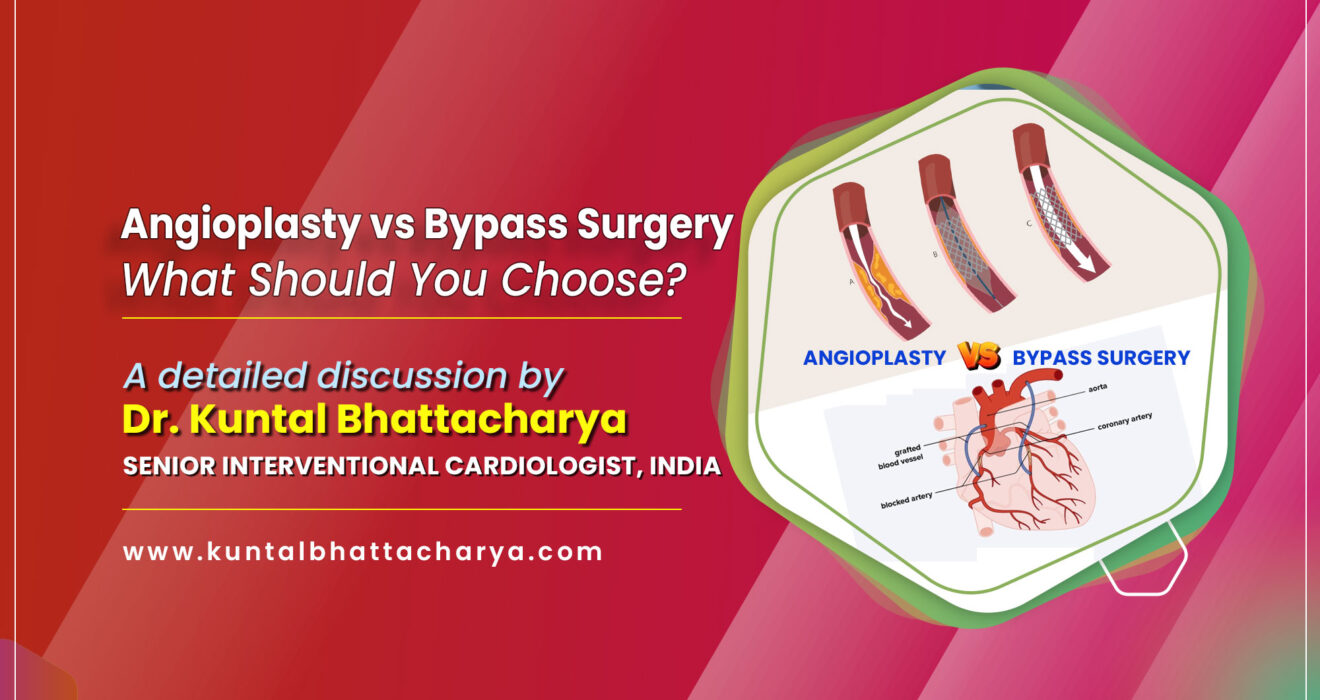
When significant blockages are diagnosed, the question often arises: “What’s the best way to fix this?” This is where two major treatment options come into play: Angioplasty with Stenting and Coronary Artery Bypass Grafting (CABG) Surgery, more commonly known as Bypass Surgery.
For many patients, deciding between these two powerful interventions can feel overwhelming. It involves understanding complex medical terms, weighing risks and benefits, and considering long-term implications. My aim today is to demystify these procedures, to explain in simple, human terms the crucial differences between angioplasty and bypass surgery, and to guide you on how we, as your cardiology team, approach this vital decision.
This isn’t about choosing one over the other in a generic sense; it’s about choosing the right treatment for your heart, based on its unique anatomy, the extent of your disease, and your overall health. Let’s embark on this journey together to find a clear path forward for your heart.
Section 1: Understanding Coronary Artery Disease (CAD) – The Root of the Problem
To fully appreciate the solutions, we must first understand the problem. Coronary Artery Disease (CAD) is a progressive condition where the major blood vessels that supply the heart (the coronary arteries) become damaged and narrowed.
The Process of Atherosclerosis:
Imagine the inside of your arteries as smooth, clean pipes. Over time, due to factors like high cholesterol, high blood pressure, diabetes, smoking, and genetics, fatty deposits (plaques) begin to accumulate on the inner walls of these pipes. This process is called atherosclerosis.
- Narrowing: As plaques grow, they narrow the artery, restricting blood flow. This is like rust building up in a pipe, reducing the water flow.
- Hardening: The plaques can harden, making the arteries stiff and less elastic.
- Rupture and Clot: Sometimes, a plaque can rupture, leading to the formation of a blood clot. This clot can suddenly and completely block the artery, causing a heart attack.
Symptoms of CAD:
- Angina: Chest pain or discomfort, often described as pressure, squeezing, or fullness. It may spread to the arms, neck, jaw, or back, and is typically triggered by exertion or stress.
- Shortness of Breath: Feeling breathless, especially during physical activity.
- Fatigue: Unusual tiredness.
- Heart Attack: Severe chest pain, sweating, nausea, and radiating pain.
When diagnostic tests (like an ECG, stress test, or angiogram) confirm significant blockages causing these symptoms or posing a high risk, intervention becomes necessary. The goal is to restore robust blood flow to the heart muscle, alleviate symptoms, and prevent future cardiac events.
Section 2: The Minimally Invasive Approach – Angioplasty with Stenting (PCI)
Let’s begin with Angioplasty, a procedure I frequently perform as an Interventional Cardiologist. It’s often referred to as Percutaneous Coronary Intervention (PCI).
What is Angioplasty with Stenting?
Angioplasty is a minimally invasive procedure designed to open narrowed or blocked coronary arteries without major surgery. It typically involves:
- Access: A thin, flexible tube called a catheter is inserted into an artery, usually in the wrist (radial artery) or groin (femoral artery).
- Guidewire: Under X-ray guidance, the catheter is guided to the heart and into the blocked coronary artery. A tiny guidewire is then advanced through the blockage.
- Balloon Inflation: A small balloon catheter is threaded over the guidewire to the site of the blockage. The balloon is inflated, compressing the plaque against the artery walls and widening the artery.
- Stent Placement: After the balloon expands the artery, a stent is usually deployed. A stent is a tiny, mesh-like tube made of metal, which is expanded and left in place to act as a scaffold, keeping the artery open and preventing it from narrowing again. Most modern stents are drug-eluting stents (DES), coated with medication to further prevent re-narrowing.
Key Features of Angioplasty:
- Minimally Invasive: No large incisions, no opening of the chest.
- Local Anesthesia and Sedation: Patients are usually awake but relaxed during the procedure.
- Shorter Hospital Stay: Typically 1-2 days.
- Faster Recovery: Patients can often resume normal activities within a week or two.
Who is a Good Candidate for Angioplasty?
Angioplasty is often the preferred choice for:
- Single or Two-Vessel Disease: Blockages in one or two major coronary arteries.
- Specific Anatomical Features: Blockages that are not excessively long, heavily calcified, or located in very complex positions.
- Acute Heart Attack (STEMI): In emergency situations, angioplasty (known as primary PCI) is the gold standard to quickly open the blocked artery and minimize heart muscle damage.
- Patients Unsuitable for Surgery: Due to other health conditions or advanced age.
Potential Advantages of Angioplasty:
- Quicker recovery and return to daily life.
- Less pain and scarring compared to surgery.
- Avoids the risks associated with general anesthesia and open-chest surgery.
- Can be repeated if new blockages occur or if a stent re-narrows (though modern stents have significantly reduced re-narrowing rates).
Section 3: The Surgical Solution – Coronary Artery Bypass Grafting (CABG) Surgery
Now, let’s turn our attention to Bypass Surgery, a more extensive but often highly effective procedure, performed by cardiac surgeons.
What is Bypass Surgery (CABG)?
Bypass surgery is a major open-heart surgical procedure that creates new pathways for blood to flow around blocked coronary arteries.
- General Anesthesia: The patient is put completely to sleep.
- Incision: A long incision is made down the center of the chest to access the heart. The breastbone (sternum) is divided.
- Grafts: Healthy blood vessels (grafts) are harvested from other parts of the body, typically:
- Internal Mammary Artery: From inside the chest wall. These are often the most durable grafts.
- Saphenous Vein: From the leg.
- Radial Artery: From the arm.
- Bypassing Blockages: One end of the graft is attached to the aorta (the body’s main artery), and the other end is attached to the coronary artery below the blockage. This effectively “bypasses” the blockage, creating a new route for blood flow. Multiple bypasses can be performed for multiple blockages (e.g., double, triple, or quadruple bypass).
- Heart-Lung Machine (Often): In traditional CABG, the heart is temporarily stopped, and a heart-lung machine takes over the function of pumping blood and oxygenating it. However, “off-pump” or “beating-heart” bypass surgery is also performed in select cases, where the heart remains beating throughout the procedure.
- Closure: Once the grafts are in place, the breastbone is wired together, and the incision is closed.
Key Features of Bypass Surgery:
- Major Surgery: Involves opening the chest and general anesthesia.
- Longer Hospital Stay: Typically 5-7 days or more.
- Longer Recovery: Full recovery can take 6-8 weeks or even longer, as the breastbone needs time to heal.
Who is a Good Candidate for Bypass Surgery?
Bypass surgery is often the preferred choice for:
- Multi-Vessel Disease: Blockages in three or more major coronary arteries.
- Left Main Coronary Artery Disease: Blockage in the left main artery, which supplies blood to a large portion of the heart muscle. This is often considered very high-risk.
- Complex Blockages: Long, heavily calcified, or diffuse blockages that are difficult to treat effectively with stents.
- Patients with Diabetes: For multi-vessel disease, bypass surgery has shown superior long-term outcomes compared to angioplasty in diabetic patients.
- Weakened Heart Muscle: Patients with very poor heart pumping function (low LVEF) sometimes benefit more from the complete revascularization offered by CABG.
Potential Advantages of Bypass Surgery:
- More Complete Revascularization: Can address multiple, complex blockages in one procedure.
- Superior Long-Term Durability: Especially with internal mammary artery grafts, which tend to stay open longer than stents in certain situations.
- Better Outcomes for Specific Groups: Proven to be more effective in certain high-risk groups, such as those with extensive multi-vessel disease or diabetes.
Section 4: Angioplasty vs. Bypass Surgery: A Head-to-Head Comparison
To make the decision clearer, let’s put the two procedures side-by-side.
| Feature | Angioplasty with Stenting (PCI) | Bypass Surgery (CABG) |
| Invasiveness | Minimally invasive (catheter-based) | Major open-heart surgery (chest incision) |
| Anesthesia | Local anesthesia with conscious sedation | General anesthesia |
| Hospital Stay | Shorter (1-2 days) | Longer (5-7+ days) |
| Recovery Time | Faster (1-2 weeks for normal activities) | Longer (6-8+ weeks for full recovery) |
| Treatment Focus | Opens blocked arteries, places stents | Creates new blood flow routes around blockages |
| Number of Blockages | Typically 1-2, or specific complex blockages | Multiple (3+ vessels), complex, or Left Main disease |
| Scarring | Minimal (small puncture site) | Significant (chest scar, possible leg/arm scar) |
| Long-Term Durability | Good, especially with modern DES, but depends on complexity | Excellent, especially with arterial grafts |
| Complications | Bleeding, stroke, kidney issues, stent thrombosis (rare) | Bleeding, infection, stroke, heart attack, cognitive issues (rare) |
| Repeat Procedure | Possible to repeat for new or re-narrowed blockages | New blockages can form in native arteries or grafts |
Section 5: The Crucial Decision: What Should You Choose?
This is the million-dollar question, and the answer is rarely simple. It’s a highly personalized decision that involves a careful evaluation of many factors, always keeping your best interest at heart. As your cardiologist in Kolkata, my role is to guide you through this process with clarity and compassion.
Key Factors Influencing the Decision:
- Extent and Location of Blockages:
- Single or Simple Blockages: Angioplasty is usually preferred.
- Left Main Coronary Artery Disease: This is often a critical blockage. For many years, CABG was the clear winner. However, with advancements in PCI, it can be considered for specific anatomy, especially in patients with lower surgical risk. This is a nuanced discussion.
- Multi-Vessel Disease (3+ arteries): This is where the debate is most intense. For many multi-vessel disease patients, particularly those with diabetes, CABG often offers a more complete and durable revascularization, with better long-term survival. For others, especially those with less complex disease and specific anatomical features, angioplasty can be a good option.
- Overall Health and Co-morbidities:
- Diabetes: As mentioned, diabetic patients with multi-vessel disease often fare better with CABG due to higher rates of re-intervention with PCI.
- Kidney Disease, Lung Disease, Advanced Age: Patients with other severe health issues might have a higher risk with major surgery. In such cases, angioplasty might be considered, even for more complex blockages, if the benefits outweigh the surgical risks.
- Prior Strokes/Bleeding Risk: These can influence the choice, as both procedures carry some risk.
- Heart Function (Ejection Fraction): If your heart’s pumping function is severely weakened, your cardiologist will carefully weigh the benefits of complete revascularization (often better achieved with CABG) versus the risks of major surgery.
- Patient Preference and Lifestyle: Your preferences, fears, desired recovery time, and lifestyle are important. Some patients prioritize a faster recovery, while others prefer what they perceive as a more “definitive” surgical solution.
- Acute vs. Stable Disease:
- Acute Heart Attack (STEMI): Angioplasty is the immediate, life-saving treatment to open the blocked artery.
- Stable Angina: For stable blockages, there is more time to deliberate and choose the optimal long-term strategy.
The Heart Team Approach:
In complex cases, especially those involving multi-vessel or left main disease, a “Heart Team” approach is often employed. This means a discussion involving an interventional cardiologist (like myself) and a cardiac surgeon, who together review your angiogram and clinical profile. This collaborative discussion, based on the latest scientific evidence and our collective experience, helps us arrive at the most evidence-based and personalized recommendation for you.
Ultimately, the goal is to make a decision that:
- Alleviates your symptoms effectively.
- Minimizes your risk of future heart events.
- Optimizes your long-term survival and quality of life.
Section 6: Beyond the Procedure – Lifestyle and Long-Term Care
Whether you undergo angioplasty or bypass surgery, remember that these procedures are not a cure for Coronary Artery Disease. They are interventions to address the blockages. The underlying disease process (atherosclerosis) remains.
Therefore, a commitment to a heart-healthy lifestyle is paramount for long-term success:
- Medication Adherence: Taking prescribed medications (e.g., antiplatelets, statins, blood pressure medications) is crucial.
- Dietary Changes: A heart-healthy diet rich in fruits, vegetables, whole grains, and lean proteins, low in saturated and trans fats.
- Regular Exercise: As advised by your doctor, often initiated through cardiac rehabilitation.
- Smoking Cessation: Absolutely critical.
- Management of Co-morbidities: Strict control of blood pressure, diabetes, and cholesterol.
These lifestyle modifications, combined with regular follow-up with your cardiologist, will help you maintain the benefits of your procedure and protect your heart for years to come.
Conclusion: Your Partner in Heart Health
The decision between angioplasty and bypass surgery is one of the most significant choices you might face in your cardiac care journey. It requires careful consideration, open discussion, and expert guidance.
As a Sr. Consultant Interventional Cardiologist in Kolkata, my promise is to provide you with all the information, support, and skilled care you need. We will thoroughly evaluate your condition, discuss all available options, and together, choose the path that offers you the best possible outcome.
Your heart is precious. Let’s work together to ensure its pathways remain clear, strong, and capable of sustaining a full, active, and healthy life.
Ready to Discuss Your Heart’s Treatment Options?
Consult Dr. Kuntal Bhattacharya to understand whether Angioplasty with Stenting or Bypass Surgery is the safest and most effective choice for your specific health needs.
[Book Your Consultation Today]
Disclaimer: This blog post provides general health information and is not a substitute for professional medical advice, diagnosis, or treatment. Always seek the advice of a qualified healthcare provider like Dr. Kuntal Bhattacharya with any questions you may have regarding a medical condition.
Follow Dr. Kuntal Bhattacharya on Facebook & Youtube for regular updates.
Read Also:
- CRT-P vs CRT-D: A Detailed Guide to Understanding the Difference
- Exclusive Guide to Coronary Angioplasty: An essential Insight from Interventional Cardiologist (PCI)
- Treatment Areas for Advanced Cardiac Treatments in 2025
- How to Book an Appointment for Heart Specialist Doctor Dr. Kuntal Bhattacharya in Kolkata in 2025
- Modern Technology in Cardiac Devices in 2025
- Recovery and Care After CRT-P/D Implantation in 2025
- Leadless Pacemaker: Safe, Small, and Reliable Heart Solution
- How to Find the Best TAVI and TAVR Doctor in Kolkata in 2025?